100%
4
Rated
Attempts
127
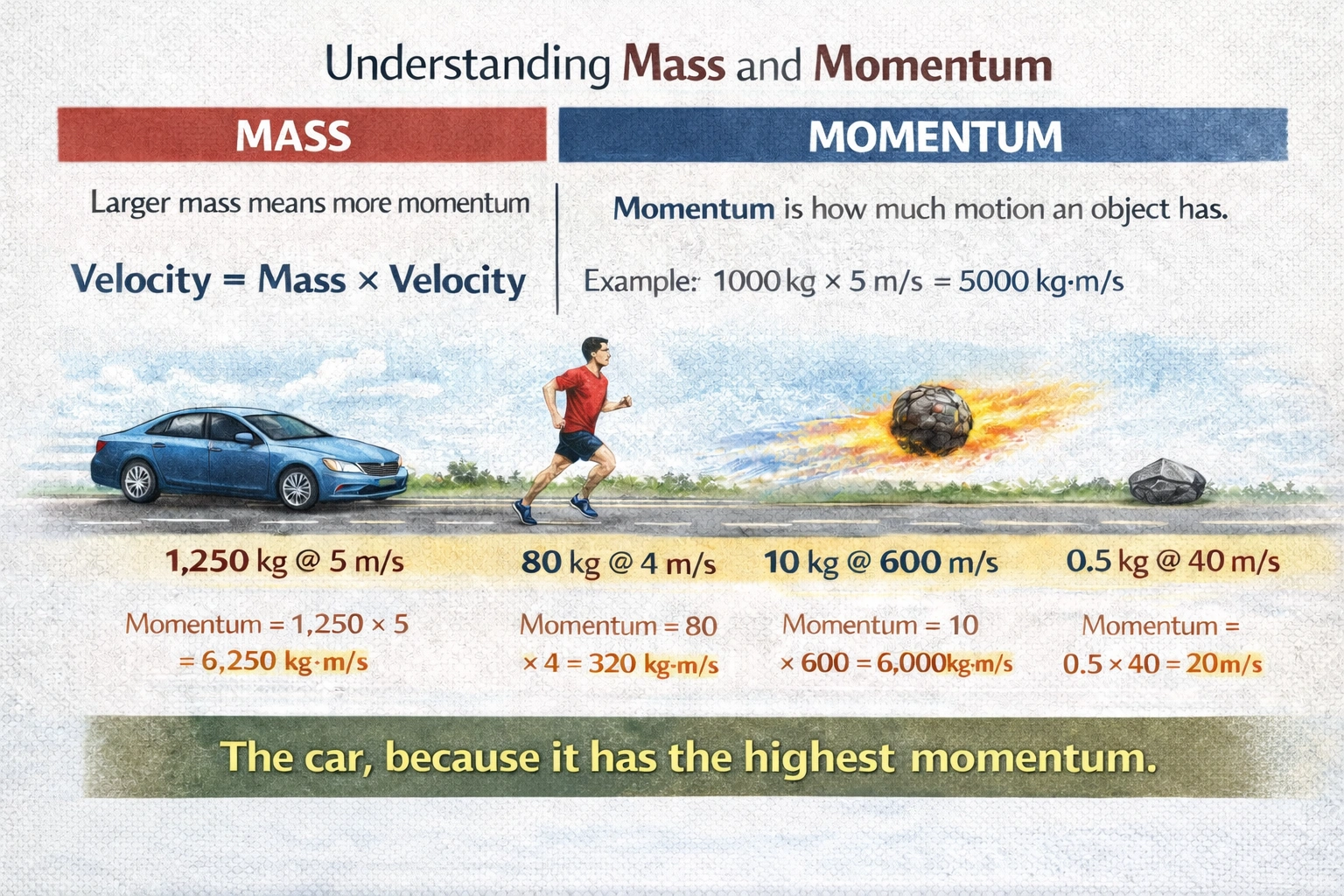
Which of these objects has the greatest momentum?
-
A
A 1,250-kg car moving at 5 m/s
-
B
An 80-kg person running at 4 m/s
-
C
A 10-kg piece of meteorite moving at 600 m/s
-
D
A 0.5-kg rock moving at 40 m/s
A
A 1,250-kg car moving at 5 m/s
B
An 80-kg person running at 4 m/s
C
A 10-kg piece of meteorite moving at 600 m/s
D
A 0.5-kg rock moving at 40 m/s
Topic Flashcards
Click to FlipMini Quiz
1 / 3
Does an object with a large mass always have more momentum than an object with a small mass?
Related Questions
Top Picks
Sublimation is the change in matter from solid to gas or gas to solid without passing through a liquid phase. Outside of the laboratory, which solid provides the best example of this?
A 1.0-kg block on a table is given a push so that it slides along the table. If the block is accelerated at 6 m/s2, what was the force applied to the block?
A 60-watt lightbulb is powered by a 110-volt power source. What is the current being drawn?
A wave moves through its medium at 20 m/s with a wavelength of 4 m. What is the frequency of the wave?
An electromagnet is holding a 1,500-kg car at a height of 25 m above the ground. The magnet then experiences a power outage, and the car falls to the ground. Which of the following is false?
Available FREE Test
Sets
Available Test
Sets