100% 4 Rated
Attempts 127

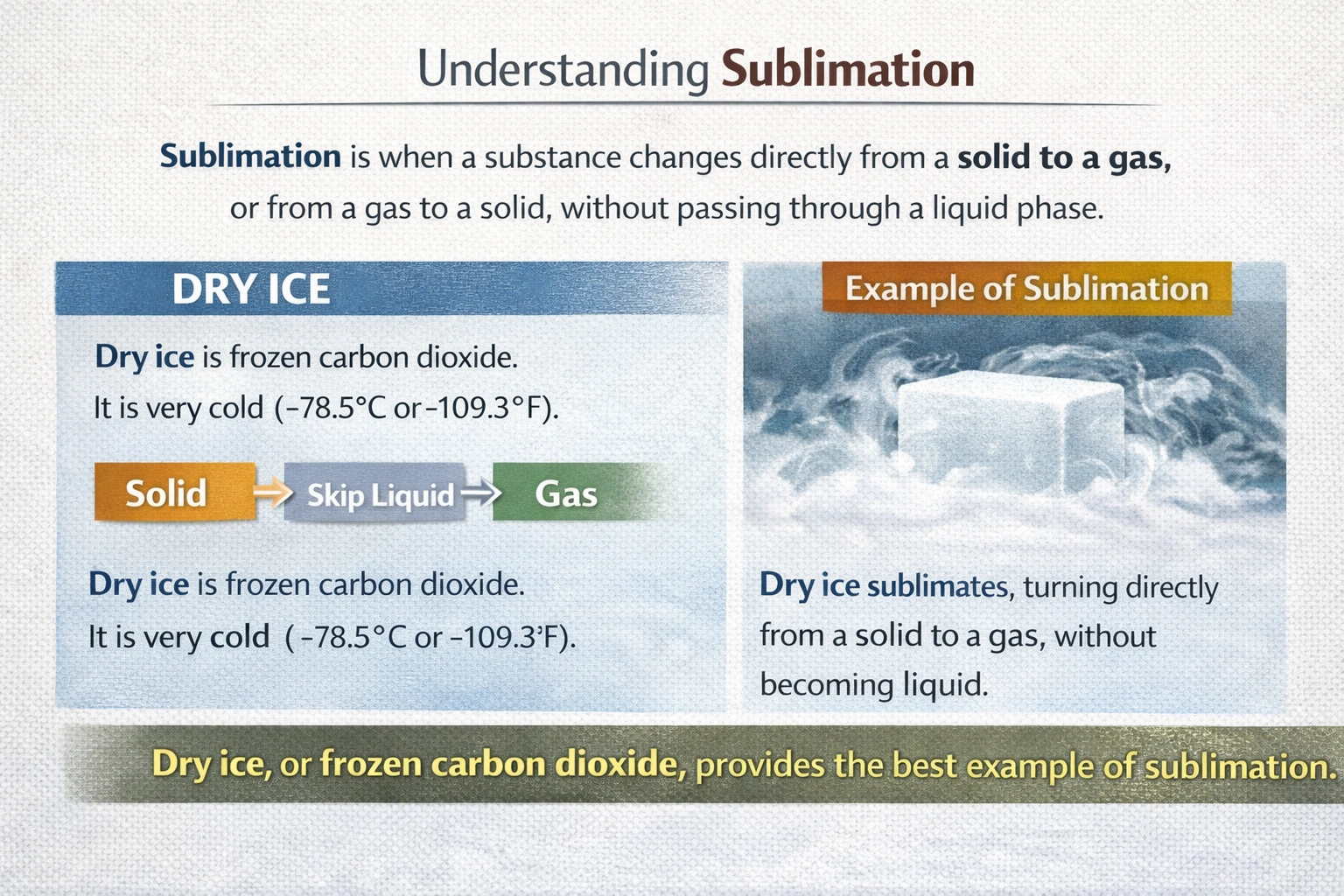
Sublimation is the change in matter from solid to gas or gas to solid without passing through a liquid phase. Outside of the laboratory, which solid provides the best example of this?

  1. A
    Iron
  2. B
    Silver
  3. C
    Salt crystal
  4. D
    Dry ice

Topic Flashcards

Click to Flip
Question

On a cold winter day, you notice the snow on the ground slowly disappears even though the temperature never rises above freezing. What phase change is likely occurring, and does it require adding or removing heat energy?

Answer

This is sublimation (solid to gas). It requires adding heat energy (endothermic), which it absorbs from the surroundings (e.g., sunlight).

Question

In a freezer, you might find ice cubes that have shrunk and lost their sharp edges after several months, even though they never melted. Name and explain the process responsible for this.

Answer

This is sublimation. The ice slowly transitions directly from solid water to water vapor because the vapor pressure of ice is not zero, even below 0°C. This process is why freezer-burned food appears dried out.

Question

Name the reverse process of sublimation. What is a common natural example of this reverse process?

Answer

The reverse process is deposition (gas to solid). A common natural example is the formation of frost on cold surfaces when water vapor in the air turns directly into ice crystals.

Question

During sublimation, what happens to the particles of a solid in terms of their arrangement and energy?

Answer

The particles in the solid gain sufficient energy to break free from the rigid, fixed positions of the solid phase and escape directly into the gas phase, where they are widely spaced and move freely. The intermolecular forces are overcome.

Question

Compare the energy required for 1 kg of a substance to sublime versus the energy required to melt it and then boil it. Which path requires more energy?

Answer

Sublimation requires more energy. The energy for sublimation is approximately equal to the sum of the energy required for melting (latent heat of fusion) plus the energy required for vaporization (latent heat of vaporization). Going directly from solid to gas must overcome both sets of intermolecular attractions at once.

Mini Quiz

1 / 3
Does the process of sublimation occur at a specific temperature for a given substance, similar to how melting occurs at a melting point?
Available Test Sets
Available FREE Test Sets