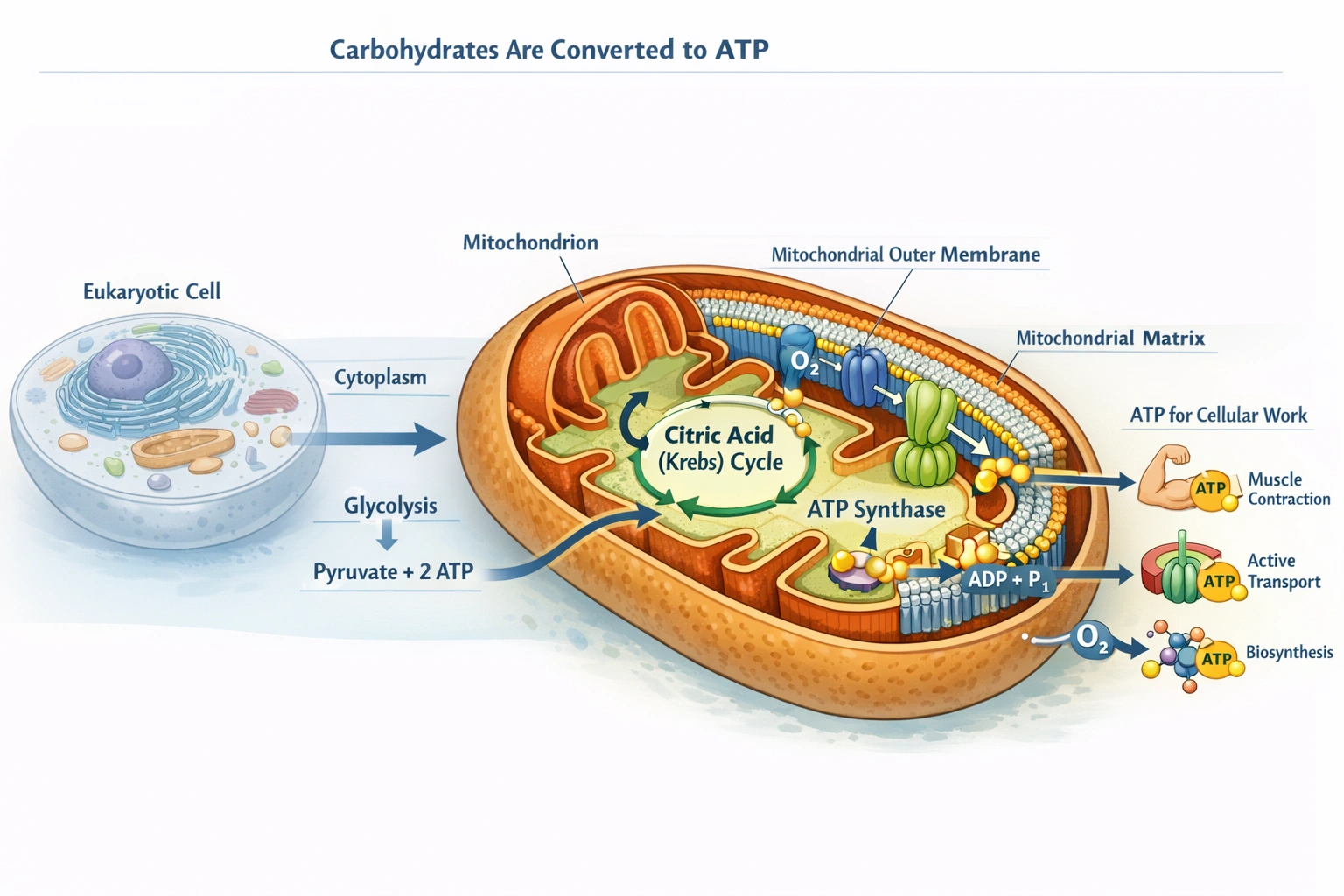
A cell processes the conversion of carbohydrates to ATP to help perform various biological functions. Where does this conversion occur in the cell?
-
A
Vacuole
-
B
Lysosome
-
C
Mitochondria
-
D
Golgi apparatus
The conversion of carbohydrates to ATP occurs in the mitochondria.
Cellular respiration is the metabolic process that converts biochemical energy from nutrients like carbohydrates into adenosine triphosphate (ATP), the universal energy currency of the cell. This complex, multi-stage process begins in the cytoplasm with glycolysis, which partially breaks down glucose into pyruvate, yielding a small amount of ATP. However, the vast majority of ATP is generated subsequently through aerobic respiration, which requires oxygen and takes place within the mitochondria. Specifically, the pyruvate enters the mitochondrial matrix, where it is converted to acetyl-CoA and enters the Krebs (citric acid) cycle. The high-energy electrons harvested from these processes are carried by molecules like NADH and FADH2 to the inner mitochondrial membrane. There, they pass through the electron transport chain, driving the pumping of protons across the membrane. The resulting proton gradient powers ATP synthase, an enzyme that phosphorylates ADP to produce ATP in a process called oxidative phosphorylation. This series of reactions makes the mitochondrion the primary ATP-producing organelle in eukaryotic cells.
A) Vacuole
Vacuoles are membrane-bound organelles primarily involved in storage, waste management, and maintaining turgor pressure in plant cells. They may store carbohydrates or other nutrients but lack the enzymatic machinery (the Krebs cycle enzymes, electron transport chain complexes, and ATP synthase) required for ATP synthesis. In animal cells, vacuoles are small and generally involved in endocytosis or exocytosis, not energy production.
B) Lysosome
Lysosomes are the digestive centers of the cell, containing a battery of hydrolytic enzymes that break down macromolecules, pathogens, and cellular debris in an acidic environment. While this catabolic process releases monomers that can be used in metabolism, lysosomes themselves do not synthesize ATP. The breakdown within lysosomes is primarily for recycling components, and the energy released is dissipated as heat rather than being captured in chemical bonds.
C) Mitochondria
Mitochondria are often termed the "powerhouses of the cell" due to their central role in ATP production. Their structure is key to their function: the highly folded inner membrane provides a large surface area for the electron transport chain and ATP synthase, while the matrix houses the enzymes for the Krebs cycle. This compartmentalization allows for the efficient coupling of electron transport, proton gradient formation, and ATP synthesis, yielding up to 36 molecules of ATP per glucose molecule under aerobic conditions.
D) Golgi apparatus
The Golgi apparatus is part of the endomembrane system and functions in modifying, sorting, and packaging proteins and lipids for secretion or delivery to other organelles. It is crucial for cellular secretion and membrane trafficking. While the Golgi apparatus requires ATP to fuel its vesicular transport and modification processes, it is a consumer of ATP, not a producer. It does not contain the machinery for carbohydrate catabolism or oxidative phosphorylation.
Conclusion
The journey from carbohydrate to ATP involves a coordinated pathway across cellular compartments. Initial breakdown happens in the cytoplasm, but the high-yield energy extraction is localized to a specialized organelle. The mitochondrion, with its unique double-membrane structure and complement of respiratory enzymes, is evolutionarily optimized to perform the final and most productive stages of cellular respiration. Its role in harnessing the energy stored in chemical bonds through the electron transport chain and chemiosmosis makes it the definitive site for the conversion of carbohydrate-derived energy into ATP.
Topic Flashcards
Click to FlipWhere does most ATP production from carbohydrates occur in a eukaryotic cell?
In the mitochondria.
Which mitochondrial structure contains the electron transport chain?
The inner mitochondrial membrane.
Which mitochondrial structure contains the electron transport chain?
The inner mitochondrial membrane.
What molecule produced from carbohydrates enters the mitochondria for ATP production?
Pyruvate.
Why are mitochondria called the “powerhouses of the cell”?
They produce the majority of ATP used for cellular activities.