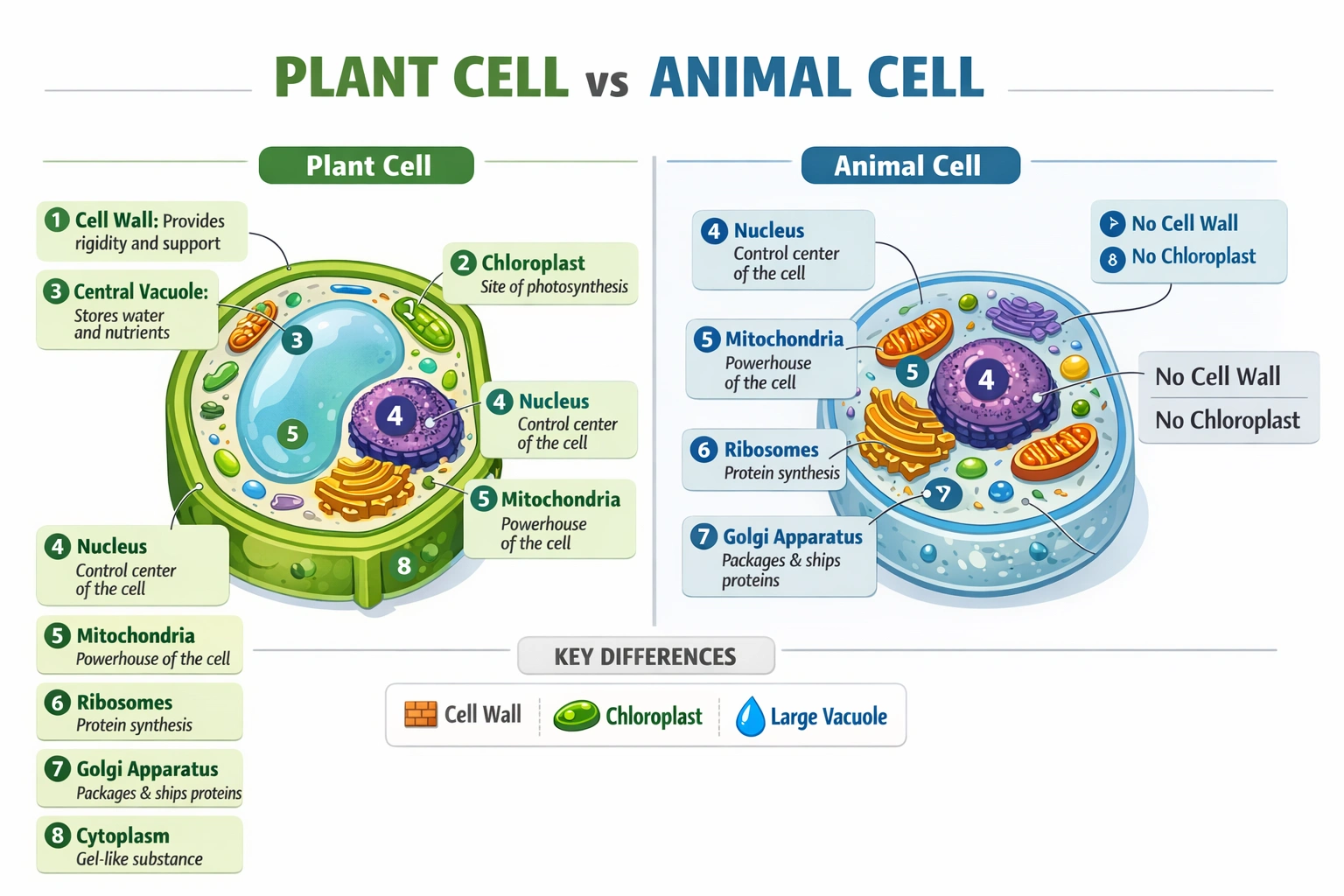
What organelle is only associated with plant cells?
-
A
Cell wall
-
B
Ribosome
-
C
Cytoplasm
-
D
Golgi apparatus
The cell wall is an organelle only associated with plant cells.
When comparing typical plant and animal cells, several structures are unique to one type or the other. The cell wall is a rigid, extracellular layer that surrounds the plasma membrane of plant cells. It is primarily composed of cellulose, along with hemicellulose, pectin, and often lignin. This structure provides mechanical strength and structural support, protects the cell from mechanical damage and pathogen attack, helps maintain cell shape, and prevents excessive water uptake that could cause the cell to burst. While other organisms like fungi and bacteria also have cell walls, their chemical composition (chitin in fungi, peptidoglycan in bacteria) is distinct. In the context of comparing standard eukaryotic plant and animal cells, the cell wall is a defining feature of plant cells not found in animal cells.
A) Cell wall
The plant cell wall is a complex, dynamic structure essential for plant morphology, growth, and defense. It is not a living part of the protoplast but is secreted by it. Animal cells lack this rigid external layer; they are enclosed only by a flexible plasma membrane, which allows for greater mobility and shape changes, a necessity for functions like muscle contraction and phagocytosis.
B) Ribosome
Ribosomes are complexes of ribosomal RNA (rRNA) and protein that serve as the sites for protein synthesis. They are universal organelles found in all living cells—both prokaryotic and eukaryotic, plant and animal. They can be free in the cytoplasm or attached to the rough endoplasmic reticulum. Their presence is mandatory for translating genetic code into proteins, making them common to all cellular life, not unique to plants.
C) Cytoplasm
The cytoplasm is the gel-like substance enclosed within the plasma membrane of every cell. It consists of the cytosol (the aqueous solution), organelles, and various inclusions. It is the site for many metabolic reactions and the medium through which organelles are suspended and molecules are transported. The cytoplasm is a fundamental cellular component in all life forms, from bacteria to human cells, and is therefore not specific to plant cells.
D) Golgi apparatus
The Golgi apparatus is a membrane-bound organelle present in virtually all eukaryotic cells, including both plant and animal cells. It functions in modifying, sorting, and packaging proteins and lipids received from the endoplasmic reticulum for secretion or delivery to other organelles. In plant cells, the Golgi has the additional crucial role of synthesizing and modifying polysaccharides (like pectins and hemicelluloses) that are major components of the cell wall. However, the organelle itself is not exclusive to plants.
Conclusion
Distinguishing between plant and animal cells involves identifying features present in one but absent in the other. Ribosomes, cytoplasm, and the Golgi apparatus are essential and ubiquitous components of eukaryotic cells. The cell wall, however, represents a major structural adaptation specific to plants, algae, fungi, and bacteria. Within the framework of a biology question comparing plant and animal cells, the cell wall is correctly identified as the organelle associated solely with plant cells, as animal cells rely on an internal cytoskeleton and extracellular matrix for support rather than a rigid external wall.
Topic Flashcards
Click to FlipWhich structure is only associated with plant cells (when compared to animal cells)?
The cell wall.
What is the main function of the plant cell wall?
To provide structural support and protection.
What is the primary component of plant cell walls?
Cellulose.
Why don’t animal cells have cell walls?
They require flexibility for movement and shape changes.
Which organelle helps produce materials used in plant cell walls?
The Golgi apparatus.