What is the basis for classifying an organism as either an autotroph or a heterotroph?
-
A
The way an organism obtains its energy
-
B
The organism's ranking in the taxonomic system
-
C
The type of ecosystem in which an organism lives
-
D
Whether the organism is unicellular or multicellular
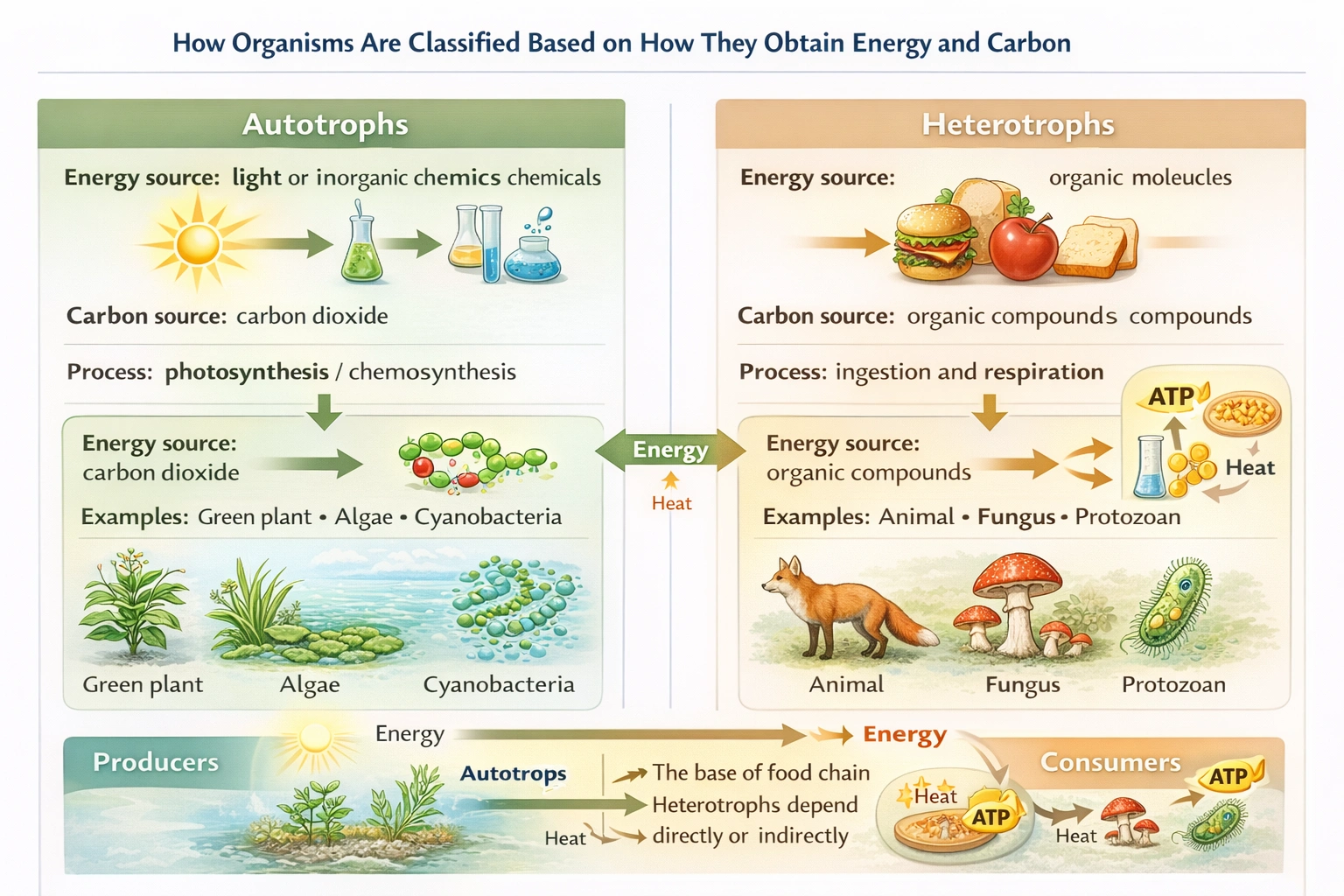
Organisms are classified as autotrophs or heterotrophs based on the way they obtain energy.
This classification scheme divides life based on nutritional strategy, specifically the source of energy and carbon used for growth and metabolism. Autotrophs, meaning "self-feeders," have the capacity to synthesize their own organic molecules from simple inorganic substances. They obtain energy either from sunlight (photoautotrophs, like plants, algae, and cyanobacteria) or from the oxidation of inorganic chemicals (chemoautotrophs, like some bacteria and archaea found in deep-sea vents). Their carbon source is typically carbon dioxide (CO₂). Heterotrophs, meaning "other-feeders," cannot fix carbon from inorganic sources. They must consume organic compounds produced by other organisms to obtain both energy and carbon. This includes animals, fungi, and most bacteria and protists. This fundamental distinction in energy acquisition underpins the structure of food webs and the flow of energy through ecosystems.
A) The way an organism obtains its energy
This is the precise and definitive criterion. Autotrophs capture energy from non-living, abiotic sources (light or inorganic chemicals) and use it to build organic matter. Heterotrophs obtain energy by breaking down the organic matter built by autotrophs or other heterotrophs. This difference in the initial energy source is the primary dividing line between these two trophic groups.
B) The organism's ranking in the taxonomic system
Taxonomic ranking (Domain, Kingdom, Phylum, etc.) is based on evolutionary relationships, shared ancestry, and a suite of morphological, genetic, and developmental characteristics. While trophic mode can be consistent within a taxon (e.g., all animals are heterotrophs), it is not the basis for the taxonomic ranking itself. Both autotrophs and heterotrophs are found across multiple kingdoms (e.g., Plantae are autotrophs, Animalia and Fungi are heterotrophs). Taxonomy reflects phylogeny, not feeding strategy alone.
C) The type of ecosystem in which an organism lives
An organism's habitat does not determine its trophic classification. Autotrophs and heterotrophs exist in every ecosystem on Earth, from forests and oceans to deserts and hydrothermal vents. While the specific types of autotrophs might differ (e.g., plants on land vs. phytoplankton in water), the fundamental classification as autotroph or heterotroph is a physiological trait, not an ecological one. The ecosystem influences the abundance and interactions of these groups but does not define them.
D) Whether the organism is unicellular or multicellular
Unicellularity and multicellularity refer to the level of cellular organization and complexity. This is independent of nutritional mode. There are unicellular autotrophs (e.g., Chlamydomonas, a green alga) and unicellular heterotrophs (e.g., Amoeba). Similarly, there are multicellular autotrophs (e.g., trees) and multicellular heterotrophs (e.g., humans). Cellular organization and feeding strategy are two different axes of biological classification.
Conclusion
Classifying organisms by how they obtain energy provides critical insight into their role in the biosphere. Autotrophs are primary producers, forming the base of nearly all ecological pyramids by converting inorganic energy and matter into organic forms. Heterotrophs are consumers, relying on the biochemical work done by autotrophs. This classification cuts across distinctions of size, habitat, and taxonomy, focusing on the most fundamental metabolic relationship between an organism and its environment. The source of energy—whether directly from the non-living world or indirectly via consuming other life—is the essential basis for the autotroph-heterotroph dichotomy.
Topic Flashcards
Click to FlipWhat is the basis for classifying an organism as an autotroph or heterotroph?
The way the organism obtains its energy.
What is an autotroph?
An organism that makes its own organic food from inorganic sources.
What is a heterotroph?
An organism that obtains energy by consuming organic matter made by other organisms.
What type of autotroph uses sunlight as an energy source?
Photoautotroph.
What role do autotrophs play in food webs?
They are primary producers.