What is the function of a lysosome?
-
A
Store energy for future use
-
B
Process genetic information
-
C
Synthesize and package proteins
-
D
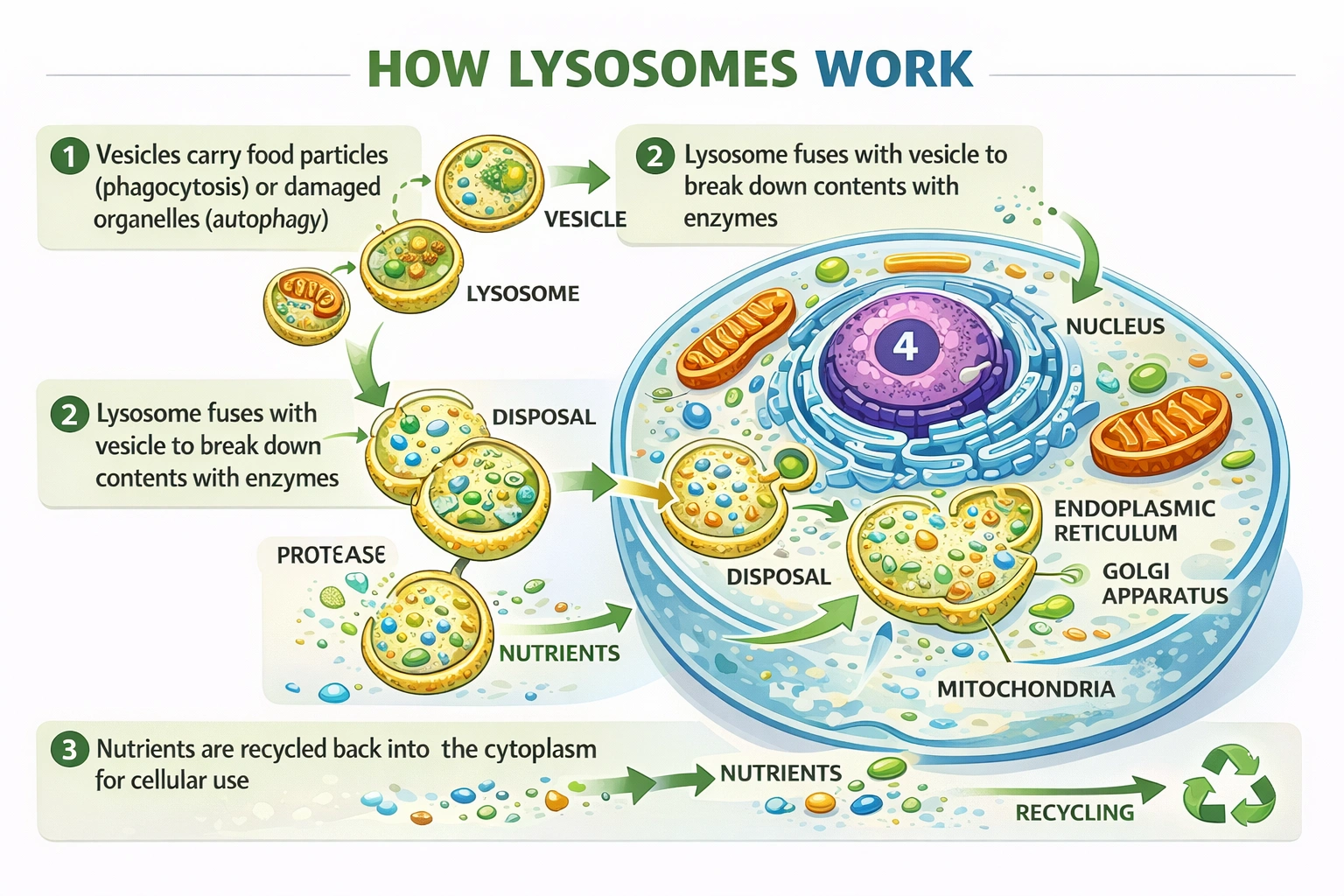
Break down foods and old organelles
The function of a lysosome is to break down foods and old organelles.
Lysosomes are membrane-bound organelles that serve as the digestive system of the cell. They contain a potent cocktail of over 50 different hydrolytic enzymes, including proteases, lipases, nucleases, and carbohydrases, all of which function optimally in an acidic environment (pH ~4.5-5.0). This acidic interior is maintained by proton pumps in the lysosomal membrane. Lysosomes are formed by the fusion of vesicles from the Golgi apparatus, which contain the enzymes, with endosomes, which bring in material from outside or inside the cell. Their primary roles are intracellular digestion and recycling: they break down macromolecules from phagocytosed food particles, degrade worn-out or damaged organelles through a process called autophagy, and destroy invading bacteria or viruses.
A) Store energy for future use
Energy storage is not a function of lysosomes. Cells store energy in chemical forms such as glycogen granules (in animal cells and fungi), starch grains (in plant cells), or lipid droplets (triglycerides) found in the cytoplasm. Lysosomes are involved in breaking down these storage molecules to release their components for energy production elsewhere (e.g., in mitochondria), but they do not themselves act as storage depots.
B) Process genetic information
Genetic information is processed in the nucleus (where DNA is transcribed into RNA) and on ribosomes (where RNA is translated into protein). Lysosomes contain no machinery for transcription or translation. Their enzymes can degrade nucleic acids (DNA and RNA) as part of their recycling function, but this is destruction, not processing of genetic information for cellular use.
C) Synthesize and package proteins
Protein synthesis occurs on ribosomes. The initial modification and packaging of proteins for secretion or membrane insertion are carried out by the endoplasmic reticulum and the Golgi apparatus. Lysosomes receive their digestive enzymes, which are themselves proteins, from the Golgi. The lysosome is the final destination for these enzymes, not a site of their synthesis or primary packaging.
D) Break down foods and old organelles
This is the definitive function. When a cell engulfs a food particle through phagocytosis, the resulting phagosome fuses with a lysosome to form a phagolysosome, where the contents are digested. Similarly, during autophagy, a damaged organelle or piece of cytoplasm is enveloped by a double membrane to form an autophagosome, which then fuses with a lysosome. The lysosomal enzymes dismantle the captured material into basic monomers (amino acids, fatty acids, sugars, nucleotides), which are then released back into the cytosol for reuse in biosynthesis or energy production.
Conclusion
Lysosomes are essential for cellular homeostasis, acting as both a recycling center and a waste disposal unit. By breaking down complex biomolecules and cellular debris, they provide the cell with a constant supply of raw materials and prevent the accumulation of toxic or non-functional components. This degradative function is unique and critical; while other organelles build, store, or process, lysosomes specialize in controlled demolition and renewal. Their role in breaking down ingested nutrients and clearing out old organelles is central to cellular health, adaptation, and longevity.
Topic Flashcards
Click to FlipWhat is the primary function of a lysosome?
To break down food particles and old or damaged organelles.
What type of enzymes are found inside lysosomes?
Hydrolytic (digestive) enzymes.
What cellular process breaks down worn-out organelles using lysosomes?
Autophagy.
Q: Why is the interior of a lysosome acidic?
To allow digestive enzymes to function effectively.
What happens to materials after lysosomal digestion? .
They are recycled and reused by the cell