Which statement correctly compares cytokinesis in plants and animals?
-
A
Cytokinesis in plants involves a new cell wall, but it involves physically deforming the cell in animals.
-
B
Cytokinesis in plants relies on formation of microtubules between the new cells, but actin plays this role in animals.
-
C
Cytokinesis does not happen in plants, leading to multinucleate plant cells, but it involves forming a cell wall in animals.
-
D
Cytokinesis in plants uses a line of mitochondria to separate the two new cells, but the endoplasmic reticulum is used in animals.
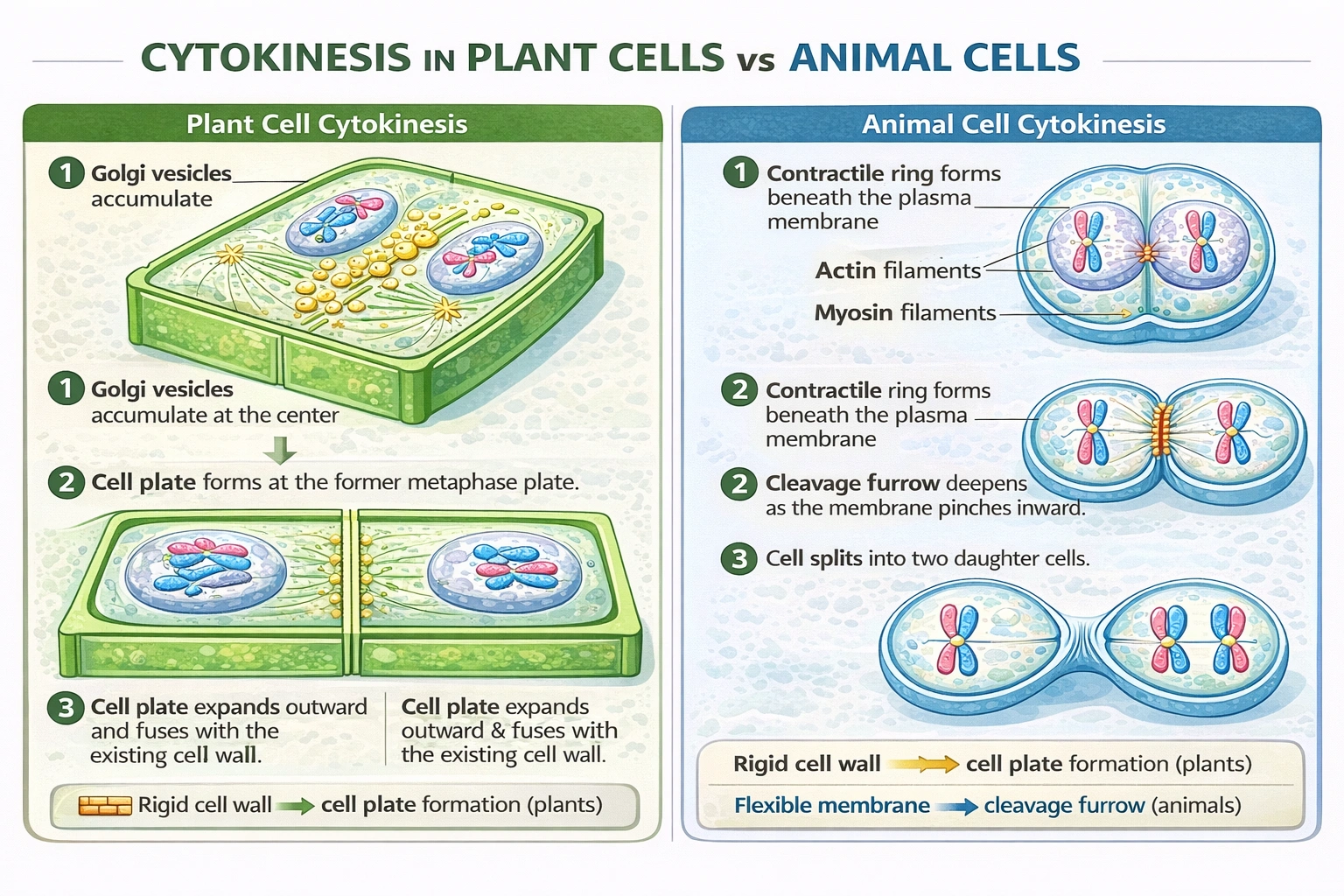
Cytokinesis in plants involves the formation of a new cell wall, while in animals it involves the physical deformation of the cell via a cleavage furrow.
Cytokinesis is the process of cytoplasmic division that follows nuclear division (mitosis or meiosis). The mechanism differs fundamentally between plant and animal cells due to the presence of a rigid cell wall in plants. Animal cells, surrounded only by a flexible plasma membrane, divide by forming a contractile ring composed of actin and myosin microfilaments just beneath the membrane at the cell's equator. This ring contracts inward, pinching the cell in two like a drawstring, forming a cleavage furrow. Plant cells, constrained by their cell wall, cannot pinch inward. Instead, they build a new cell wall, called the cell plate, from the inside out. This partition forms at the metaphase plate from Golgi-derived vesicles carrying cell wall precursors (polysaccharides and glycoproteins) that fuse together.
A) Cytokinesis in plants involves a new cell wall, but it involves physically deforming the cell in animals.
This statement accurately captures the core difference. In plants, vesicle fusion forms a cell plate that matures into a new cell wall, dividing the cytoplasm. In animals, an actomyosin contractile ring physically constricts the cell membrane to create two daughter cells. The presence or absence of a pre-existing rigid cell wall dictates these divergent strategies.
B) Cytokinesis in plants relies on formation of microtubules between the new cells, but actin plays this role in animals.
This statement contains elements of truth but is imprecise and misleading. In plants, a structure called the phragmoplast—composed of microtubules and microfilaments—does guide vesicles to the cell plate formation site. However, the primary division structure is the cell plate/wall, not the microtubules themselves. In animals, actin is indeed the primary force-generator. However, plant cytokinesis also involves actin, and animal cytokinesis utilizes microtubules for spindle positioning. The distinction is not that one uses only microtubules and the other only actin; it's that the end result is a cell wall versus a cleavage furrow.
C) Cytokinesis does not happen in plants, leading to multinucleate plant cells, but it involves forming a cell wall in animals.
This statement is completely false. Cytokinesis absolutely occurs in plants, resulting in distinct daughter cells with their own cytoplasm and organelles. While some plant tissues (like the endosperm in some seeds) can be coenocytic (multinucleate) during development, this is an exception, not the rule. Furthermore, animal cells do not form a cell wall; they have a cleavage furrow. This option reverses the facts for both cell types.
D) Cytokinesis in plants uses a line of mitochondria to separate the two new cells, but the endoplasmic reticulum is used in animals.
This is biologically inaccurate. Mitochondria and endoplasmic reticulum (ER) are organelles that may be repositioned during cytokinesis but are not the primary machinery for division. In plants, the cell plate forms from the fusion of Golgi-derived vesicles, not a line of mitochondria. The ER is often present near the forming cell plate, likely involved in membrane and calcium signaling, but it does not "separate" the cells. In animals, the cleavage furrow is driven by the actomyosin ring, not the ER.
Conclusion
The contrasting strategies of cytokinesis reflect the fundamental architectural differences between plant and animal cells. The animal cell's flexible membrane allows for constriction, a process efficient for motile or shape-changing cells. The plant cell, encased in a rigid wall, must construct a new partition internally. The formation of a cell plate that develops into a new cell wall is the definitive characteristic of plant cytokinesis, while the formation of a cleavage furrow defines animal cytokinesis. This dichotomy is a key concept in comparative cell biology.
Topic Flashcards
Click to FlipHow does cytokinesis differ between plant and animal cells?
Plants form a new cell wall, while animals divide by membrane constriction.
What structure forms during cytokinesis in plant cells?
A cell plate.
What structure causes cytokinesis in animal cells?
A cleavage furrow formed by a contractile ring.
Why can’t plant cells divide by pinching inward like animal cells?
Because they have a rigid cell wall.
Which cytoskeletal proteins drive cleavage furrow formation in animal cells?
Actin and myosin.