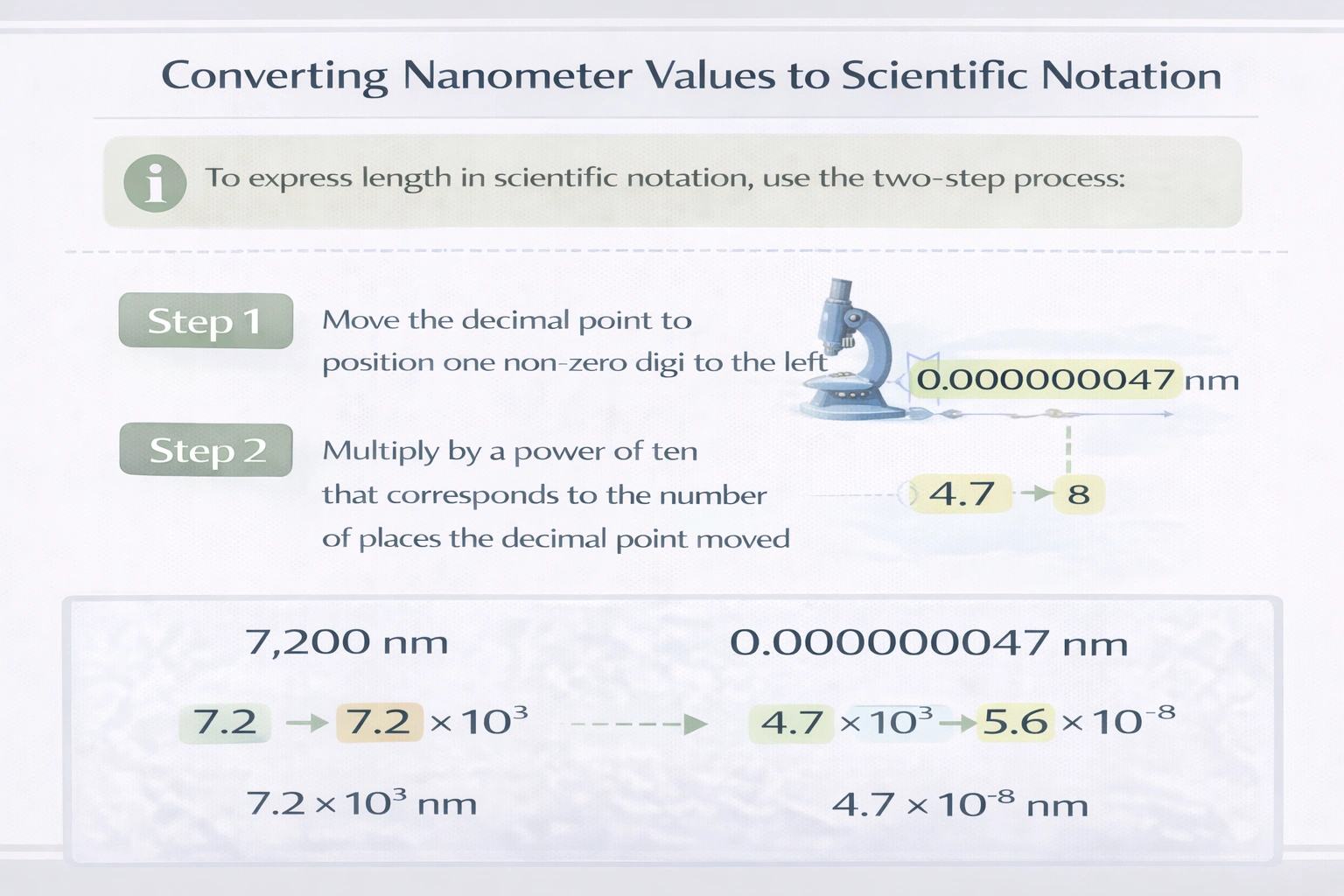
A nanometer is equal to 1×10^-9 meter. How is this value written in standard notation?
-
A
0.0000000001 m
-
B
0.000000001 m
-
C
1,000,000,000 m
-
D
10,000,000,000 m
A nanometer is written as 0.000000001 meters in standard notation.
The metric prefix "nano-" signifies a factor of one-billionth, or 10⁻⁹. Converting from scientific notation (1 × 10⁻⁹) to standard notation requires moving the decimal point in the coefficient (1.0) nine places to the left. This results in a decimal number where the digit '1' occupies the ninth place to the right of the decimal point, preceded by eight zeros.
A) 0.0000000001 m
This value has ten digits after the decimal point, with the '1' in the tenth place. This represents 1 × 10⁻¹⁰ meters, which is one-tenth of a nanometer (0.1 nm). It is an order of magnitude smaller than one nanometer.
B) 0.000000001 m
This value has nine digits after the decimal point, with the '1' in the ninth place. This correctly represents 1 × 10⁻⁹ meters. There are eight zeros between the decimal and the '1', and the '1' itself is in the 9th position, equaling one nanometer.
C) 1,000,000,000 m
This is 1 × 10⁹ meters, or one billion meters (a gigameter). This is the inverse of a nanometer; it is a vastly larger unit of length. This option misinterprets the negative exponent as a positive one.
D) 10,000,000,000 m
This is 1 × 10¹⁰ meters, or ten billion meters. Like option C, this results from misapplying the conversion, likely by using a positive exponent and an incorrect coefficient.
Conclusion:
Understanding metric prefixes is key to unit conversion. The prefix "nano-" unequivocally means 10⁻⁹. Converting this factor from scientific notation involves moving the decimal point nine places to the left from 1.0, which produces the decimal representation with eight leading zeros: 0.000000001 meters.

Topic Flashcards
Click to FlipConvert the value 1 × 10 − 9 1×10 −9 meters (one nanometer) into standard decimal notation.
0.000000001 0.000000001 meters.
How many zeros are between the decimal point and the digit "1" in the standard notation of 1 × 10 − 12 1×10 −12 (one picometer)?
11 zeros (written as 0.000000000001 0.000000000001).
Which is larger: 1 × 10 − 6 1×10 −6 meters or 1 × 10 − 9 1×10 −9 meters? Write both in standard notation to compare.
1×10 −6 m ( 0.000001 0.000001 m) is larger than 1 × 10 − 9 1×10 −9 m ( 0.000000001 0.000000001 m).
Write 2.5 × 10 − 8 2.5×10 −8 meters in standard notation.
0.000000025 meters.
If a virus is about 100 nanometers in diameter, how many meters is that? Express your answer in scientific notation.
1×10 −7 meters (since 100 × 10 − 9 = 10 − 7 100×10 −9 =10 −7 ).