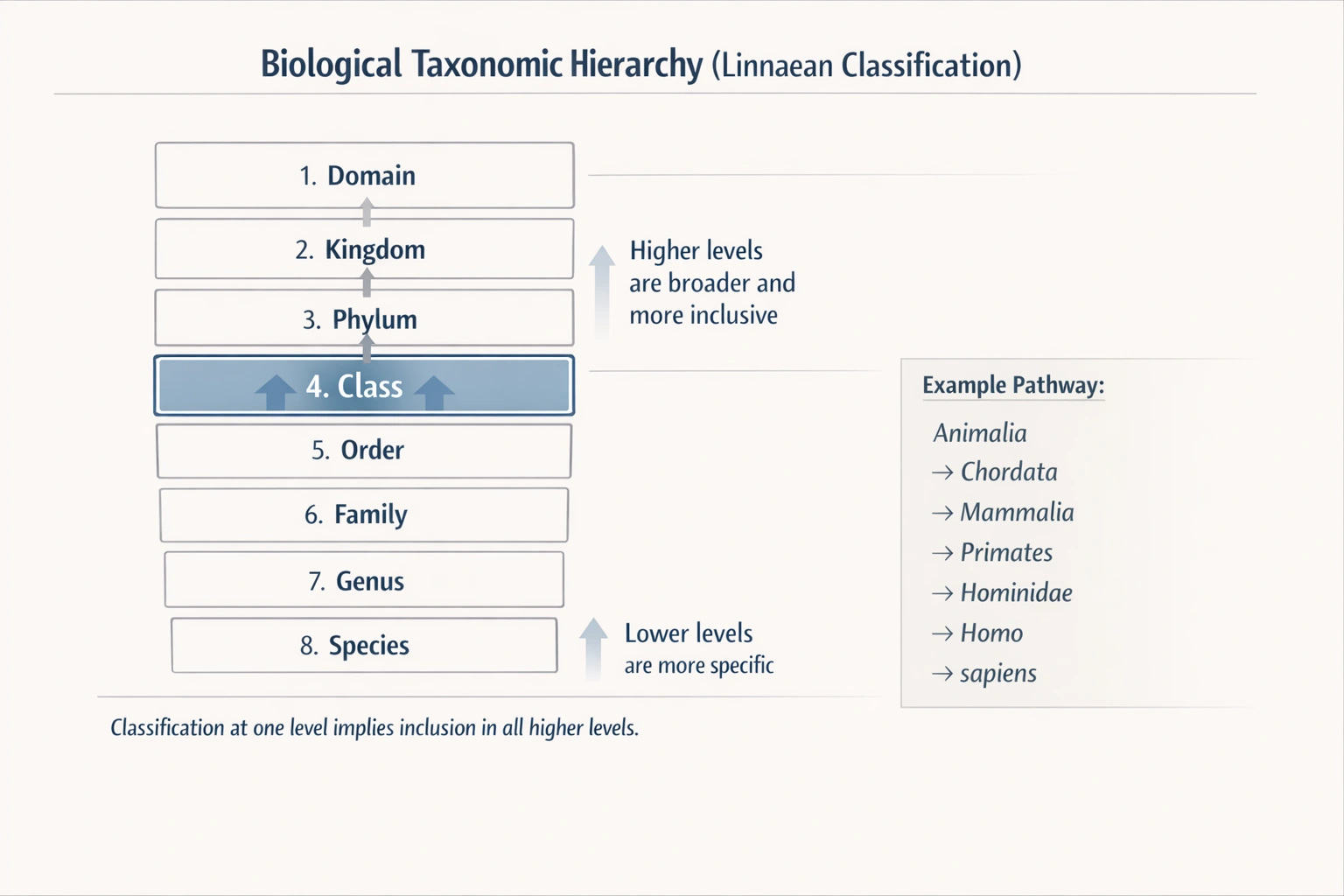
A researcher classifies a newly discovered organism in the class taxonomy level. What other taxonomic level is this new organism classified in?
-
A
Order
-
B
Family
-
C
Species
-
D
Kingdom
Due to the nested, hierarchical nature of biological classification, an organism assigned to a Class is automatically a member of all the higher, more inclusive ranks, including Kingdom.
The Linnaean taxonomic system is a hierarchy where each level is contained within the level above it. The sequence from broadest to most specific is: Domain, Kingdom, Phylum, Class, Order, Family, Genus, Species. Therefore, definitively placing an organism in a Class inherently implies its membership in the ranks superior to Class, its specific Phylum and Kingdom.
A) Order
Order is a taxonomic rank more specific than Class. The hierarchy flows from Class to Order. Placing an organism in a Class indicates a broad categorization; the specific Order within that Class has not yet been determined. The organism will eventually be placed into an Order, but its classification at the Class level does not automatically specify which Order.
B) Family
Family is an even more specific rank than Order, situated two levels below Class. Determining an organism’s Family requires more detailed analysis than is needed for Class placement. Assignment to a Class provides no information about its Family; that is a subsequent, finer level of classification.
C) Species
Species is the most fundamental and specific unit of classification. Determining an organism’s species is often the final step, involving detailed morphological, genetic, and ecological data. Classifying an organism at the Class level is a very broad grouping that encompasses many different orders, families, genera, and species. Therefore, the species remains unknown at this stage.
D) Kingdom
Kingdom is a major, high-level taxonomic rank more inclusive than Phylum and Class. The hierarchical structure dictates that all organisms within a given Class also belong to the Phylum and Kingdom that contain that Class. By definitively assigning the organism to a Class, the researcher has necessarily placed it within a specific Phylum and Kingdom.
Conclusion:
In a nested hierarchical system, classification at a given level confirms membership at all higher levels. An organism placed in a Class is confirmed to belong to a particular Kingdom and Phylum. It is not, however, classified into the more specific subordinate levels like Order, Family, or Species until further analysis is conducted. Therefore, Kingdom is a confirmed level of classification once the Class is known.
Topic Flashcards
Click to FlipWhat taxonomic ranks are more inclusive (higher) than Class in the standard hierarchy?
Domain, Kingdom, and Phylum. An organism placed in a Class is automatically also classified in these higher ranks.
True or False: Knowing an organism's Class tells you its specific Order.
Order is a more specific rank below Class. Many different Orders can exist within a single Class.
Arrange these ranks from most inclusive to least: Family, Class, Kingdom, Species.
Kingdom, Class, Family, Species.
If a new animal is classified in Class Mammalia, what Kingdom must it belong to?
Kingdom Animalia. All mammals are animals.
Why is Species not automatically determined when an organism is classified at the Class level?
Because a Class is a broad category containing many different species. Species identification requires detailed study of unique traits.