Which organelles work together to protect a plant cell from the external environment?
-
A
Flagella and pili
-
B
Cytoplasm and lysosome
-
C
Cell wall and cell membrane
-
D
Ribosome and Golgi apparatus
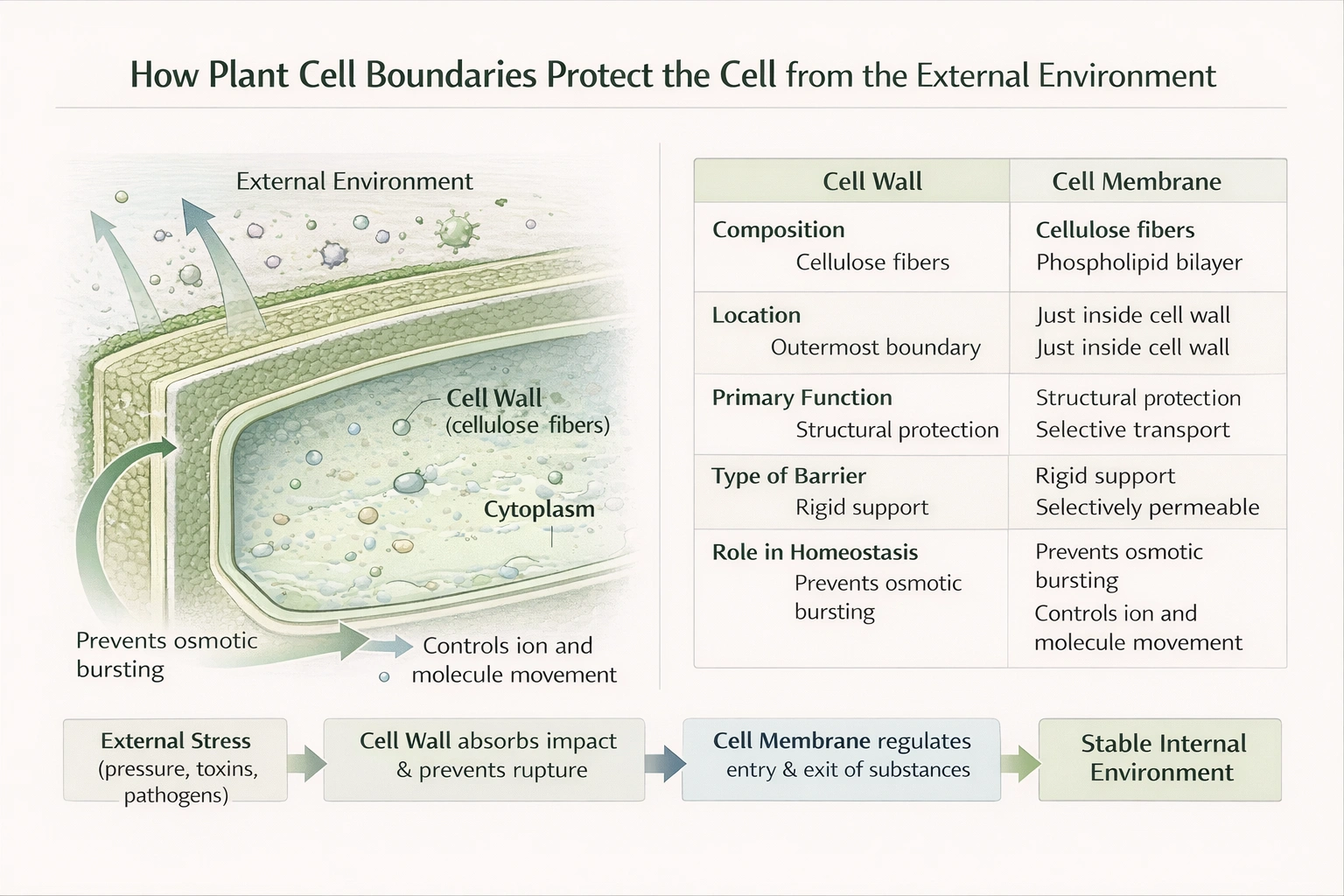
The cell wall and cell membrane form a dual-layer system that provides comprehensive protection and regulatory control for a plant cell.
Plant cells possess an outer, rigid cell wall and an inner, dynamic plasma membrane. The cell wall offers mechanical defense, structural support, and protection against physical stress and pathogens. The cell membrane provides selective permeability, controlling all molecular traffic in and out of the cell to maintain internal homeostasis. Together, they create a robust boundary against environmental challenges.
A) Flagella and pili
Flagella and pili are cellular appendages found primarily in prokaryotes. Flagella are for motility, and pili are involved in attachment or genetic transfer. These structures are not involved in protection and are not present in typical plant cells.
B) Cytoplasm and lysosome
The cytoplasm is the gel-like interior matrix housing organelles and metabolic reactions. Lysosomes are membrane-bound organelles in animal cells containing digestive enzymes for breaking down waste. Plant cells typically use a large central vacuole for similar degradative functions. While these internal components are vital for cell function and waste management, they do not constitute a protective barrier against the external environment.
C) Cell wall and cell membrane
The cell wall, composed mainly of cellulose, provides formidable structural support and mechanical protection. It resists turgor pressure, defines cell shape, and acts as a first line of defense. Inside it, the cell membrane provides selective permeability, controlling the entry and exit of substances to protect the cell's internal environment from toxins and maintain ionic balance.
D) Ribosome and Golgi apparatus
Ribosomes are sites of protein synthesis, and the Golgi apparatus modifies, sorts, and packages proteins and lipids for secretion or delivery. These organelles are central to the cell's biosynthetic and secretory pathways but are not involved in forming a protective boundary with the external world.
Conclusion:
Protection from the external environment requires a barrier that combines structural integrity with regulatory control. The cell wall serves as an external exoskeleton handling physical forces, while the cell membrane acts as a discerning gateway fine-tuning chemical composition. Flagella and pili are irrelevant to plant cells, and internal organelles like the cytoplasm, lysosomes, ribosomes, and Golgi apparatus perform vital internal functions but do not serve as protective boundaries.
Topic Flashcards
Click to FlipTrue or False: The Golgi apparatus and ribosomes work together primarily to synthesize and modify the components of the cell's protective boundary.
True. They produce and process proteins and lipids that are used to build and maintain the cell membrane and cell wall, but they are not the protective boundary themselves.
Which two structures form the complete protective boundary system of a plant cell?
The cell wall (for structural strength and physical defense) and the cell membrane (for selective permeability and chemical regulation).
What is the primary structural component of the plant cell wall that provides rigidity and defense?
Cellulose. This polysaccharide forms strong fibrils, creating a rigid exoskeleton that protects against physical stress and pathogens.
How does the function of the plant cell wall differ from that of the cell membrane in providing protection?
The wall is a rigid, porous barrier against physical forces and large pathogens. The membrane is a flexible, selective barrier that controls molecular traffic and detects chemical signals.
Why are structures like flagella or pili not involved in protecting a plant cell from its environment?
They are appendages for motility (flagella) or attachment (pili) found in bacteria, not in plant cells. Plant cells rely on passive structural defenses.