Which organisms are heterotrophs?
-
A
Algae
-
B
Bears
-
C
Bacteria
-
D
Flowers
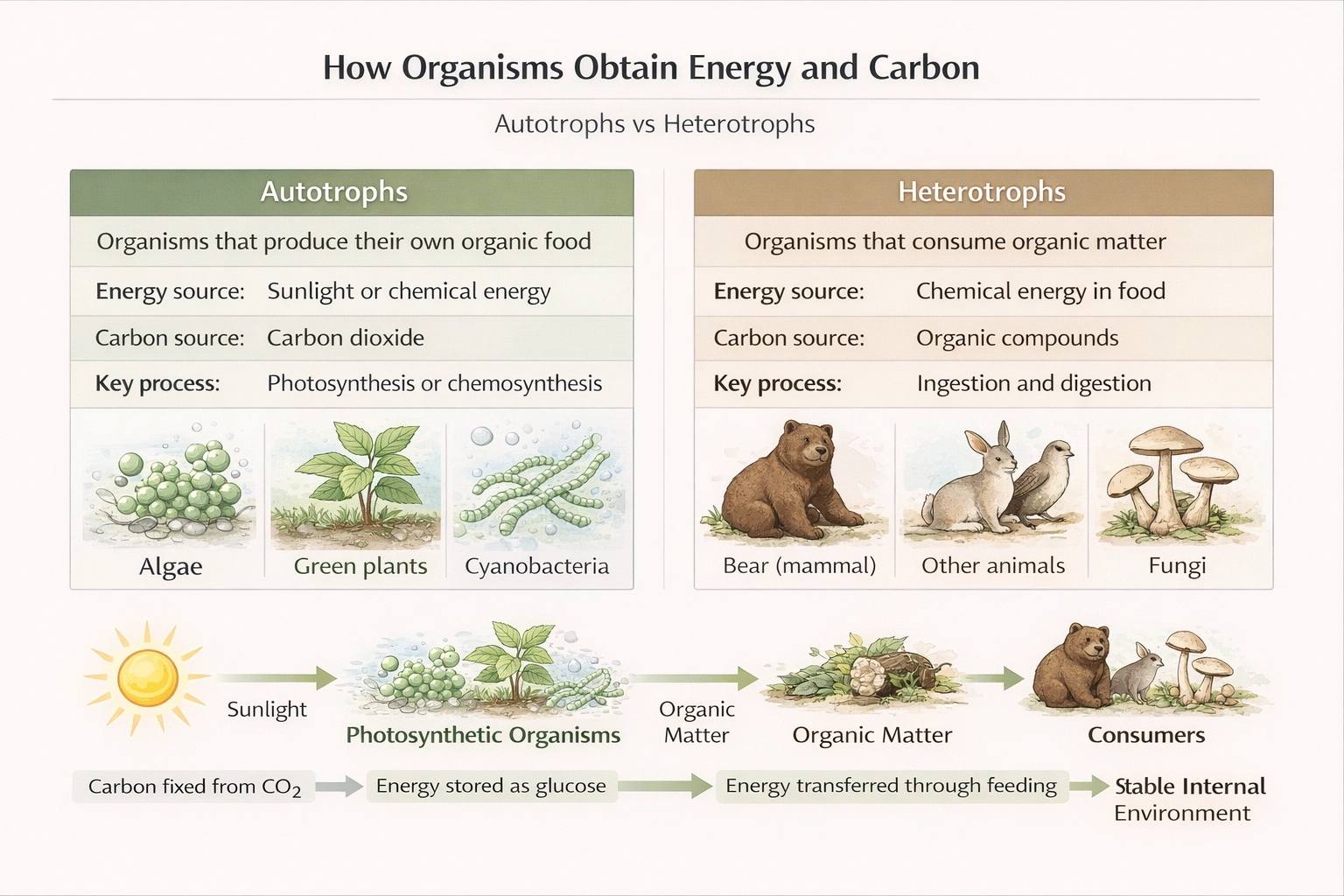
Heterotrophs are organisms that cannot synthesize their own organic compounds and must obtain carbon and energy by consuming other organisms.
Bears, as members of the kingdom Animalia, are obligate heterotrophs. They lack the cellular machinery for photosynthesis or chemosynthesis and must ingest other living things or organic matter to acquire the organic molecules and energy needed for growth, maintenance, and reproduction.
A) Algae
Algae are a diverse group of primarily photosynthetic organisms. They contain chlorophyll and harness light energy to convert carbon dioxide and water into glucose, defining them as autotrophs (specifically, photoautotrophs). They produce their own food and form the base of many aquatic food webs.
B) Bears
Bears are large mammals that obtain nutrients by consuming other organisms. They are omnivores, eating plants, fish, insects, and other mammals. Their digestive systems break down complex organic matter into absorbable nutrients, which is the hallmark of heterotrophic nutrition.
C) Bacteria
The domain Bacteria exhibits incredible metabolic diversity, including both autotrophic and heterotrophic species. Autotrophic bacteria include cyanobacteria (photosynthetic) and nitrifying bacteria (chemosynthetic). Heterotrophic bacteria include decomposers and pathogens. Therefore, the term "bacteria" alone does not specify heterotrophy; it encompasses both nutritional strategies.
D) Flowers
Flowers are the reproductive structures of angiosperms (flowering plants). They are organs, not independent organisms. The plant itself is an autotroph, producing food via photosynthesis in its leaves. Since the question asks for "organisms," and a flower is not a standalone organism capable of independent nutrition, it is an incorrect choice.
Conclusion:
Heterotrophy is a nutritional mode where an organism consumes pre-formed organic matter. Algae are autotrophs, flowers are parts of autotrophic organisms, and bacteria as a group include both autotrophs and heterotrophs. Only bears represent an organism that is unequivocally and exclusively heterotrophic from the given options.
Topic Flashcards
Click to FlipWhat is the defining characteristic that classifies an organism as a heterotroph?
It cannot produce its own organic carbon compounds and must consume other organisms or organic matter to obtain energy and nutrients.
Which group listed contains organisms that are exclusively heterotrophic?
Bears (Kingdom Animalia). All animals are obligate heterotrophs.
Name a kingdom where all members are heterotrophs, and a kingdom where members can be either autotrophs or heterotrophs.
All members of Kingdom Animalia are heterotrophs. Kingdom Protista contains both autotrophs (like algae) and heterotrophs (like amoebas).
True or False: All bacteria are heterotrophs because they lack chloroplasts.
False. Bacteria have diverse metabolisms. Many are autotrophic (e.g., cyanobacteria use photosynthesis; nitrifying bacteria use chemosynthesis).
Why is a "flower" an incorrect answer when asking for heterotrophic organisms?
A flower is an organ of an autotrophic plant. The plant itself is the organism, and it produces its own food via photosynthesis.