Which statement confirms that the cell membrane is selectively permeable?
-
A
Receptors are found on a cell's surface.
-
B
Cells communicate with each other using cell signals.
-
C
Environmental changes can cause a cell to expand or shrink.
-
D
Sodium ions must travel through ion channels to enter the cell.
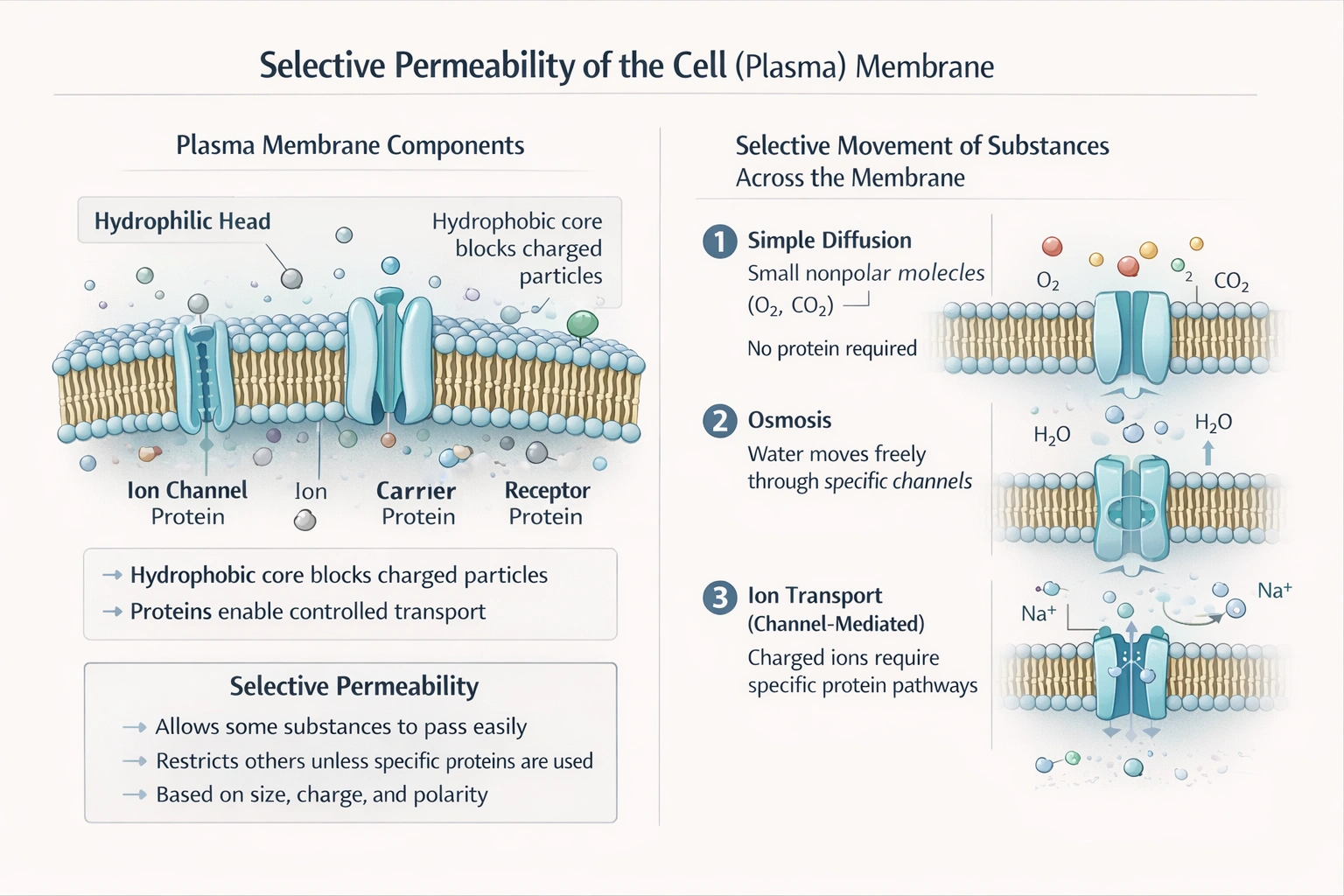
Selective permeability is demonstrated by the requirement for specialized transport mechanisms for substances that cannot freely cross the lipid bilayer. The plasma membrane's selective permeability allows some substances to pass through freely while restricting or controlling the passage of others based on size, charge, and polarity. Direct evidence of this selectivity is the mandatory use of integral membrane proteins, such as channels or transporters, for the movement of essential ions and molecules that are otherwise impermeable.
A) Receptors are found on a cell's surface.
The presence of receptor proteins is evidence for cell signaling and communication. These proteins bind specific ligands to initiate a cellular response. While receptors are integral to membrane function, their primary role is signal transduction, not the demonstration of controlled passage for general solutes. This does not directly confirm selective permeability as a barrier function.
B) Cells communicate with each other using cell signals.
Intercellular communication is a broad biological function that relies on the synthesis, release, detection, and response to chemical signals. This process may involve membranes being permeable to some signals or the presence of membrane receptors. However, the phenomenon of communication itself is not direct proof of the membrane's role as a selective barrier for the transit of ions and nutrients.
C) Environmental changes can cause a cell to expand or shrink.
This observation demonstrates osmosis, the passive diffusion of water across a semi-permeable membrane. It shows that the membrane is freely permeable to water molecules. However, it only confirms permeability for one specific substance (water) and does not speak to the selective control over other solutes like ions, sugars, or amino acids, which is the essence of selective permeability.
D) Sodium ions must travel through ion channels to enter the cell.
Sodium ions (Na⁺) are small, charged, and hydrophilic. They cannot diffuse through the hydrophobic core of the phospholipid bilayer. Their entry into the cell is strictly dependent on specific integral membrane proteins, such as ion channels or transporters. This mandatory use of a protein-mediated pathway for an essential ion conclusively shows that the membrane acts as a selective barrier, allowing passage only via regulated mechanisms.
Conclusion:
Selective permeability means the membrane controls what passes through. The need for ion channels for sodium ions provides definitive evidence of this control. The presence of receptors and cell communication relates to signaling, not general permeability. Osmosis demonstrates permeability to water but not selective control over other substances. Therefore, the ion channel requirement is the clearest confirmation of selective permeability.
Topic Flashcards
Click to FlipWhat is the term for the property of a membrane that allows only certain substances to pass while restricting others?
Selective permeability (or semi-permeability). This is a defining feature of the cell membrane.
Why can't sodium ions (Na⁺) simply diffuse through the lipid bilayer of the cell membrane?
They are charged (ions) and hydrophilic. The hydrophobic interior of the bilayer blocks their passage, requiring protein channels or pumps.
True or False: The fact that water moves into and out of a cell during osmosis is the best proof that the membrane is selectively permeable.
False. Osmosis shows the membrane is permeable to water, but selective permeability is best proven by the restriction of substances, like ions, requiring specific proteins to cross.
How do ion channels serve as direct evidence for a membrane's selective permeability?
They are specific pathways for ions that cannot cross on their own. Their necessity proves the membrane selectively controls ion movement.
What common feature do sodium channels, glucose transporters, and receptor proteins share in relation to the membrane?
They are all integral membrane proteins. However, only channels and transporters directly demonstrate selective permeability by controlling substance passage.