Which organism would most likely be labeled as a consumer?
-
A
Archaea
-
B
Autotroph
-
C
Heterotroph
-
D
Prokaryote
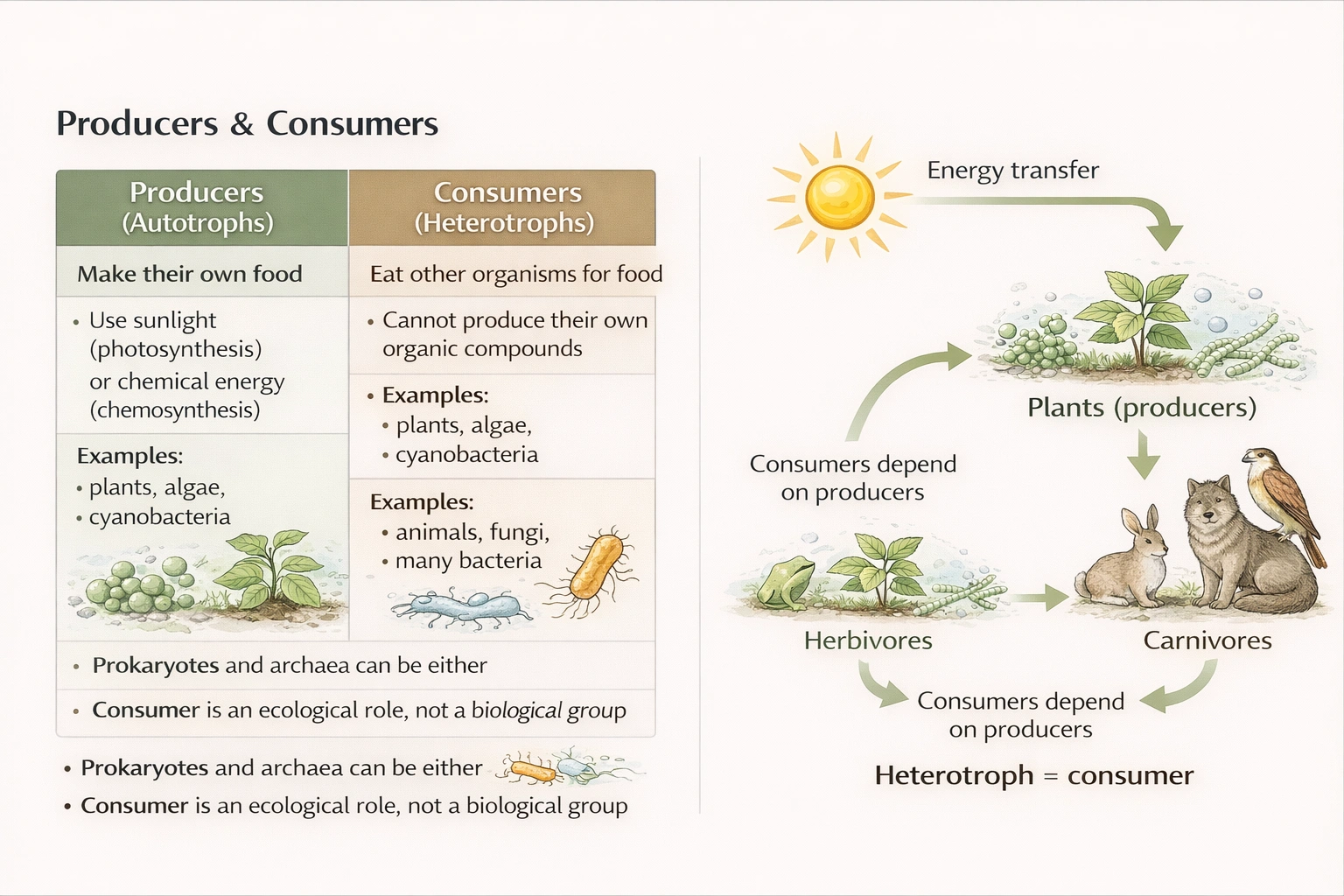
In ecology, a consumer is an organism that obtains energy and nutrients by feeding on other organisms or their organic remains, which is functionally synonymous with being a heterotroph.
Heterotrophs cannot fix carbon and must consume pre-formed organic compounds. This nutritional strategy directly translates to the ecological roles of primary consumer (herbivore), secondary/tertiary consumer (carnivore), or decomposer/detritivore within food webs.
A) Archaea
Archaea constitute one of the three domains of life, a phylogenetic classification. Archaea exhibit diverse metabolisms: some are methanogens (chemolithoautotrophs), others are heterotrophic. The label "Archaea" refers to a broad evolutionary group, not a specific ecological role, so it does not reliably correspond to "consumer."
B) Autotroph
Autotrophs are producers. They synthesize their own organic molecules from simple inorganic substances using light or chemical energy. Plants, algae, and certain bacteria are autotrophs. They form the foundational trophic level in ecosystems and are the source of food for consumers. By definition, an autotroph is not a consumer.
C) Heterotroph
All animals, fungi, and many protists and bacteria are heterotrophs. They function as consumers within ecosystems because they rely on consuming other living or dead organic matter for energy and carbon. The term heterotroph is the precise biological classification that is functionally equivalent to the ecological label of consumer.
D) Prokaryote
"Prokaryote" describes cellular organization, organisms lacking a membrane-bound nucleus (including both Bacteria and Archaea). This is a structural category that encompasses a wide variety of metabolic types. Many prokaryotes are heterotrophic consumers, but many others are autotrophic producers. Therefore, it is an imprecise and often incorrect label for the specific ecological role of consumer.
Conclusion:
The ecological role of a consumer is best described by the organism's nutritional mode. Autotrophs are producers, not consumers. Archaea and Prokaryote are broad taxonomic or structural categories that include organisms with various ecological roles. Heterotroph is the term that accurately and consistently describes organisms that derive energy and carbon by ingesting or absorbing organic matter, making them consumers.
Topic Flashcards
Click to FlipWhat is the fundamental ecological role of an organism that cannot produce its own food and must eat other organisms?
Consumer (or heterotroph). This includes herbivores, carnivores, and decomposers.
Which term describes an organism's nutritional mode and directly indicates it is a consumer in an ecosystem?
Heterotroph. This biological term is synonymous with the ecological role of consumer.
True or False: An autotrophic prokaryote, like a cyanobacterium, is considered a consumer in its ecosystem.
False. Autotrophs are producers. They convert inorganic carbon into organic matter, forming the base of the food web.
Why is the label "prokaryote" not a reliable indicator of an organism being a consumer?
Prokaryotes include both autotrophs (producers) and heterotrophs (consumers). It refers to cell structure, not ecological function.
In a food chain, what is the specific term for a consumer that eats producers (plants or algae)?
A primary consumer (or herbivore). This is the first consumer level.