According to the theory of the same name, after the “Big Bang” there were only what two things?
-
A
mass and gravity
-
B
matter and antimatter
-
C
space and time
-
D
neutrons and electrons
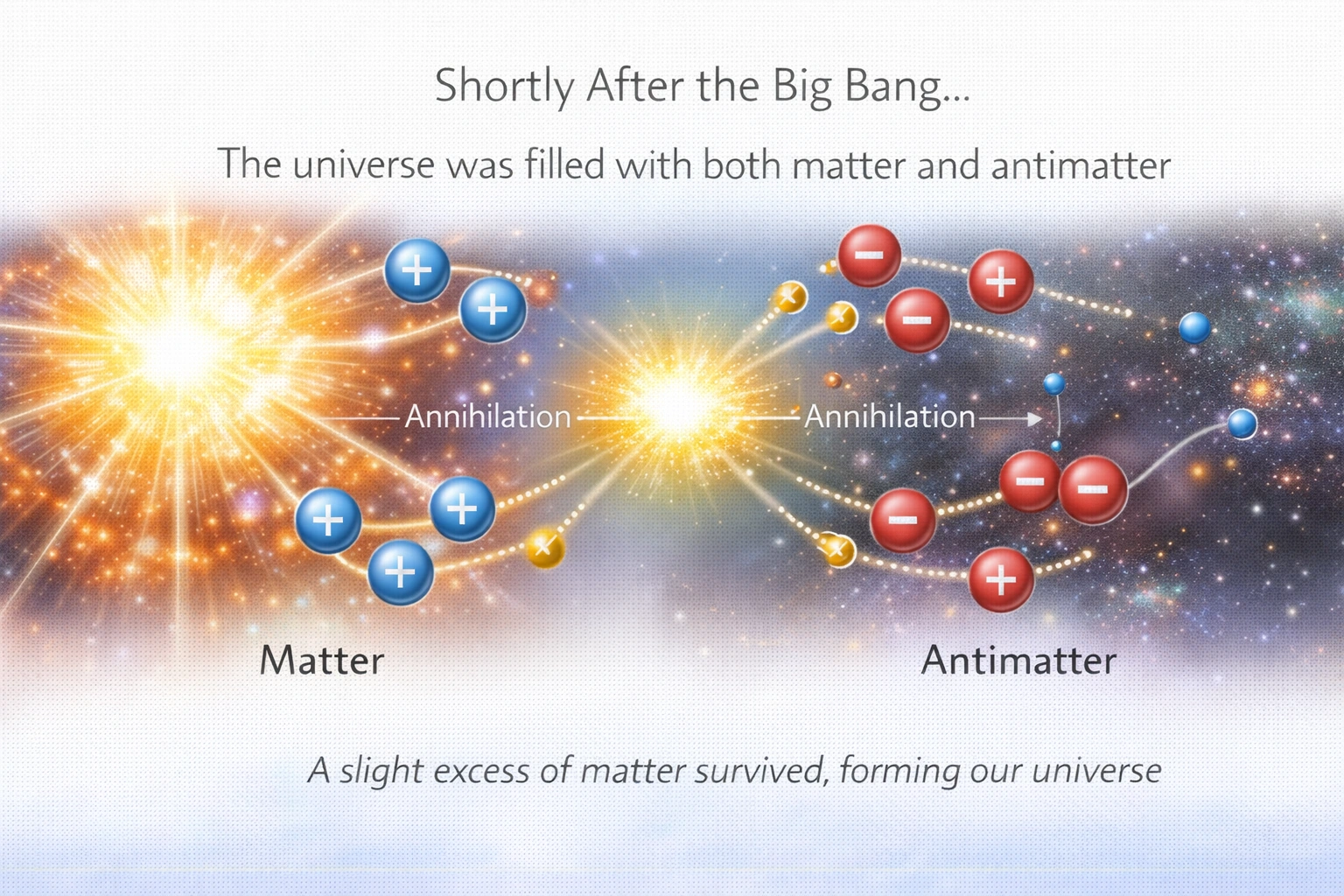
After the Big Bang, the universe was primarily composed of matter and antimatter.
These two components were created in nearly equal amounts. Over time, the matter survived, forming the structure of the universe we observe today.
A) Mass and gravity
While mass and gravity are fundamental concepts in the universe, they are not the primary components referred to in the theory following the Big Bang. The early universe, immediately after the Big Bang, was composed of extremely high-energy particles, and mass was converted into energy. Gravity, although essential, came into play later as matter began to form and cluster. Thus, this answer is not correct.
B) Matter and antimatter
According to the Big Bang theory, shortly after the Big Bang, the universe was filled with high-energy particles, including matter and antimatter. These particles were created in nearly equal amounts. When they collided, they annihilated each other, releasing energy. However, there was a slight excess of matter over antimatter, which allowed matter to survive and eventually form the stars, galaxies, and other structures we observe today. This makes B) the correct answer.
C) Space and time
Space and time were indeed created during the Big Bang, but they were not the only entities present. The Big Bang theory primarily discusses the creation of matter and energy, and how the universe evolved from an extremely hot and dense state. While space and time were intrinsically linked with the Big Bang, they are not the only entities described in the question.
D) Neutrons and electrons
While neutrons and electrons are important particles in the early universe, the universe after the Big Bang was dominated by matter and antimatter. Neutrons and electrons formed later as the universe cooled and began to form more stable particles. Therefore, this option is incorrect.
Conclusion: The universe after the Big Bang consisted of matter and antimatter, making B) the correct answer.

Topic Flashcards
Click to FlipWhat is the term for the process in which a particle of matter and a particle of antimatter collide and convert into energy?
Annihilation
What slight asymmetry in the early universe allowed matter to dominate over antimatter?
Baryon asymmetry / Matter-antimatter asymmetry.
In the earliest moments after the Big Bang, what were the two primary constituent "things" in the universe?
Matter and antimatter
What ultimately happened to most of the antimatter produced in the early universe?
It annihilated with matter, leaving a small excess of matter
Besides matter and antimatter, what other fundamental components (like forces) were present in the hot, dense early universe?
Energy and the fundamental forces (electromagnetism, strong force, weak force, gravity).