Why is the metric system used in science?
-
A
The base units are used interchangeably.
-
B
It is easy to remember how the system works.
-
C
The units are expressed as a base of a hundred.
-
D
It is a universally accepted way to report values.
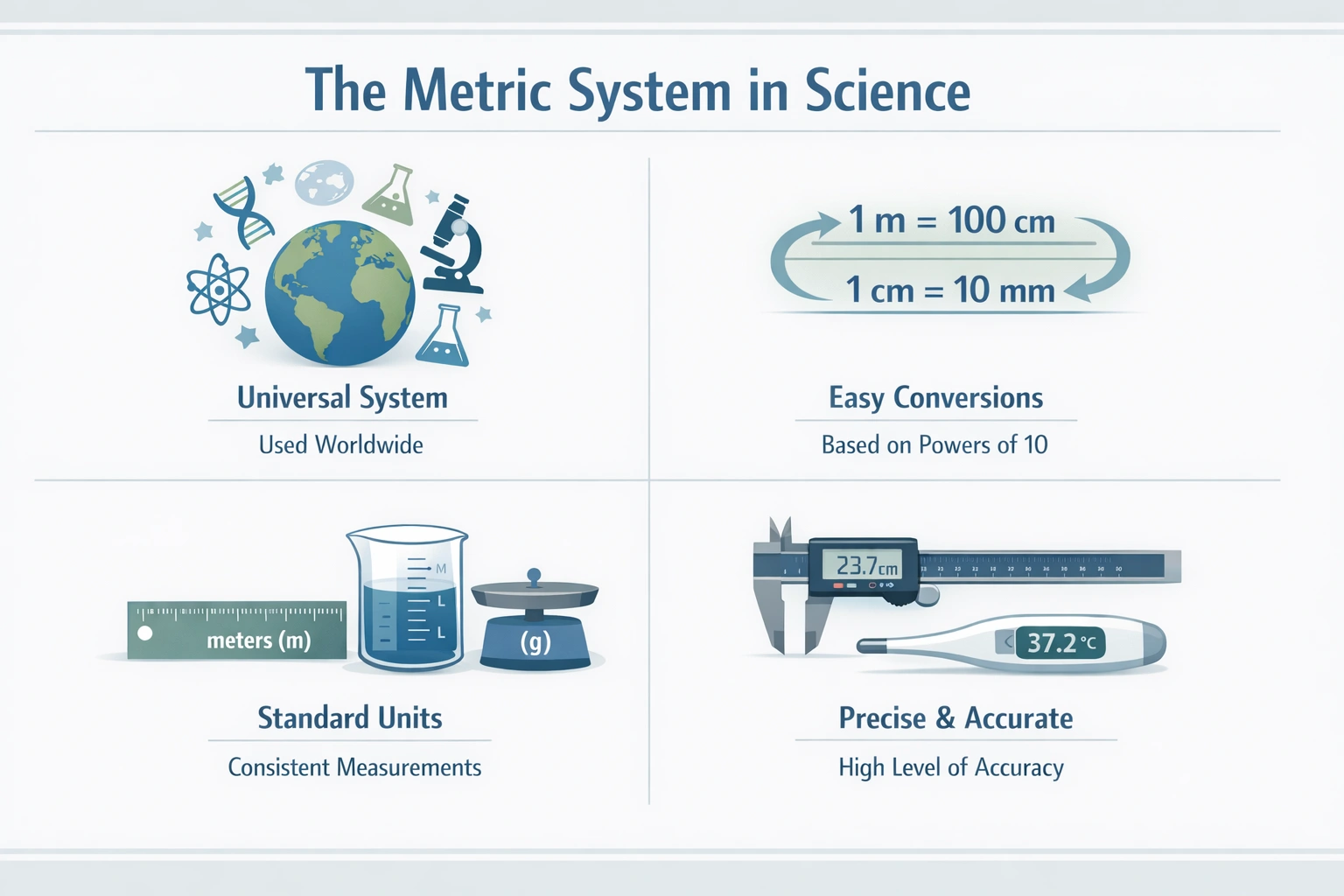
The metric system is a universally accepted way to report values.
Scientific research is a global endeavor requiring unambiguous communication and precise replication of experiments. The International System of Units (SI), the modern form of the metric system, serves as this common language. Its universal adoption by the scientific community and international standards bodies ensures that measurements taken in one laboratory are understood identically in another, regardless of location. This standardization is fundamental for comparing data, validating results, and building upon the work of others across borders.
A) The base units are used interchangeably.
Base units in the metric system, such as the meter for length, kilogram for mass, and second for time, are defined for specific physical quantities. They are not interchangeable; a meter cannot be used to express mass. The system's strength lies in the coherent relationships between units and the use of decimal prefixes that scale these base units by powers of ten. This structure allows for straightforward conversion within a dimension but does not permit the substitution of a unit of length for a unit of mass.
B) It is easy to remember how the system works.
The decimal, or base-ten, nature of the metric system is often considered more logical and easier to learn than systems using arbitrary conversion factors. However, this relative simplicity is a beneficial consequence of its design, not the primary reason for its adoption in science. The critical driving factor is the need for a single, coherent, and internationally recognized standard. A system that was merely easy to remember but not universally standardized would fail to meet the essential requirements of precision and global collaboration that define modern scientific practice.
C) The units are expressed as a base of a hundred.
This description mischaracterizes the foundation of the metric system. The system is decimal, meaning it is based on powers of ten. While some prefixes like centi- (10⁻², or one-hundredth) and hecto- (10², or one hundred) involve the number one hundred, the framework encompasses a full range of prefixes from nano- (10⁻⁹) to giga- (10⁹). The consistent use of factors of ten for scaling is what facilitates easy conversion, not an exclusive reliance on a base of one hundred.
D) It is a universally accepted way to report values.
This statement captures the essential rationale. The SI system is maintained by international agreement under the oversight of the General Conference on Weights and Measures. Nearly every country and all major scientific journals and organizations mandate its use. This universal acceptance eliminates the confusion and potential for error that arise when converting between different measurement systems, ensuring clarity, consistency, and reliability in scientific communication worldwide.
Conclusion:
The selection of a measurement system for science is dictated by the need for global consistency, precision, and collaborative efficiency. While the metric system benefits from a logical decimal structure, its paramount importance stems from its formal recognition as the international standard. This universal acceptance provides a common framework that allows scientists everywhere to share, understand, and verify experimental data, making it an indispensable tool for the advancement of knowledge.
Topic Flashcards
Click to FlipWhat is the main purpose of using the International System of Units (SI) in global scientific research?
To provide a standardized, unambiguous language for reporting measurements so data can be shared and understood worldwide.
What key advantage does the metric (SI) system have over systems like the U.S. customary units in a laboratory setting?
It is based on powers of ten, allowing for easy conversion between units (e.g., grams to kilograms) without complex arithmetic.
What is the base SI unit for measuring mass, and why is using it important for a chemist in Japan collaborating with a chemist in Germany?
The kilogram (kg). Using the same base unit ensures they are both measuring mass in the same way, preventing calculation errors.
When a scientific journal requires data in SI units, what does this "universal acceptance" primarily prevent?
It prevents confusion, conversion errors, and misinterpretation of data that can occur when different measurement systems are used.
The metric system is described as "decimal." What does this mean for converting from a unit like meters to kilometers?
You only need to move the decimal point (e.g., 1000 meters = 1 kilometer), as conversions are based on factors of 10.