Which of the following describes a sample that is boiling?
-
A
The energy of the particles is increasing.
-
B
The particles are getting closer together.
-
C
The temperature of the substance is increasing.
-
D
The cohesive forces between particles are getting stronger.
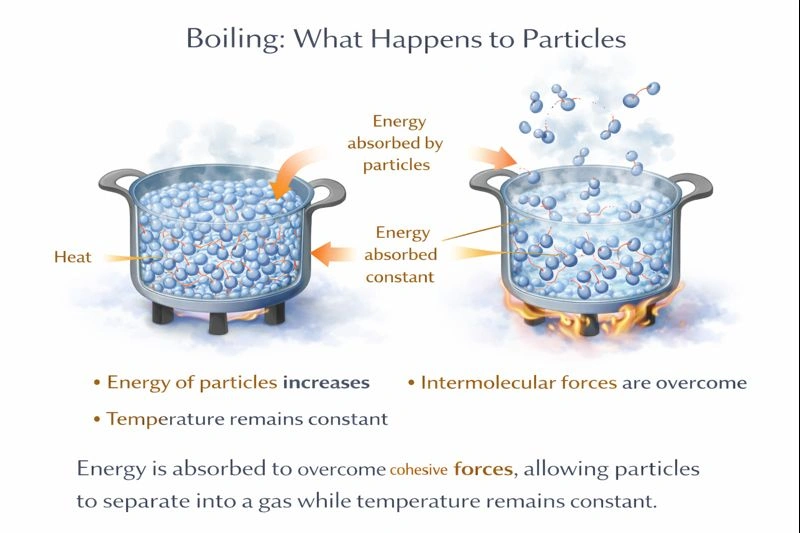
During boiling, the energy of the particles is increasing.
Boiling is a phase change from liquid to gas that occurs at a constant temperature (the boiling point) for a pure substance at a given pressure. The thermal energy supplied during boiling does not increase the average kinetic energy of the particles (which would raise the temperature), but instead increases their potential energy. This energy is used to overcome the attractive intermolecular forces (cohesive forces) holding the liquid together, allowing particles to break free into the gaseous state. Thus, the total energy—kinetic plus potential—of the particles increases.
A) The energy of the particles is increasing.
Heat is continuously absorbed during boiling. This absorbed energy increases the particles' total energy. It provides the necessary energy to break intermolecular bonds (increasing potential energy) while maintaining constant average kinetic energy (constant temperature).
B) The particles are getting closer together.
This describes condensation (gas to liquid) or compression, not boiling. During boiling, particles transition from the relatively close-packed, disordered arrangement of a liquid to the far-apart, random motion of a gas. The average distance between particles increases dramatically.
C) The temperature of the substance is increasing.
For a pure substance boiling at constant external pressure, the temperature remains constant at the boiling point throughout the phase change. The added heat energy is used exclusively for the process of vaporization (the latent heat of vaporization), not for raising the temperature. Once all liquid is converted to gas, continued heating will then increase the temperature of the vapor.
D) The cohesive forces between particles are getting stronger.
Cohesive forces are the intermolecular attractions (e.g., hydrogen bonds, dipole-dipole forces, London dispersion forces) that hold a liquid together. During boiling, these forces are being overcome. As particles gain sufficient energy to escape into the gas phase, the effective strength of cohesive forces within the remaining liquid does not increase; in fact, the process involves breaking these forces.
Conclusion:
Boiling is characterized by the absorption of thermal energy at a constant temperature. This input of energy increases the total energy of the particles, providing the necessary work to break intermolecular attractions and facilitate the transition from the liquid to the gaseous state. The temperature remains steady, particle separation increases, and cohesive forces are overcome, not strengthened.

Topic Flashcards
Click to FlipWhat happens to the temperature of a pure substance while it is actively boiling at constant pressure?
It remains constant at the boiling point.
Where does the heat energy go when it is supplied to a boiling liquid, if not into raising the temperature?
It is used to overcome intermolecular forces (increasing potential energy) to change phase from liquid to gas.
During boiling, the average distance between particles is ______.
Increasing (as they move from the liquid state to the far-apart gaseous state).
What is the key difference between heating a substance within a phase (e.g., liquid water from 25°C to 99°C) and heating it during a phase change (e.g., boiling at 100°C)?
Within a phase: heat increases kinetic energy (temperature rises). During a phase change: heat increases potential energy (temperature stays constant).
Once a liquid has completely vaporized, what does additional heat energy begin to increase?
The kinetic energy (and thus the temperature) of the gas particles.