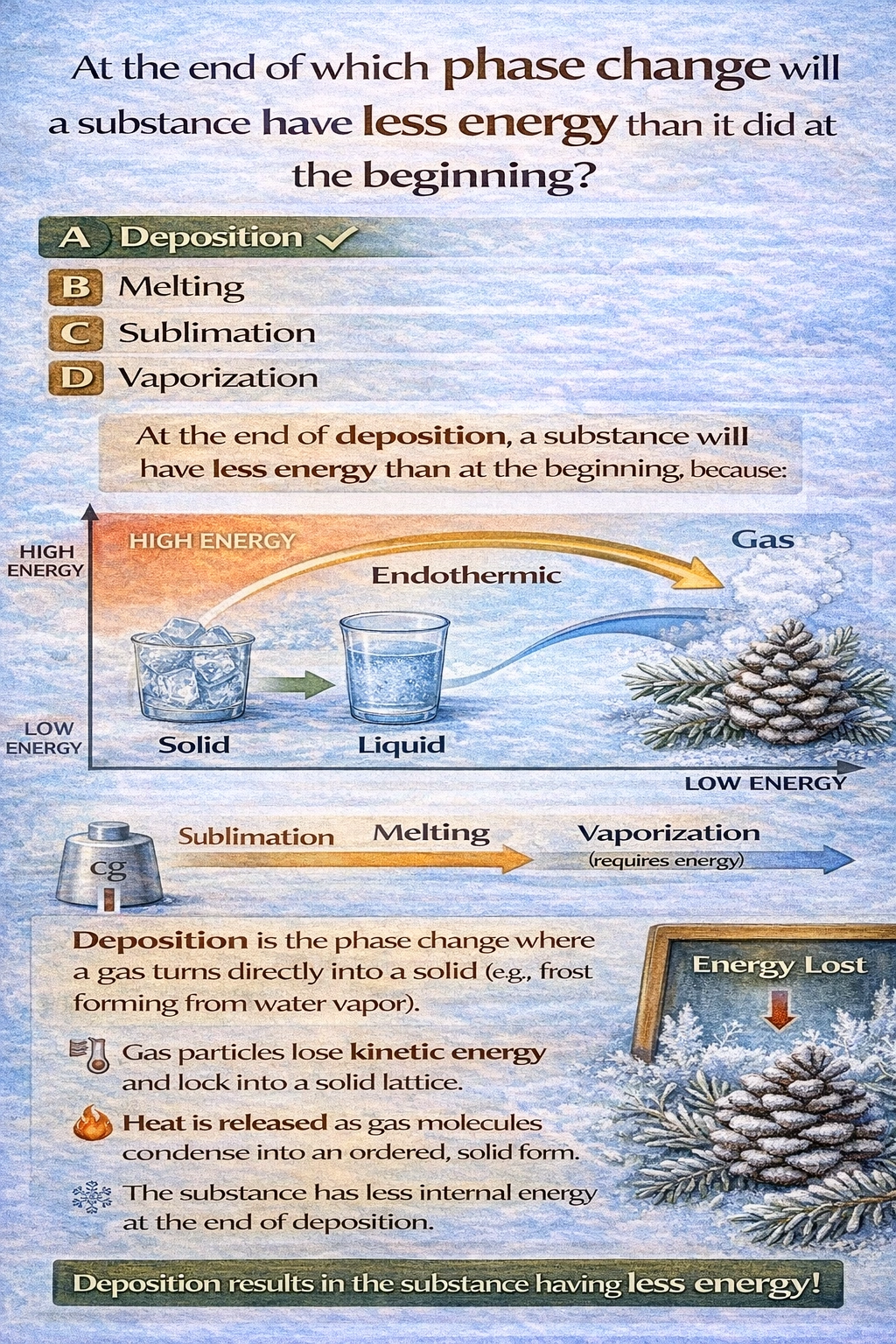
At the end of which phase change will a substance have less energy than it did at the beginning?
-
A
Deposition
-
B
Melting
-
C
Sublimation
-
D
Vaporization
At the end of deposition, a substance will have less energy than it did at the beginning.
Phase changes involve the absorption or release of thermal energy (heat). The internal energy of a substance is related to the kinetic and potential energy of its particles. Changes to a more ordered state (e.g., gas to solid) release energy, lowering the substance's internal energy.
A) Deposition
Deposition is the phase change where a gas turns directly into a solid, bypassing the liquid phase (e.g., frost forming from water vapor). This is an exothermic process that releases a significant amount of latent heat into the surroundings. The gas particles, which have high kinetic energy and are widely dispersed, lose energy and become locked into the fixed, ordered lattice of a solid. The decrease in particle motion and potential energy results in a substantial net loss of internal energy for the substance.
B) Melting
Melting is the change from solid to liquid. This process is endothermic, requiring an input of heat energy to overcome the intermolecular forces holding the solid lattice together. The added energy increases the particles' kinetic energy, allowing them to slide past one another. Therefore, the substance has more internal energy as a liquid than it did as a solid.
C) Sublimation
Sublimation is the direct change from solid to gas (e.g., dry ice becoming CO₂ gas). This is a highly endothermic process. It requires energy to break the strong intermolecular bonds of the solid and additionally to allow the particles to disperse as a gas. The resulting gas particles possess high kinetic energy and greater separation, meaning the substance's internal energy increases dramatically.
D) Vaporization
Vaporization (evaporation or boiling) is the change from liquid to gas. This process requires a large input of heat energy, known as the enthalpy of vaporization, to break the attractive forces between liquid molecules and allow them to separate into the gaseous state. The gaseous state has much higher particle kinetic energy and greater intermolecular distances, leading to a significant increase in the substance's internal energy.
Conclusion:
Phase changes that result in a more ordered, condensed state (gas to liquid, liquid to solid, gas to solid) are exothermic and decrease the internal energy of the substance. Deposition, the transition from gas directly to solid, results in the greatest increase in order and therefore the largest release of energy, leaving the substance with less energy than it started with.

Topic Flashcards
Click to FlipWhat is the phase change called when a gas turns directly into a solid?
Deposition
Which type of phase change (exothermic or endothermic) results in the substance having less internal energy at the end?
Exothermic phase changes. They release thermal energy to the surroundings, lowering the substance's internal energy.
Deposition and sublimation are opposite processes. How do their energy changes compare?
Deposition is exothermic (releases energy, substance loses energy). Sublimation is endothermic (absorbs energy, substance gains energy).
Which phase change—freezing, condensation, or deposition—typically releases the greatest amount of energy per gram?
Deposition. Going directly from gas to solid releases both the heat of vaporization and the heat of fusion.
Frost forming on a window is an example of deposition. What is happening to the energy of the water vapor?
The water vapor loses energy (releases heat) as its particles slow down and arrange into a fixed, solid structure.