100%
4
Rated
Attempts
127
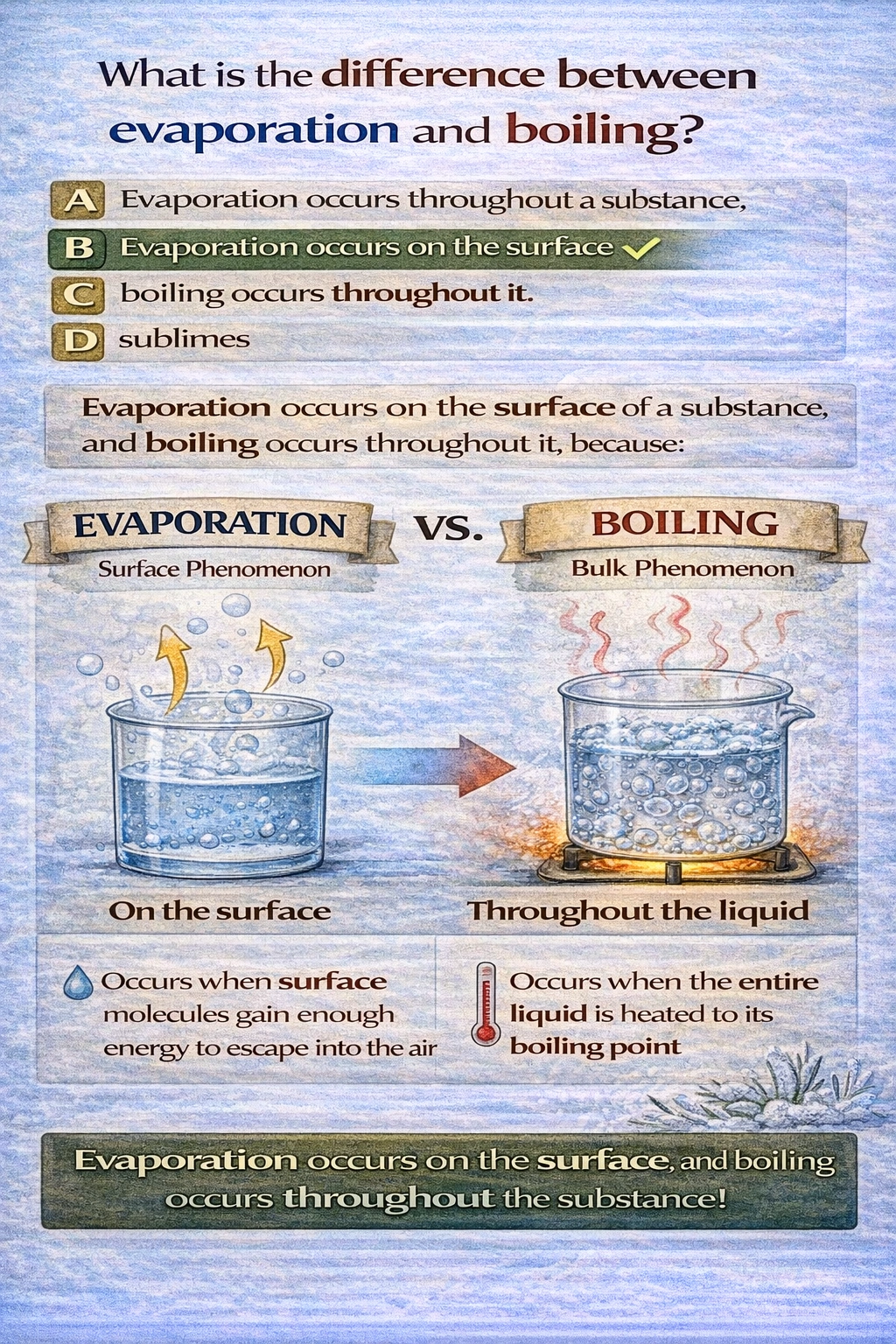
What is the difference between evaporation and boiling?
-
A
Evaporation occurs throughout a substance, and boiling occurs on the bottom of it.
-
B
Evaporation occurs on the surface of a substance, and boiling occurs throughout it.
-
C
. Evaporation occurs on the bottom of a substance, and boiling occurs on the surface of it.
-
D
Evaporation occurs on the surface of a substance, and boiling occurs on the bottom of it.
A
Evaporation occurs throughout a substance, and boiling occurs on the bottom of it.
B
Evaporation occurs on the surface of a substance, and boiling occurs throughout it.
C
. Evaporation occurs on the bottom of a substance, and boiling occurs on the surface of it.
D
Evaporation occurs on the surface of a substance, and boiling occurs on the bottom of it.
Topic Flashcards
Click to FlipMini Quiz
1 / 3
Is evaporation correctly described as a surface-only phenomenon?
Related Questions
Top Picks
The amount of heat that has been removed from the substance allows the particles to draw closer together, and the material changes from a liquid to a solid. Which of the following is being described?
A neutral atom has two electrons in its first energy shell, eight electrons in its second energy shell, and three electrons in its third energy shell. Which electrons will be lost when the atom reacts to become stable?
How many potassium and nitrogen ions are needed to form an ionic compound?
What is the net charge of the ionic compound barium iodide (BaI₂)?
What type of reaction is described by the following equation?
2Na(s) + ZnCl₂(aq) → Zn(s) + 2NaCl(aq)
Available FREE Test
Sets
Available Test
Sets