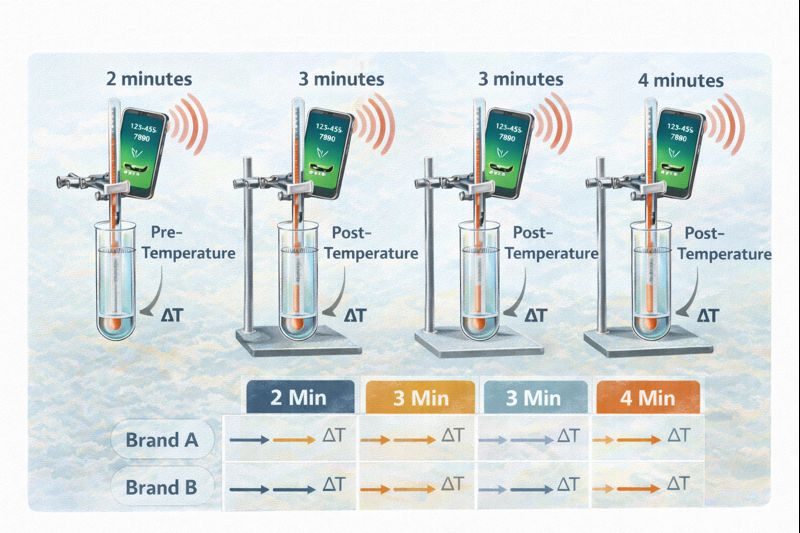
Best design to test cell phone radiation heating water?
-
A
One phone, 2 min, single tube
-
B
One phone, multiple times
-
C
Three brands, 2 min each
-
D
Three brands, multiple durations
The best experimental design tests three different brands of phones, each set to ring for different durations, and records the water temperature before and after each trial.
A robust experiment controls for confounding variables, tests for a dose-response relationship, and includes replication. Testing only one phone or one duration cannot determine if an effect is generalizable or related to exposure time. Using multiple brands controls for the possibility that heating is a peculiarity of one specific phone model. Testing multiple durations (e.g., 2, 3, and 4 minutes) is crucial: if radiation causes heating, a longer exposure should generally produce a greater temperature increase. This dose-response pattern is strong evidence for a causal effect. Measuring temperature before and after each trial is necessary to calculate the change attributable to the exposure.
A) One phone, 2 min, single tube
This design has no replication, no control for phone variability, and tests only one duration. It cannot distinguish between an effect of the phone and random fluctuation or pre-existing temperature differences.
B) One phone, multiple times
Repeating the test with one phone improves reliability for that specific device but does not address whether the effect is model-specific. It also typically involves only one duration unless explicitly varied in the design.
C) Three brands, 2 min each
This design improves upon A and B by controlling for brand/model variation. However, testing all phones for the same single duration can only show if different brands produce different amounts of heat at that specific time. It cannot establish whether longer exposure leads to more heating, which is key to supporting a causal claim.
D) Three brands, multiple durations
This is the most rigorous design. It includes replication across brands (controlling for device-specific effects) and tests multiple durations to investigate a dose-response relationship. Pre- and post-measurements are implied for calculating temperature change. This design can determine if heating is a general phenomenon related to cell phone use and if the effect increases with exposure time.
Conclusion
To convincingly test a cause-and-effect hypothesis, an experiment should manipulate the independent variable (exposure duration), control for potential confounders (phone model), and look for a predictable pattern (more exposure = more effect). The design using three brands and multiple durations fulfills these criteria most completely.
Topic Flashcards
Click to FlipIn the cell phone radiation experiment, what is the independent variable (the factor being changed on purpose) in the best design?
The duration of radiation exposure (multiple durations tested) and the brand/model of phone. These are the factors manipulated to observe an effect.
Why is testing only one duration (like 2 minutes) considered a weak experimental design for this question?
It cannot establish a dose-response relationship. You need multiple durations to see if longer exposure leads to greater heating, which is key evidence for causation.
True or False: Using three different phone brands in the experiment is primarily to make the experiment more expensive and complicated.
False. Using multiple brands controls for the variable of phone model, ensuring any observed effect is due to radiation in general, not a quirk of one specific device.
What is the term for the relationship where a greater amount of the cause (longer radiation exposure) leads to a greater effect (higher temperature)?
A dose-response relationship. This is a critical piece of evidence for establishing a causal link.
What should be measured both BEFORE and AFTER each test trial to accurately calculate the effect of the radiation?
The water temperature. The change in temperature (ΔT) is the dependent variable.