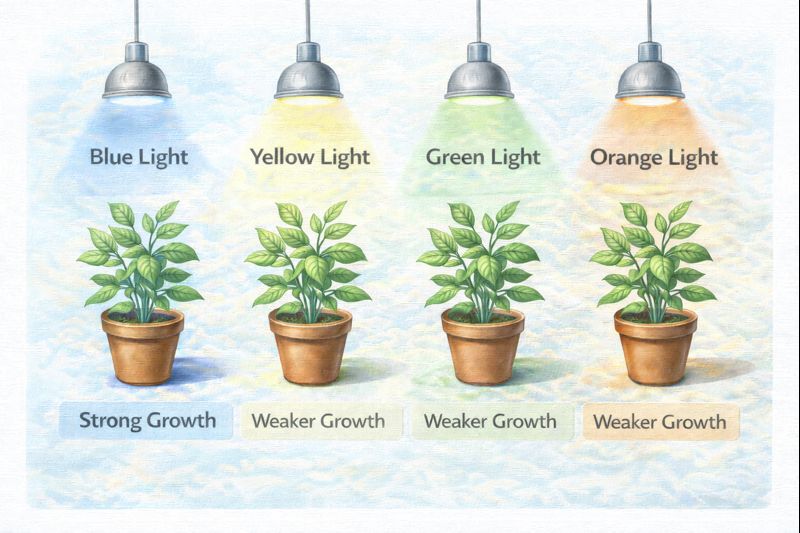
Which light color is most effective for growing green plants indoors?
-
A
Blue
-
B
Yellow
-
C
Green
-
D
Orange
Blue light is among the most effective single colors for driving photosynthesis and promoting healthy growth in green plants indoors.
The effectiveness of light for photosynthesis depends on the absorption spectrum of plant pigments, primarily chlorophyll a and chlorophyll b. These pigments have strong absorption peaks in the blue-violet region (around 430-450 nm) and the red region (around 640-660 nm). Green and yellow light (500-600 nm) is poorly absorbed and is mostly reflected, which is why plants appear green. While a combination of red and blue light is ideal for overall growth, blue light plays crucial roles beyond pure energy capture: it regulates stomatal opening, promotes phototropism, inhibits stem elongation (leading to shorter, sturdier plants), and drives chlorophyll synthesis. For indoor growth where natural full-spectrum light is absent, providing blue light is essential for compact, vegetative growth.
A) Blue
Blue photons are highly energetic and are absorbed efficiently by chlorophyll. They drive the photosystem II reactions strongly and are critical for the development of chloroplasts and the suppression of overly elongated, "leggy" growth that occurs under low-light or predominantly red-light conditions.
B) Yellow
Yellow light (570-590 nm) falls within the green-yellow range of the spectrum, which is the region of lowest absorption by chlorophyll. Plants reflect much of this light, so it contributes very little to photosynthetic activity and is inefficient as a primary light source.
C) Green
Green light (495-570 nm) is the most reflected color and therefore has the lowest absorption by chlorophyll in the upper leaf layers. While some green light can penetrate deeper into the leaf canopy and be used by chloroplasts located lower down, its photosynthetic efficiency is the lowest of all visible colors when used alone.
D) Orange
Orange light (590-620 nm) is closer to red and is absorbed better than green or yellow, but its efficiency is still less than that of pure red light. It can support photosynthesis but is not as effective as blue or red.
Conclusion
For maximum photosynthetic yield, a full spectrum or a mix of red and blue is best. However, among the single-color options provided, blue light corresponds to a major chlorophyll absorption peak and is particularly important for regulating plant morphology and health under artificial lighting. Therefore, it is the most effective single color for indoor plant growth.
Topic Flashcards
Click to FlipWhat are the two primary colors (wavelengths) of light that chlorophyll a and b absorb most strongly for photosynthesis?
Blue light (around 430-450 nm) and red light (around 640-660 nm). Green light is poorly absorbed.
Why is green light the least effective color for driving photosynthesis in a typical green plant leaf?
Chlorophyll pigments reflect green light, which is why leaves appear green. Most green light is not absorbed by the upper chloroplasts.
Beyond energy for photosynthesis, what key aspect of plant growth and development is specifically regulated by blue light?
Photomorphogenesis: Blue light inhibits stem elongation (prevents leggy growth), promotes stomatal opening, and directs phototropism (growth toward light).
In an indoor grow light setup, why would using only red light lead to poor plant structure?
While red light drives photosynthesis, without blue light, plants become excessively tall and spindly ("leggy") as stem elongation is not inhibited.
True or False: A combination of red and blue light provides a more complete spectrum for overall plant health than blue light alone.
True. Red light is highly efficient for photosynthesis and flowering, while blue light is crucial for structure and regulation. Together they are optimal.