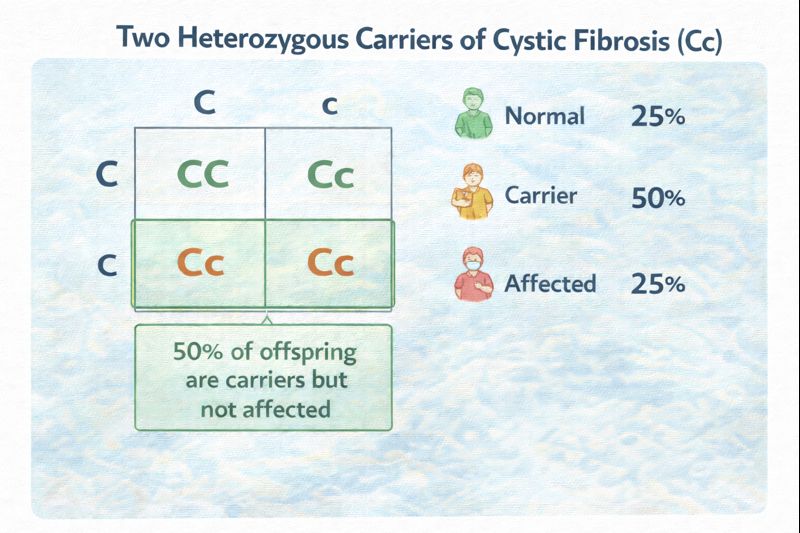
Two heterozygous carriers (Cc) of cystic fibrosis. Percent of offspring who are carriers but not affected?
-
A
0%
-
B
25%
-
C
50%
-
D
100%
Fifty percent of the offspring from two heterozygous parents (Cc x Cc) are expected to be heterozygous carriers who are not affected by cystic fibrosis.
Cystic fibrosis is an autosomal recessive disorder caused by mutations in the CFTR gene. The allele 'C' represents the normal (dominant) allele, and 'c' represents the recessive disease-causing allele. Heterozygous individuals (Cc) are carriers; they have one functional copy of the gene and are phenotypically normal. A cross between two carriers follows Mendelian monohybrid inheritance. The Punnett square for Cc x Cc yields the following genotypic ratio: 1 CC (25%) : 2 Cc (50%) : 1 cc (25%). The CC offspring are homozygous normal and not carriers. The cc offspring are homozygous recessive and affected by the disease. The Cc offspring are heterozygous; they carry one copy of the recessive allele but, because the disorder is recessive, they are not affected. They are phenotypically normal carriers.
A) 0%
This would be true only if it were impossible to produce heterozygous offspring, such as in a cross between two homozygous individuals (CC x CC or cc x cc). In a cross between two heterozygotes, heterozygotes are produced.
B) 25%
This is the expected percentage of offspring who will be affected (cc genotype). It is also the percentage of offspring who will be homozygous normal (CC). It is not the percentage of carriers.
C) 50%
This is the correct proportion for heterozygous carrier offspring in a monohybrid cross between two heterozygotes. Statistically, half of the children from such a couple will inherit one normal and one disease allele.
D) 100%
This would mean all offspring are carriers, which occurs only if one parent is homozygous affected (cc) and the other is homozygous normal (CC), producing all Cc offspring. In a Cc x Cc cross, only 50% are carriers.
Conclusion
For an autosomal recessive trait, the offspring of two heterozygous parents have a 25% chance of being affected, a 50% chance of being an unaffected carrier, and a 25% chance of being unaffected and not a carrier. Therefore, the percentage of offspring who are carriers but not affected is 50%.
Topic Flashcards
Click to FlipWhat is the genotype of a parent who is a "heterozygous carrier" of an autosomal recessive disorder like cystic fibrosis?
Cc (one normal allele 'C', one disease allele 'c'). They are phenotypically normal but can pass on the disease allele.
In a cross between two heterozygous parents (Cc x Cc), what is the probability that an offspring will inherit the genotype 'cc' and be affected by the disorder?
25%. The Punnett square genotypic ratio is 1 CC : 2 Cc : 1 cc.
True or False: In an autosomal recessive disorder, an individual must have two copies of the recessive allele to show the disease phenotype.
True. A single dominant allele (C) is enough for a normal phenotype. Only the homozygous recessive (cc) genotype is affected.
What percentage of offspring from two heterozygous parents are expected to be phenotypically normal (unaffected)?
75%. This includes both homozygous normal (CC, 25%) and heterozygous carrier (Cc, 50%) genotypes.
If a child of two heterozygous parents is unaffected, what is the probability that this child is a carrier?
2/3 (or about 66.7%). Among the unaffected offspring (CC and Cc), 2 out of 3 are carriers (Cc).