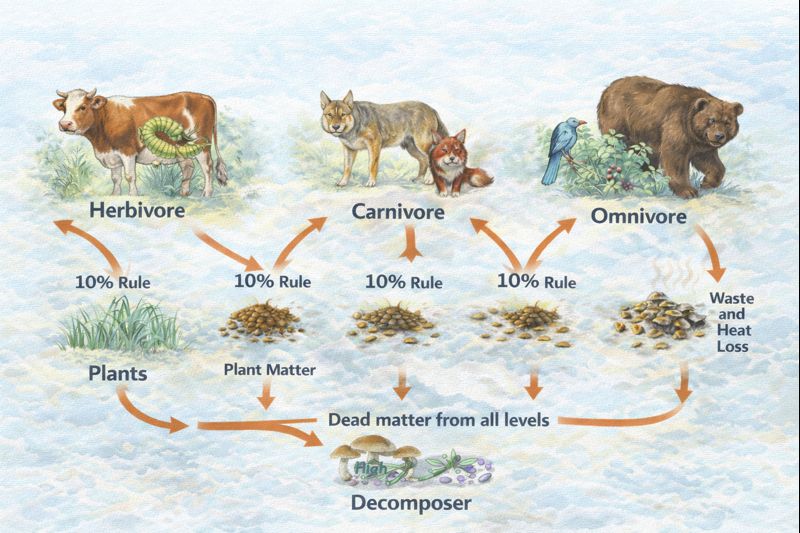
Whose efficiency of energy is greater?
-
A
Herbivore
-
B
Carnivore
-
C
Omnivore
-
D
Decomposer
Decomposers have the greatest efficiency in capturing and utilizing energy from an ecosystem.
In ecology, "efficiency" can refer to different things. The common "10% rule" describes trophic efficiency, the transfer of energy from one trophic level to the next, which is low (~10%). By this measure, herbivores (primary consumers) are more efficient than carnivores (secondary or tertiary consumers) because they are closer to the energy source (plants). However, decomposers (bacteria and fungi) operate differently. They are saprotrophs that feed on dead organic matter from all trophic levels. They respire to obtain energy but do so at ambient temperatures, minimizing heat loss. More importantly, they have extremely high assimilation efficiency, they can absorb nearly all the simple molecules resulting from the external digestion of detritus. They effectively capture and recycle the energy that was "lost" as waste, dead bodies, and uneaten material from the entire food web, making their functional energy capture from the ecosystem's total primary production the greatest.
A) Herbivore
Herbivores typically have low assimilation efficiency (often 20-50%) because they cannot digest all plant material (e.g., cellulose without symbionts). Their net production efficiency (growth per assimilated energy) is also low due to metabolic costs. Their position gives them access to more total energy than higher levels, but their conversion efficiency is not the greatest.
B) Carnivore
Carnivores have high assimilation efficiency (~80%) from their nutrient-dense prey, but they are at a high trophic level. The energy available to them is only a small fraction (about 1%) of the original plant energy due to losses at each transfer. Their overall ecological efficiency is the lowest among consumer types.
C) Omnivore
Omnivores feed at multiple levels, which can provide a more stable energy supply. Their efficiencies are intermediate, depending on their diet mix. They are not inherently more efficient than decomposers at capturing total system energy.
D) Decomposer
Decomposers are the ultimate recyclers. They utilize the energy stored in dead producers, consumers, and waste products, energy that would otherwise remain locked in organic matter. Their mode of external digestion and absorption allows them to utilize a very high percentage of the chemical energy in detritus. In terms of processing the total energy flow through an ecosystem, decomposers are exceptionally efficient.
Conclusion
While trophic transfer between living levels is inefficient, decomposers specialize in mining the energy from the accumulated waste of all levels. They prevent energy from being lost from the system in the form of uneaten dead matter. Therefore, when considering the efficient use of the total energy originally fixed by producers, decomposers surpass herbivores, carnivores, and omnivores.
Topic Flashcards
Click to FlipWhat is the term for the percentage of energy at one trophic level that is converted into biomass at the next level?
Trophic efficiency. This is typically very low (around 10%), explaining why food chains are short.
Why do decomposers (like fungi and bacteria) have such high assimilation efficiency compared to herbivores?
They externally digest detritus into simple molecules they can fully absorb. Herbivores cannot fully digest tough plant materials like cellulose.
True or False: A carnivore assimilates a higher percentage of the energy from its food than a herbivore does from its food.
True. Meat is easier to fully digest and absorb than plant matter, giving carnivores higher assimilation efficiency (often ~80% vs. ~30% for herbivores).
What key ecological role makes decomposers critical for energy flow, even though they aren't part of the standard trophic pyramid?
Nutrient and energy recycling. They break down dead organisms and waste, returning raw materials to the ecosystem and capturing energy other consumers lost.
In terms of accessing the total original energy from sunlight captured by plants, which group gets the most: herbivores or decomposers?
Decomposers. They consume the dead plant material herbivores didn't eat, plus dead herbivores and all other waste, accessing more of the ecosystem's total energy budget.