How does the respiratory system of a frog differ from that of a human?
-
A
Frogs breathe through pores in their skin.
-
B
Frogs are born with lungs but revert to gills.
-
C
Frogs are born with gills but develop lungs.
-
D
Frogs breathe exclusively through their gills.
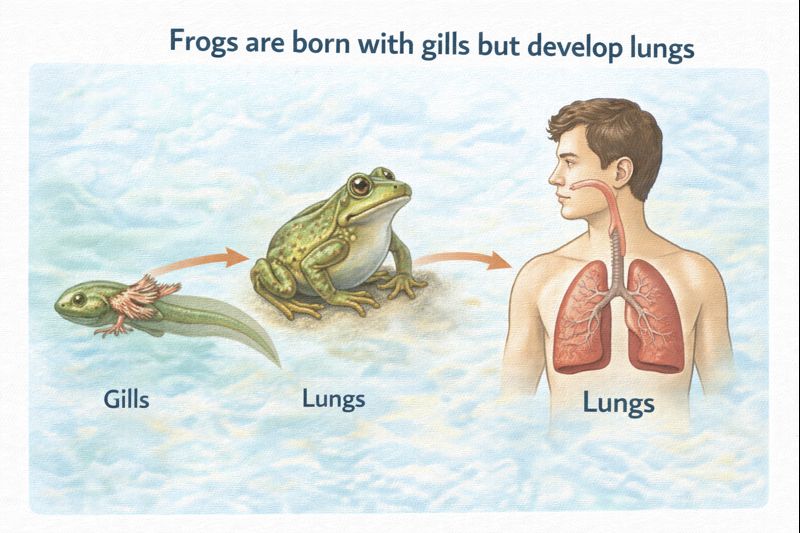
A key difference is that frogs are born with gills but develop lungs, whereas humans develop lungs in utero and are born with them.
Frogs are amphibians that undergo metamorphosis, a drastic developmental change from a larval form (tadpole) to an adult. Tadpoles are fully aquatic and respire primarily through gills, similar to fish. As metamorphosis proceeds, the gills are absorbed, and lungs develop. Adult frogs use lungs for breathing air but also employ cutaneous respiration (gas exchange through moist skin) and buccal pumping. Humans are mammals; our respiratory system develops entirely in utero. We are born with fully functional lungs and never possess gills at any post-embryonic stage. While human embryos have pharyngeal arches that are homologous to gill arches in fish, these structures develop into different anatomical features (e.g., jaw, ear bones), not functional gills.
A) Frogs breathe through pores in their skin.
While adult frogs perform significant cutaneous respiration through their skin, they do not have discrete "pores" for breathing. Their skin is thin, moist, and highly vascularized, allowing diffusion. This is a mode of respiration, but it is not the primary developmental difference highlighted in the question. Humans do not use cutaneous respiration.
B) Frogs are born with lungs but revert to gills.
This is biologically backwards. No vertebrate reverts from lungs to gills. Evolutionarily and developmentally, gills precede lungs. Frogs start life with gills and later develop lungs.
C) Frogs are born with gills but develop lungs.
This accurately describes the ontogenetic transition in frogs. Tadpoles hatch with gills. During metamorphosis, the gills degenerate as the lungs form and the animal prepares for a terrestrial life. This is a fundamental difference from humans, whose respiratory apparatus is fully developed for air-breathing at birth.
D) Frogs breathe exclusively through their gills.
This is false for adult frogs. Tadpoles breathe primarily through gills, but adults use a combination of lungs, skin, and the lining of the mouth. They do not have gills as adults.
Conclusion
The most striking difference lies in developmental pathway. Humans have a continuous, lung-based respiratory system from birth. Frogs have a biphasic life cycle with a radical shift in respiratory anatomy: they begin life as gill-breathing aquatic larvae and transform into lung-breathing (with cutaneous supplement) terrestrial adults.
Topic Flashcards
Click to FlipWhat is the term for the process where an animal undergoes a dramatic change in body structure as it develops, such as a tadpole transforming into a frog?
Metamorphosis. This includes the shift from gill-based to lung-based respiration in amphibians.
What are the two main respiratory structures used by an adult frog?
Lungs (for air) and its moist, vascularized skin (for cutaneous respiration). It does not have gills as an adult.
True or False: Both humans and frogs are born with fully developed, functional lungs.
False. Humans are born with functional lungs. Frogs (as tadpoles) are born with gills and develop lungs during metamorphosis.
How does a tadpole's primary method of breathing differ from its adult form?
A tadpole breathes underwater using gills. An adult frog breathes air using lungs and also exchanges gases through its skin.
What is the name of the pumping action frogs use to force air into their lungs, involving the floor of their mouth?
Buccal pumping. They lower the floor of the mouth to draw air in, then close nostrils and raise the floor to push air into the lungs.