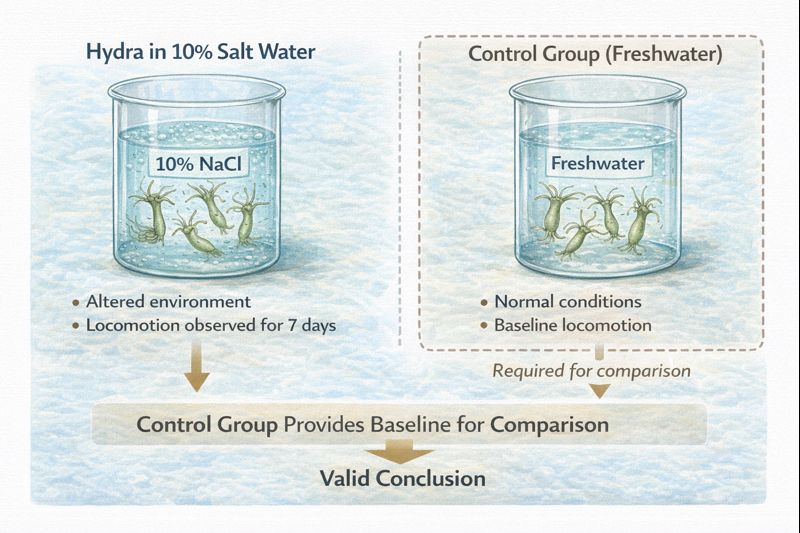
Students believed salt water would harm hydra locomotion. They placed 100 hydra in 10% salt water and observed for a week. What was missing?
-
A
Control
-
B
Hypothesis
-
C
Observation
-
D
Measurement
The experimental design was missing a control group.
A control group is essential for establishing a baseline for comparison and isolating the effect of the independent variable. In this experiment, the students tested the effect of 10% salt water (the independent variable) on hydra locomotion. They had a hypothesis (salt water harms locomotion), and they made observations/measurements. However, they only tested the experimental group (hydra in salt water). Without a parallel control group of hydra kept in their normal freshwater environment under otherwise identical conditions (same temperature, light, food, container type), they cannot attribute any changes in locomotion to the salt. The observed effects could be due to the salt, or they could be due to other factors like starvation, the stress of being transferred, natural lifecycle changes, or disease. The control group would experience all these same conditions except for the salt treatment, allowing the students to compare and determine the specific effect of salinity.
A) Control
This is the critical missing element. A proper experiment compares an experimental group (receives treatment) to a control group (does not receive treatment). The absence of a control group renders the experiment inconclusive.
B) Hypothesis
The students had a clear hypothesis: "salt water would harm hydra locomotion." This was stated at the beginning, so it was not missing.
C) Observation
The students performed observations by watching the hydra for a week. Observation was part of their method.
D) Measurement
While not explicitly stated, "observed locomotion" implies some form of qualitative or quantitative measurement (e.g., speed, contraction rate). The flaw is not the lack of measurement technique but the lack of a proper comparison group against which to interpret those measurements.
Conclusion
The scientific method requires controlled experimentation to draw valid conclusions. By testing only one condition, the students created a confounded experiment. Any result could have multiple explanations. Including a control group is non-negotiable for credible experimental design.
Topic Flashcards
Click to FlipTrue or False: Without a control group, an experiment cannot rule out the possibility that the observed results were caused by something other than the treatment.
True. This other factor is called a confounding variable. A control group helps isolate the effect of the independent variable.
In an experiment testing salt water's effect on hydra, what is the purpose of a control group kept in normal freshwater?
To provide a baseline for comparison. It ensures any changes in the experimental group are due to the salt, not other factors like handling stress or environment.
What is the independent variable in the hydra experiment described?
The presence or concentration of salt in the water. This is the factor the students intentionally changed.
What is a specific confounding variable that could affect the hydra if a control group is missing?
The stress of being transferred to a new container, which both groups would experience, but only the control group would show if the effect was due to transfer vs. salt.
If the students had included a control, what should be the only major difference between it and the experimental group?
The type of water (freshwater vs. 10% salt water). All other conditions (light, temperature, food, container) must be identical.