What happens during anabolic metabolism?
-
A
Energy is released.
-
B
Energy is absorbed.
-
C
Nutrients are recycled.
-
D
Substances are broken down.
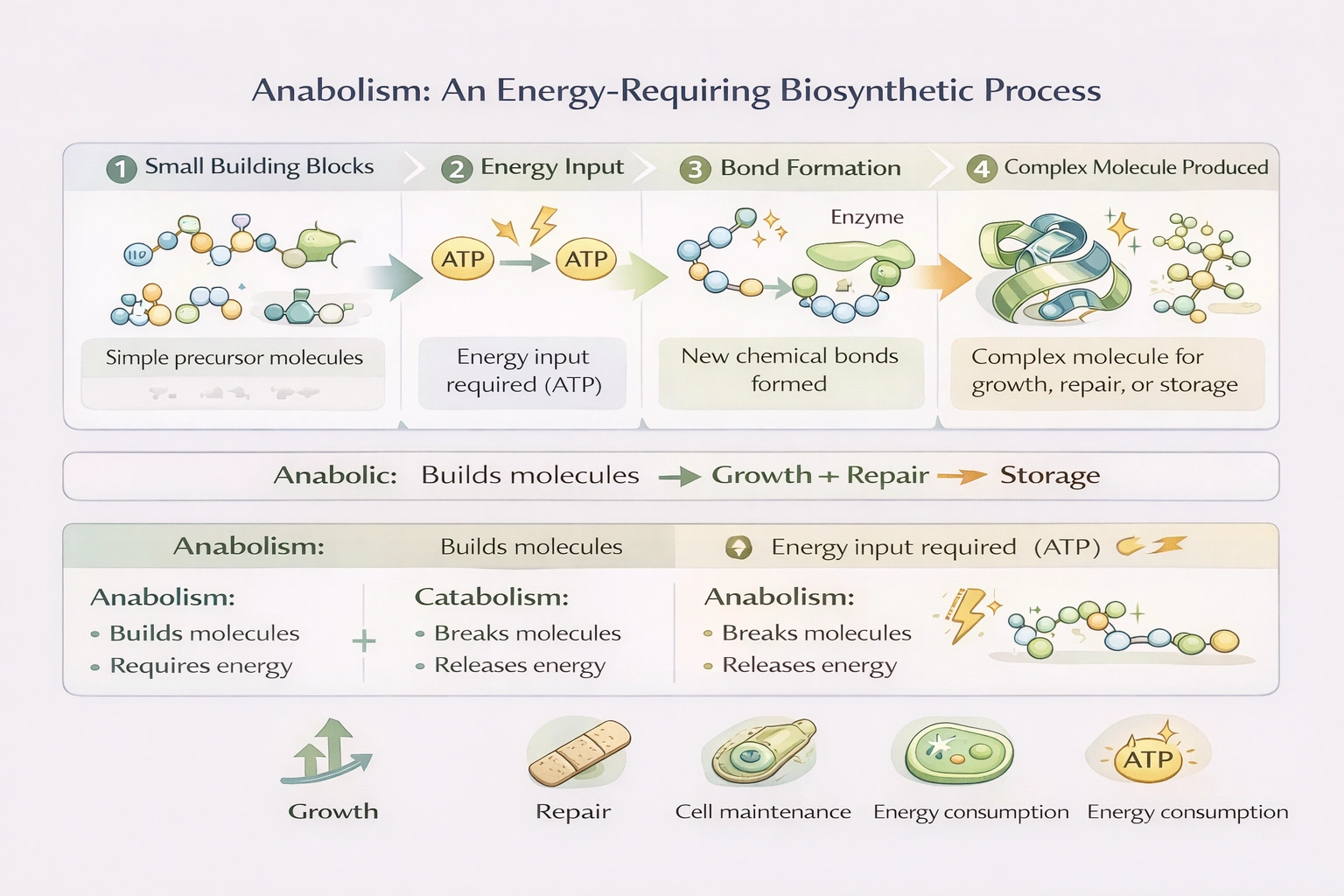
During anabolic metabolism, energy is absorbed or consumed.
Metabolism encompasses the totality of chemical reactions within an organism, divided into two opposing streams: catabolism and anabolism. Catabolic pathways break down complex molecules (like glucose or fats) into simpler ones, releasing energy that can be captured as ATP. Anabolic pathways, in contrast, are biosynthetic. They use energy, typically in the form of ATP, to construct complex molecules from simpler precursors. These endergonic reactions are fundamental to growth, repair, maintenance, and reproduction. Examples include the synthesis of proteins from amino acids, DNA from nucleotides, polysaccharides like glycogen from glucose monomers, and the construction of lipids from fatty acids and glycerol. The energy required to form new chemical bonds in these complex products is supplied by the hydrolysis of ATP or other high-energy molecules.
A) Energy is released.
Energy release is the defining characteristic of catabolic reactions, not anabolic ones. Processes like cellular respiration, glycolysis, and hydrolysis are exergonic, meaning they proceed with a net release of free energy. Stating that energy is released during anabolism reverses the fundamental thermodynamic principle that governs biosynthesis.
B) Energy is absorbed.
Anabolic reactions are endergonic, meaning they require an input of energy to proceed. This energy is used to drive thermodynamically unfavorable reactions—such as forming peptide bonds or polymerizing nucleotides—that increase molecular order and complexity. The energy currency ATP is hydrolyzed to ADP and inorganic phosphate, providing the necessary chemical drive. Photosynthesis is a prime example of a large-scale anabolic process where light energy is absorbed and converted into chemical energy stored in glucose.
C) Nutrients are recycled.
Nutrient recycling involves the breakdown of waste products or worn-out cellular components into their basic building blocks, which can then be reused. This process, such as autophagy where lysosomes digest organelles, is inherently catabolic in its initial breakdown phase. While the resulting monomers may later be used in anabolic synthesis, the act of recycling itself is a catabolic or salvaging process, not synonymous with anabolism.
D) Substances are broken down.
The breakdown of substances is the literal definition of catabolism. Digestion of food in the gut, glycogen breakdown (glycogenolysis), and protein degradation are all catabolic. Anabolism is the converse process: the building up of substances. Confusing these two terms represents a fundamental misunderstanding of metabolic direction.
Conclusion
The distinction between anabolism and catabolism is central to understanding bioenergetics. Catabolism is akin to demolition and energy harvesting, while anabolism is akin to construction and energy investment. During anabolic metabolism, the cell acts as a builder, assembling complex structures necessary for life. This construction work is not spontaneous; it requires a constant input of energy to overcome the thermodynamic costs of creating order from simpler, more disordered components. Therefore, the absorption or consumption of energy is the essential and defining event in any anabolic process.
Topic Flashcards
Click to FlipWhat happens during anabolic metabolism?
Energy is absorbed to build complex molecules.
What type of molecules are produced during anabolism?
Larger, more complex molecules.
What energy molecule commonly powers anabolic reactions?
ATP.
Give one example of an anabolic process.
Protein synthesis (amino acids → proteins)
How does anabolism differ from catabolism?
Anabolism builds molecules and requires energy; catabolism breaks molecules down and releases energy.