What is the most basic unit of structure in living things?
-
A
Cell
-
B
Organelle
-
C
Oxygen
-
D
Pigment
The cell is the most basic unit of structure in living things.
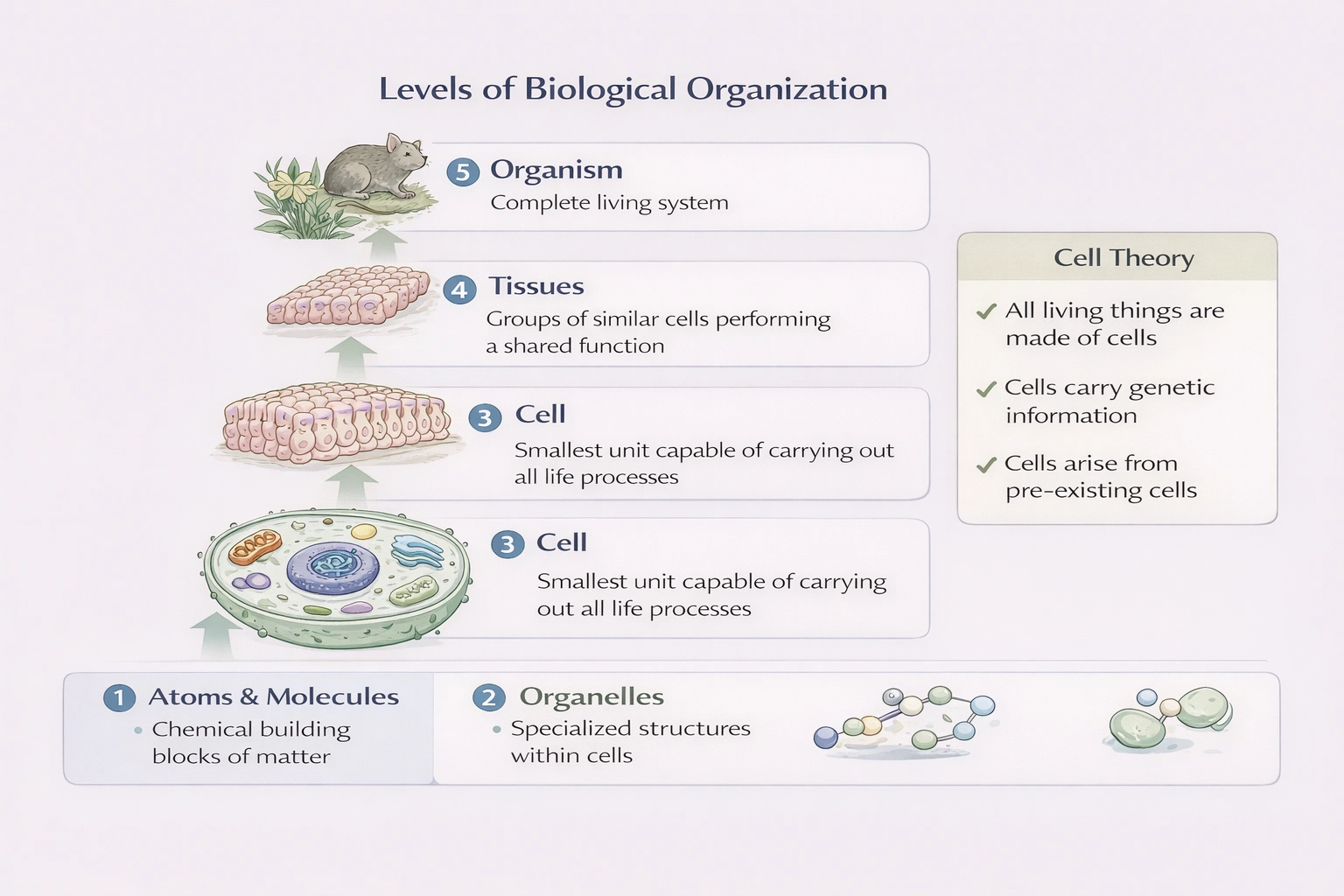
Biological organization follows a hierarchy, from atoms and molecules to organelles, cells, tissues, organs, and organisms. Among these, the cell represents the smallest entity that fulfills all the criteria necessary for life. This is formalized in the cell theory, which states that all living organisms are composed of one or more cells, the cell is the fundamental unit of structure and organization, and all cells arise from pre-existing cells. A cell is a self-contained, membrane-bound unit that can metabolize nutrients, generate energy, respond to its environment, grow, and reproduce. Unicellular organisms, like bacteria and protozoa, consist of a single cell that performs all life-sustaining activities. In multicellular organisms, such as plants and animals, cells are specialized but remain the foundational building blocks from which all higher-order structures are constructed.
A) Cell
The cell is the basic structural and functional unit of all known life. It contains the genetic material (DNA) that directs its activities, a plasma membrane that separates it from the environment, and cytoplasm where metabolic reactions occur. While cells contain smaller components, none of those components alone can independently carry out all life processes. The cell is the lowest level of organization that exhibits the properties of life in a unified, autonomous manner.
B) Organelle
Organelles are specialized, membrane-bound structures within eukaryotic cells that perform distinct functions, such as the nucleus (genetic control), mitochondria (energy production), and ribosomes (protein synthesis). However, organelles cannot exist or function independently outside of a cellular context. Prokaryotic cells, which are fully functional living organisms, lack most membrane-bound organelles. Therefore, organelles are subcellular components, not independent living units.
C) Oxygen
Oxygen is a chemical element and a diatomic molecule (O₂) that is vital for aerobic respiration in many organisms. It is an abiotic (non-living) participant in metabolic reactions. While essential for the survival of aerobic life, oxygen is not a structural component of organisms in the same way cells are. Many organisms, called anaerobes, live without oxygen. Oxygen is a resource or reactant, not a unit of biological structure.
D) Pigment
Pigments are molecules that absorb specific wavelengths of light. Examples include chlorophyll in plants (for photosynthesis) and melanin in animal skin (for protection and coloration). Pigments are biochemical compounds found within cells and organelles. They serve specialized functions but are not living entities themselves. A pile of pigment molecules lacks the organization, metabolism, and reproductive capacity that define life.
Conclusion
The quest for the "most basic unit" seeks the smallest entity that retains all the characteristics of life. Atoms and molecules form the chemical basis, but they are not alive. Organelles are sophisticated cellular machinery but are not autonomous. Resources like oxygen and compounds like pigments are materials used by living systems. The cell, however, represents the fundamental level at which the properties of life emerge. It is the simplest structure capable of independent existence, growth, and reproduction, making it the indisputable basic unit of biological structure and function.
Topic Flashcards
Click to FlipWhat is the most basic unit of structure in living things?
The cell.
Which scientific principle states that all living things are made of cells?
Cell theory.
Why is the cell considered the basic unit of life?
It is the smallest structure capable of carrying out all life processes.
Can a single cell function as a complete organism?
Yes, in unicellular organisms.
How are organelles related to cells?
Organelles are specialized structures within cells.