Why is glycolysis a catabolic pathway?
-
A
Electrons are transferred from one molecule to another.
-
B
Energy is released as glucose splits into pyruvate molecules.
-
C
Several different types of molecules are formed as products.
-
D
Different biomolecules used during this process are reduced.
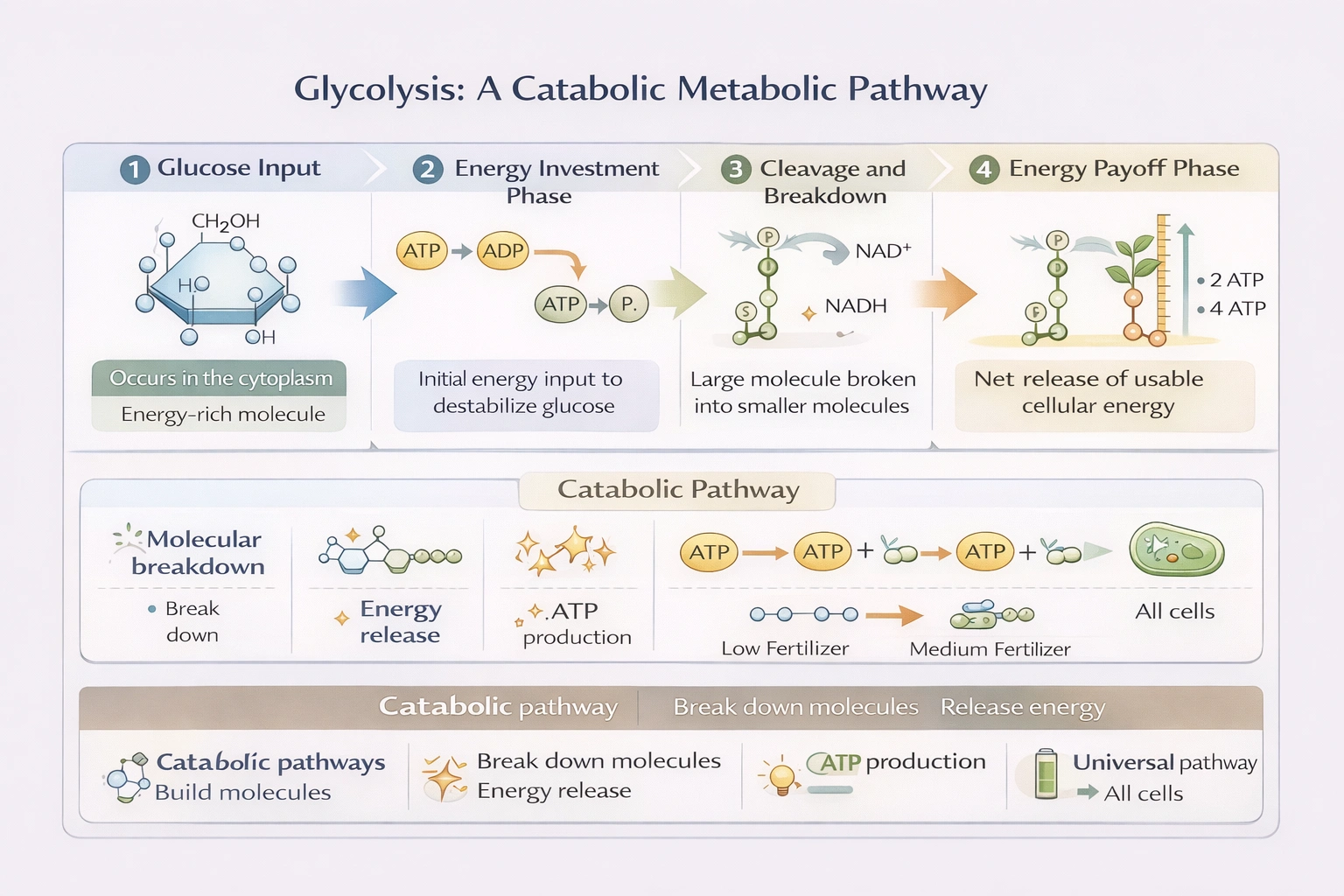
Glycolysis is a catabolic pathway because energy is released as the large glucose molecule is broken down into smaller pyruvate molecules.
Metabolism is divided into catabolism (breakdown pathways) and anabolism (buildup pathways). Catabolic reactions involve the degradation of complex organic molecules into simpler ones, a process that is typically exergonic, meaning it releases energy. Glycolysis is a universal ten-step pathway occurring in the cytoplasm that converts one six-carbon glucose molecule into two three-carbon pyruvate molecules. This breakdown process results in a net yield of energy for the cell, captured in the form of adenosine triphosphate (ATP) and reduced electron carriers (NADH). The investment of two ATP molecules in the early steps is offset by the production of four ATP molecules in the later steps, leading to a net gain of two ATP per glucose. This direct production of usable chemical energy through molecular breakdown is the hallmark of a catabolic pathway.
A) Electrons are transferred from one molecule to another.
Electron transfer through oxidation-reduction (redox) reactions is a common feature in many metabolic pathways, both catabolic and anabolic. In glycolysis, the coenzyme NAD+ is reduced to NADH, gaining electrons. However, the mere transfer of electrons does not define catabolism. Many biosynthetic (anabolic) reactions also involve reduction steps. The defining characteristic of catabolism is the breakdown of molecules with concomitant energy release, not just the occurrence of redox chemistry.
B) Energy is released as glucose splits into pyruvate molecules.
This is the core reason glycolysis is catabolic. The cleavage of the carbon-carbon bonds in glucose releases energy. Part of this energy is captured directly through substrate-level phosphorylation, where a phosphate group is transferred from a high-energy metabolic intermediate to ADP, forming ATP. The overall process transforms a single, energy-rich molecule (glucose) into smaller, lower-energy products (pyruvate), with a net output of chemical energy the cell can use.
C) Several different types of molecules are formed as products.
The production of multiple product types is not exclusive to catabolism. Anabolic pathways also generate a variety of molecules. Glycolysis produces intermediates like glyceraldehyde-3-phosphate and dihydroxyacetone phosphate, and end products like pyruvate, ATP, and NADH. While diverse products are formed, this diversity itself does not classify the pathway. A pathway could be complex and produce many intermediates but still be anabolic if it consumes net energy to build larger molecules.
D) Different biomolecules used during this process are reduced.
This statement is partially true but misleading. In glycolysis, NAD+ is reduced to NADH. However, for this reduction to occur, other molecules (specifically glyceraldehyde-3-phosphate) are oxidized. Furthermore, reduction events are not definitive of catabolism. As with electron transfer, reduction occurs in both directions of metabolism. The glucose molecule itself is oxidized overall during glycolysis, losing electrons to NAD+.
Conclusion
Pathways are classified based on their overall chemical transformation and energetic outcome. Anabolic pathways consume energy to synthesize complex molecules from simpler ones. Catabolic pathways, like glycolysis, harvest energy by breaking down complex molecules. The splitting of glucose into pyruvate, coupled with a net production of ATP, is a clear exergonic process. While glycolysis involves electron transfer, creates various intermediates, and includes reduction steps, its identity as a catabolic pathway is rooted in the fundamental action of disassembling a fuel molecule and releasing stored chemical energy for cellular use.
Topic Flashcards
Click to FlipWhy is glycolysis considered a catabolic pathway?
Because energy is released as glucose is broken down into pyruvate.
What happens to glucose during glycolysis?
It is split into two pyruvate molecules.
What form of usable energy is produced during glycolysis?
ATP.
What is the net ATP gain from glycolysis per glucose molecule?
2 ATP
How does catabolism differ from anabolism?
Catabolism breaks down molecules and releases energy; anabolism builds molecules and requires energy.