Five tropical plants are kept at varying humidity levels in a greenhouse for three months. One plant is left outside in normal conditions. Plant height is measured weekly. What is the control of the experiment?
-
A
Plant height for each tropical plant
-
B
The plant left outside in normal conditions
-
C
Humidity level readings in the greenhouse
-
D
Amount of time used to study plant height
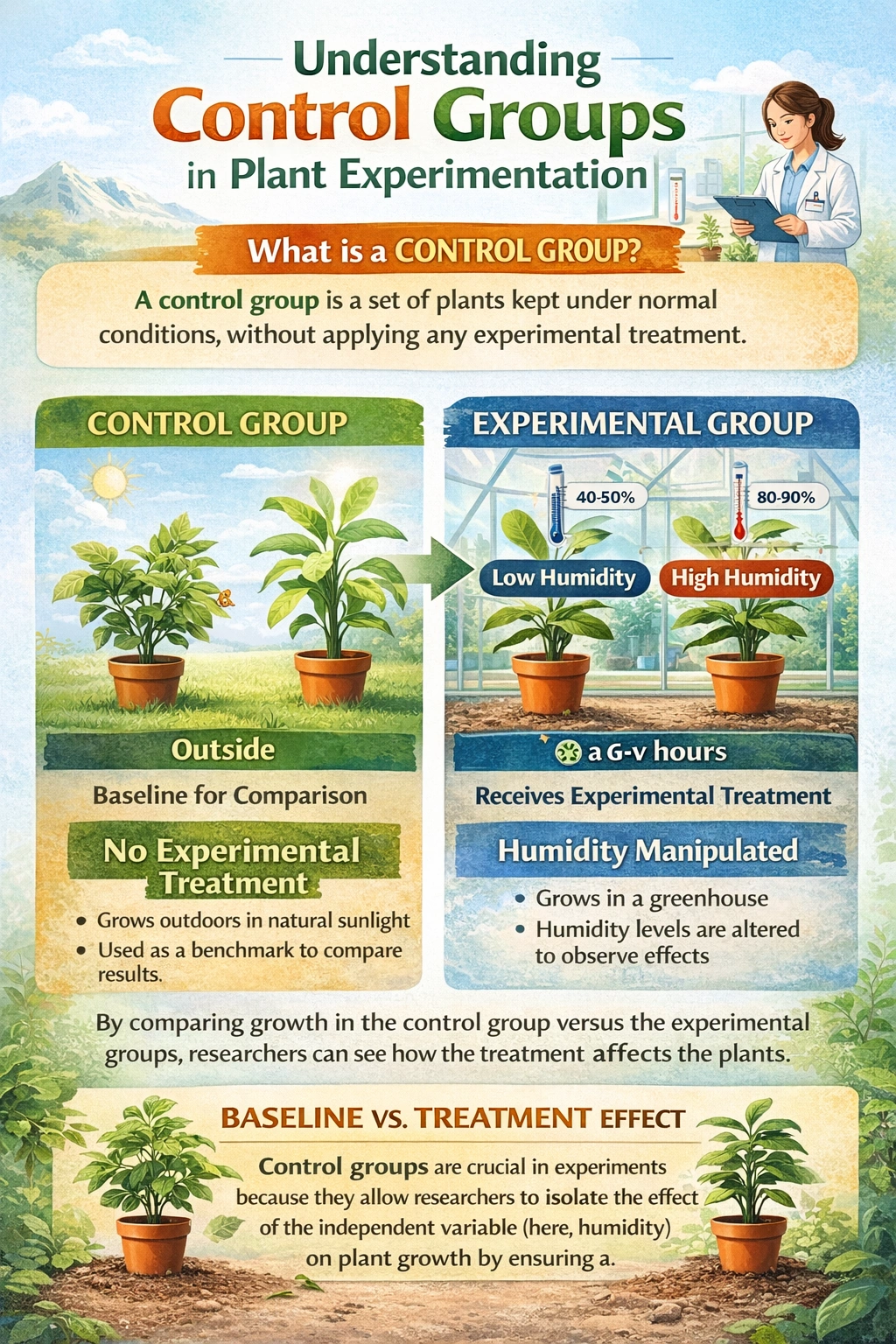
The control of the experiment is the plant left outside in normal conditions.
A control in an experiment is a group or subject that does not receive the experimental treatment. It is maintained under standard or normal conditions to serve as a baseline for comparison. This allows researchers to determine if changes in the experimental group are due to the treatment or to other external factors.
A) Plant height for each tropical plant
Plant height is the data being collected; it is the dependent variable. Measuring height is the act of recording the outcome, not a control group. The control is a specific subject or set of subjects that provide a reference point, not the measurement itself. All plants, both experimental and control, have their height measured, so this option describes the measured outcome, not the baseline condition.
B) The plant left outside in normal conditions
This plant is not exposed to the manipulated independent variable, which is varying humidity levels in the greenhouse. By being kept in "normal" conditions, it represents the standard state against which the growth of the experimental plants can be compared. Any significant difference in growth between the greenhouse plants and this outdoor plant can more reliably be attributed to the differing humidity levels, as other factors (like light, soil) are presumably similar or accounted for. This fulfills the essential role of a control.
C) Humidity level readings in the greenhouse
These readings represent the measurement and manipulation of the independent variable—the different humidity levels being tested. The control is defined by the absence of this deliberate experimental manipulation. Monitoring humidity is part of applying the treatment to the experimental group, not establishing a baseline without the treatment.
D) Amount of time used to study plant height
The three-month period is a constant or fixed variable in the experiment. Holding time constant ensures that all plants are observed for the same duration, preventing time from being a confounding variable. While crucial for a fair test, a controlled variable is not synonymous with the control group. The control group is a specific subject, whereas time is a parameter of the experimental design applied to all subjects.
Conclusion:
The control group provides a benchmark by experiencing all conditions except the one being tested. The plant outside experiences normal humidity, unlike the plants inside the greenhouse with varied humidity. Plant height is the measured outcome, humidity readings quantify the independent variable, and time is a controlled constant. Therefore, the plant left outside in normal conditions is the correct control.

Topic Flashcards
Click to FlipIn an experiment, what is the purpose of a control group?
To provide a baseline for comparison. It is not exposed to the experimental treatment, allowing researchers to see if changes in the experimental group are truly due to the treatment.
In the plant and humidity experiment, which subject serves as the control group and why?
The plant left outside in normal conditions. It is not exposed to the manipulated variable (varying greenhouse humidity), so its growth serves as the baseline.
What is the independent variable (the factor being tested) in this plant experiment?
The humidity level. This is what the researcher is deliberately changing for the plants inside the greenhouse.
What is the dependent variable (the measured outcome) in this experiment?
Plant height. This is the data collected weekly to see if it is affected by changes in humidity.
Why isn't the "amount of time" considered the control group?
Time is a controlled constant—it is kept the same for all plants. A control group must be a subject (like a plant) that is not treated.