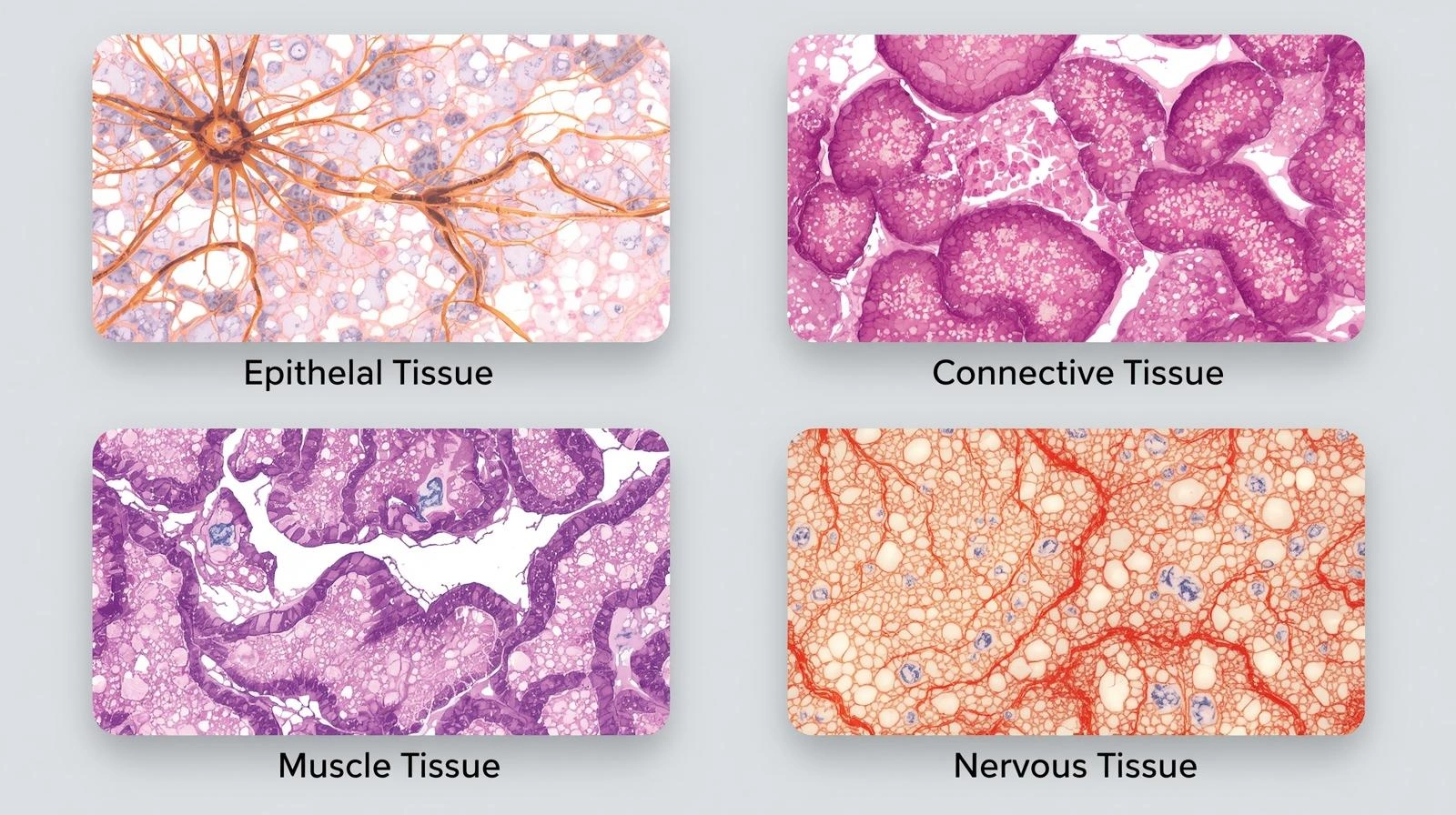
Histology is the study of_____ .
-
A
blood
-
B
cells and tissues
-
C
the heart
-
D
symptoms
Histology is fundamentally defined as the microscopic study of the structural and functional organization of cells and tissues within biological organisms.
Often referred to as microscopic anatomy, this field examines the intricate architecture of biological specimens at the cellular and tissue levels, utilizing specialized techniques such as light microscopy, electron microscopy, and various staining protocols including hematoxylin and eosin (H&E), immunohistochemistry, and special stains.
A) Blood
Blood corresponds specifically to the field of hematology rather than general histology. While hematology does examine blood cells (erythrocytes, leukocytes, and platelets) and their precursors in bone marrow, and while histological techniques such as peripheral blood smears and bone marrow biopsies utilize histological staining methods, hematology constitutes a specialized subset focused exclusively on the formed elements of blood and blood-forming tissues. Histology, by contrast, encompasses the comprehensive study of all tissue systems throughout the organism, including solid organs, epithelial linings, and connective tissue matrices, not merely the liquid connective tissue that is blood. The distinction lies in scope: hematology restricts itself to blood physiology, pathophysiology, and cellular components suspended in plasma, whereas histology investigates the fixed cellular arrangements and tissue architectures that constitute the structural fabric of all organs and organ systems.
B) Cells and tissues
Option B represents the precise and comprehensive definition of histology. This option correctly identifies the dual focus of the discipline: the cellular level (cytology) and the tissue level (histology proper), encompassing the study of how cells aggregate to form tissues and how tissues organize to form organs. The field examines both the microscopic appearance and the functional implications of tissue architecture, recognizing that biological function is inextricably linked to structural organization at the histological level.
C) The heart
The Heart falls under the domain of cardiology (the study of heart function and disease) and cardiac anatomy (the study of heart structure). While histological techniques are indeed employed to examine cardiac tissue sections—revealing the striated cardiac muscle fibers, intercalated discs, and specialized conducting tissues—the study of the heart as an organ is not synonymous with histology. Rather, histology represents one methodological approach used within cardiology to understand myocardial structure, just as it is used in hepatology, nephrology, and other specialties. The heart is merely one of many organs whose tissues may be examined histologically; defining histology as the study of the heart would erroneously limit a broad, fundamental biological discipline to the scope of a single organ system.
D) Symptoms
Symptom properly belongs to the fields of clinical medicine, symptomatology, or semiotics—the study of subjective and objective indicators of disease experienced by patients. Histology is fundamentally a morphological science concerned with the physical structure and microscopic appearance of normal tissues, whereas symptoms represent clinical manifestations of disease processes. While histopathology (the study of diseased tissues) may correlate tissue changes with clinical symptoms, histology itself is descriptive and anatomical rather than clinical. The discipline focuses on tissue preparation, sectioning, staining, and microscopic interpretation of structural features, not the evaluation of patient complaints, physical signs, or disease presentations. This distinction separates the laboratory-based morphological sciences from the patient-centered clinical diagnostic process.
Conclusion:
Histology is definitively and exclusively the study of cells and tissues (Option B), serving as the foundational biomedical science that examines the microscopic architectural organization of biological structures.

Topic Flashcards
Click to FlipWhat are the four basic types of tissues studied in histology?
Epithelial, Connective, Muscle, and Nervous tissue
What is the name of the special dye most commonly used to stain tissue samples for histological examination?
Hematoxylin and Eosin (H&E stain).
What instrument is essential for viewing histological specimens?
A microscope (usually a light or compound microscope).
What is the name of the field of study focused specifically on cells, which is a closely related but distinct discipline from histology?
Cytology.
What is the term for the preparation process where tissue is embedded in a solid medium (like paraffin) to be sliced into thin sections?
Embedding or tissue processing.