How do red blood cells carry oxygen?
-
A
They dissolve it in plasma.
-
B
They break it down from CO₂.
-
C
O₂ molecules replace cell nuclei.
-
D
Hemoglobin bonds with O₂ molecules.
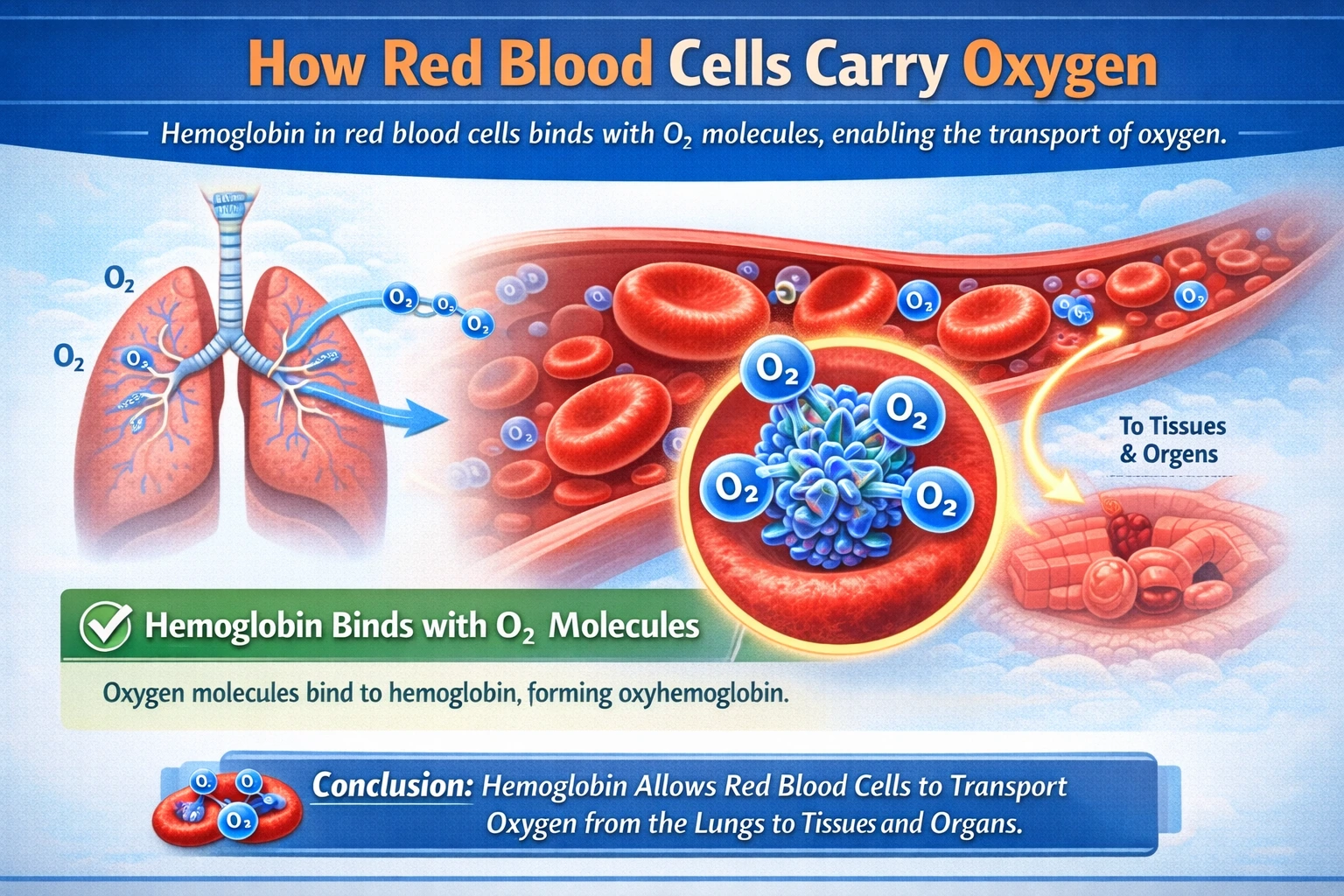
Red blood cells carry oxygen because hemoglobin bonds with O₂ molecules.
Hemoglobin is a protein found in red blood cells that binds to oxygen in the lungs and transports it through the bloodstream to tissues and organs. The bond between hemoglobin and oxygen allows red blood cells to effectively carry oxygen throughout the body.
A. They dissolve it in plasma.
Oxygen does not dissolve effectively in plasma on its own. While a small amount of oxygen is dissolved in the plasma, the majority of oxygen is carried by hemoglobin within red blood cells. Therefore, oxygen is not carried by dissolving in plasma to any significant degree.
B. They break it down from CO₂.
Oxygen is not broken down from carbon dioxide (CO₂). In fact, carbon dioxide is a byproduct of cellular respiration and is transported back to the lungs by the blood. The transport of oxygen and carbon dioxide are separate processes: oxygen is carried by hemoglobin, while carbon dioxide is carried by plasma and bicarbonate ions.
C. O₂ molecules replace cell nuclei.
This is not correct. The O₂ molecules do not replace cell nuclei. Red blood cells do not contain a nucleus at maturity; they lose their nucleus during development to make more room for hemoglobin, which is essential for oxygen transport. Oxygen binds to hemoglobin, not to the cell nucleus.
D. Hemoglobin bonds with O₂ molecules.
This is the correct answer. Hemoglobin in red blood cells binds with oxygen molecules in the lungs, forming oxyhemoglobin. This allows the red blood cells to carry oxygen from the lungs to various tissues and organs throughout the body.
Conclusion:
Red blood cells carry oxygen through the bond between hemoglobin and oxygen molecules. Other options, like dissolving oxygen in plasma or breaking it down from CO₂, do not accurately describe how oxygen is transported in the bloodstream. Hemoglobin's binding with O₂ is the key process.

Topic Flashcards
Click to FlipWhat protein in red blood cells helps carry oxygen?
Hemoglobin
Do red blood cells have a nucleus to carry oxygen?
No, red blood cells lose their nucleus to make space for hemoglobin.
What process involves red blood cells transporting carbon dioxide back to the lungs?
Cellular respiration, with carbon dioxide transported by plasma and bicarbonate ions.
Why do mature red blood cells not need a nucleus for oxygen transport?
The nucleus is ejected during maturation → more space for hemoglobin, which allows RBCs to carry much more oxygen.
What happens to oxygen when blood reaches body tissues?
Oxygen is released from hemoglobin because tissue oxygen pressure is low → hemoglobin changes shape and lets go of O₂ for cells to use.