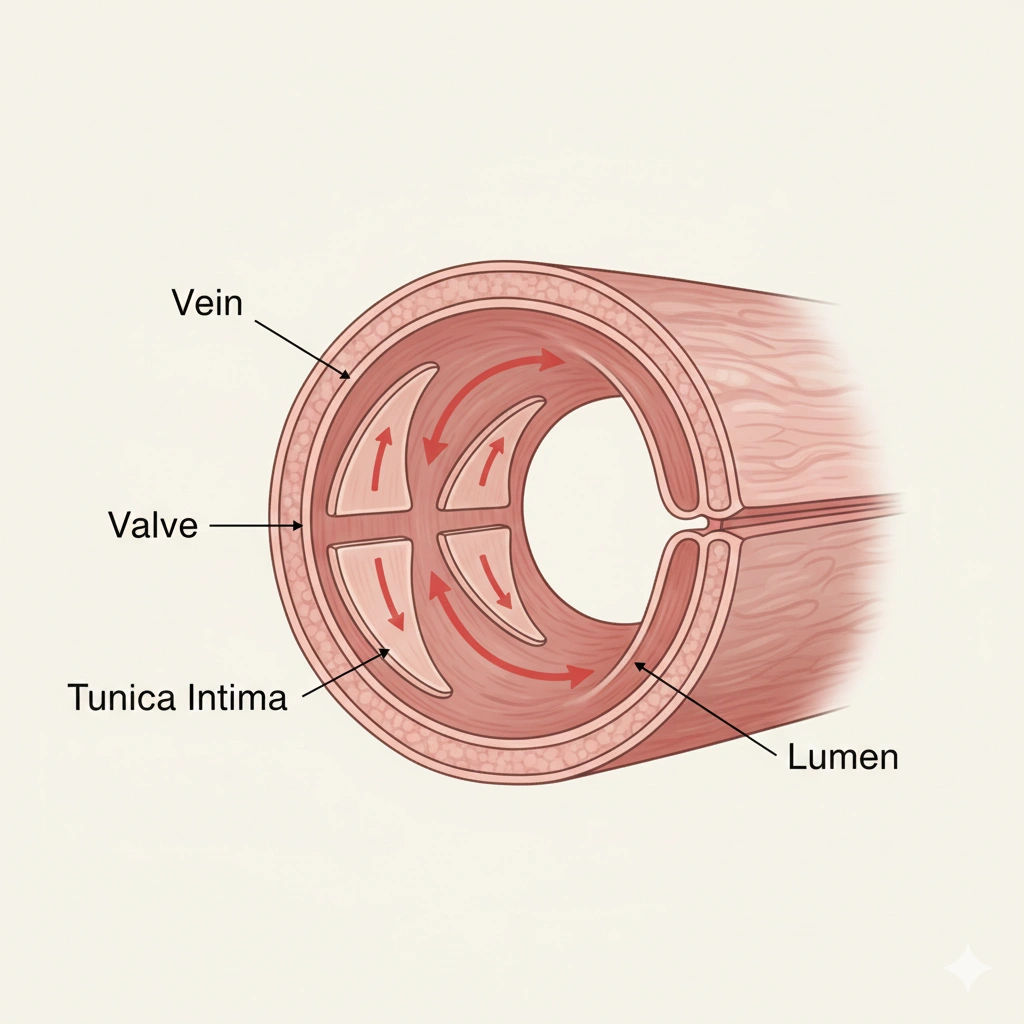
What is the purpose of valves in veins?
-
A
To filter impurities
-
B
To synchronize flow
-
C
To separate veins from arteries
-
D
To prevent reverse flow
The purpose of valves in veins is to prevent reverse flow.
Veins carry blood back to the heart, often against gravity, especially in the lower body. The valves in veins prevent blood from flowing backward, ensuring that it moves in one direction—toward the heart. This mechanism is crucial in maintaining proper circulation and preventing blood from pooling in the veins.
A. To filter impurities
Valves in veins do not filter impurities. The primary function of veins is to transport blood back to the heart, while the filtration of impurities is carried out by other organs, such as the kidneys and liver. Therefore, valves are not involved in filtering impurities in the blood.
B. To synchronize flow
Valves in veins do not synchronize the flow of blood. The main purpose of the valves is to prevent backflow and ensure unidirectional blood flow. Blood flow synchronization, especially in the heart, is managed by the heart's pacemaker and conduction system, not by veins or their valves.
C. To separate veins from arteries
Valves in veins do not serve to separate veins from arteries. Veins and arteries are distinct blood vessels with different functions, but the valves are specific to veins and are designed to prevent blood from flowing backward, not to separate veins from arteries.
D. To prevent reverse flow
This is the correct answer. The primary function of valves in veins is to prevent blood from flowing backward. As blood moves toward the heart, especially in the legs and arms, the valves open to allow blood to pass through and close to prevent any backflow, ensuring that blood continues to flow in the right direction.
Conclusion:
Valves in veins are essential for preventing reverse flow, which helps maintain efficient circulation and ensures that blood moves towards the heart without backtracking. Other options, such as filtering impurities or synchronizing blood flow, are not functions of the valves in veins.

Topic Flashcards
Click to FlipWhat is the main function of valves in veins?
Prevent reverse (backward) flow of blood. They open toward the heart and close to stop blood from flowing back downhill due to gravity.
Why do veins need valves while most arteries do not?
Veins have low pressure and rely on skeletal muscle pumps; valves prevent backflow and pooling, ensuring unidirectional return to the heart.
In which blood vessels are one-way valves primarily found to aid circulation?
Veins — especially in the legs and arms, where valves close when blood tries to flow away from the heart, maintaining forward movement.
What happens if vein valves fail to function properly?
Blood can flow backward, leading to pooling, varicose veins, swelling, or chronic venous insufficiency due to impaired return to the heart.
How do vein valves work with the skeletal muscle pump?
Muscle contractions squeeze veins and push blood forward; valves open ahead of the flow and snap shut behind it to block reverse movement.