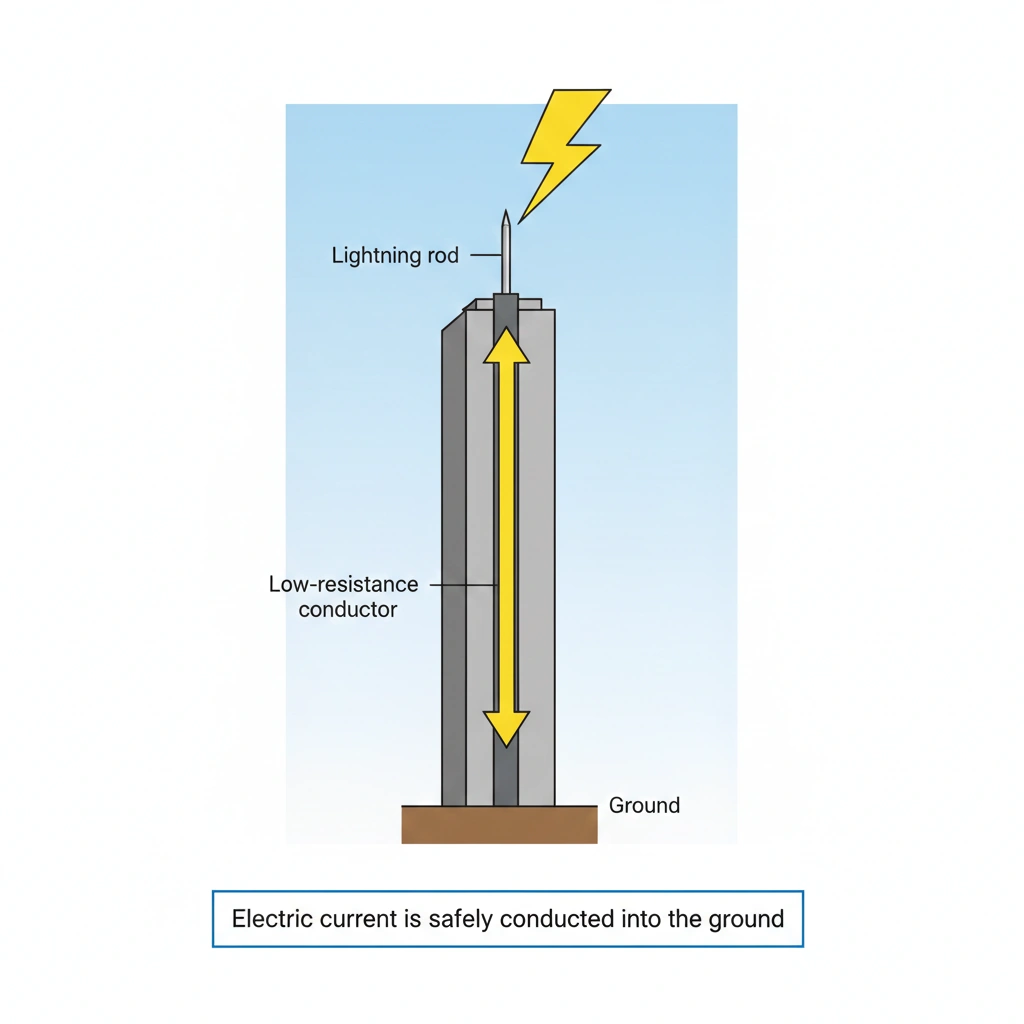
How does a lightning rod work?
-
A
Discharges clouds
-
B
Dissipates heat
-
C
Conducts current safely to ground
-
D
Attracts lightning away
A lightning rod works by conducting electric current safely to the ground.
Lightning rods are designed to protect structures by providing a low-resistance path for electric current. When lightning strikes, the rod directs the enormous electrical charge through a conductor and into the Earth, preventing the current from passing through the building itself and reducing the risk of fire or structural damage.
A) Discharges clouds
Lightning rods do not discharge clouds or prevent lightning from forming. They have no direct interaction with storm clouds and cannot remove electrical charge from them.
B) Dissipates heat
Although some heat is produced during a lightning strike, dissipating heat is not the primary function of a lightning rod. Its main role is to safely transfer electrical charge, not to cool the structure.
C) Conducts current safely to ground
A lightning rod is connected to a grounding system using conductive materials such as copper or aluminum. This creates a direct, low-resistance pathway that allows the electrical current from a lightning strike to flow into the Earth, protecting the structure from damage.
D) Attracts lightning away
While a lightning rod may increase the likelihood that lightning strikes the rod instead of other parts of the structure, attraction is not its primary purpose. Its essential function is safely conducting the current once a strike occurs.
Conclusion
The key purpose of a lightning rod is to provide a safe path for lightning current to travel into the ground, protecting buildings and people from electrical damage.
Topic Flashcards
Click to FlipWhat is the primary function of a lightning rod and its grounding system?
To provide a low-resistance, conductive path that safely directs the enormous electric current from a lightning strike into the ground, thereby protecting the structure.
Describe the key components of a lightning protection system.
1) Air Terminals (the rods or points), 2) Conductors (heavy cables that carry the current down), and 3) Grounding Electrodes (rods or plates buried deep in the earth to dissipate the charge).
Does a lightning rod "attract" lightning? Explain the nuance.
Not in an active sense. It does not reach up to the clouds. However, by being the highest, best-grounded point, it can provide a preferred, easier path for a lightning strike that was already going to occur in the vicinity, thereby "intercepting" it.
What critical principle of electricity explains why the current chooses the lightning rod's path over the building's materials?
Current seeks the path of least resistance. The metal rod and cable offer much lower electrical resistance than wood, brick, or other building materials, so the massive current flows through the designed path instead.
Why is it crucial for the grounding system to have a very low resistance and be buried in moist earth?
To dissipate the huge electrical energy safely and quickly into the earth. Moist soil has better conductivity than dry soil, ensuring the charge spreads out effectively without creating dangerous high-voltage "ground potential rise" near the structure.