Why does light refract entering glass?
-
A
Intensity greater
-
B
Frequency higher
-
C
Speed slower
-
D
Energy greater
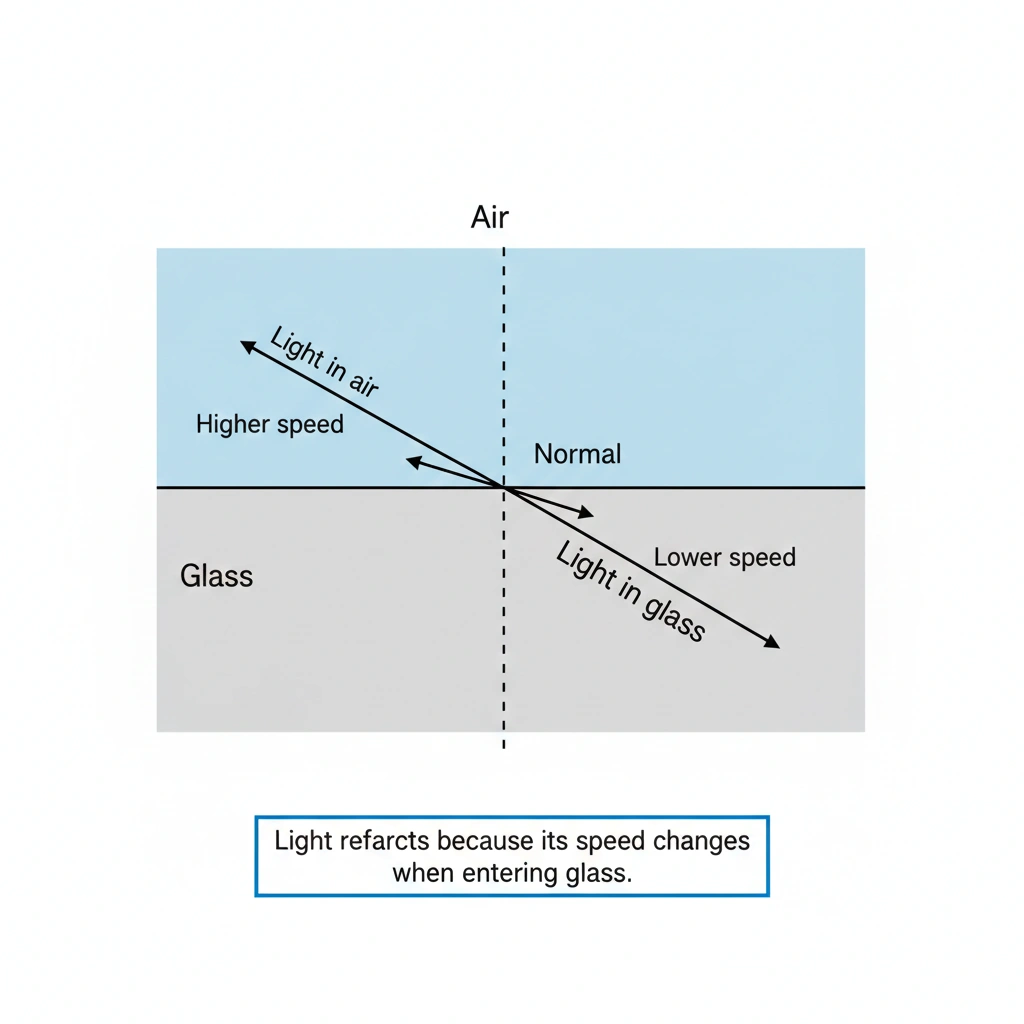
Light refracts when entering glass because it travels more slowly in glass than in air.
Refraction occurs when light changes direction as it passes from one medium into another with a different optical density. This change in direction is caused by a change in the speed of light. Glass has a higher refractive index than air, meaning light travels more slowly in glass, which causes the light rays to bend at the boundary between the two media.
A) Intensity greater
Intensity refers to the brightness of light. While some light may be reflected or absorbed at the surface of the glass, changes in intensity do not cause refraction. Refraction depends on changes in speed, not brightness.
B) Frequency higher
The frequency of light remains constant when it passes from one medium to another. Because frequency determines color, the color of the light does not change during refraction. Only the wavelength and speed change.
C) Speed slower
When light enters glass from air, its speed decreases because glass is optically denser. This reduction in speed causes the wavelength to shorten and the direction of the wavefronts to change, producing refraction as described by Snell’s law.
D) Energy greater
The energy of a photon depends on its frequency, which remains unchanged when light crosses a boundary between media. Therefore, the energy of the light does not increase and does not explain refraction.
Conclusion
Refraction occurs because light changes speed when moving between different media. Since light travels more slowly in glass than in air, its path bends, producing the observed refraction.
Topic Flashcards
Click to FlipWhat is the fundamental cause of light refraction when it enters a medium like glass from air?
A change in its speed. Light slows down in an optically denser medium like glass.
When light refracts entering glass, which of these properties remains constant: Speed, Frequency, Wavelength, or Energy?
Frequency (and therefore the photon's energy and color).
According to Snell's Law, what two properties determine the angle at which light refracts at a boundary?
The indices of refraction of the two media (n1 and n2), which are a measure of how much the speed of light is reduced in that material.
If light slows down upon entering a new medium, does it bend toward or away from the normal line (the perpendicular)?
It bends toward the normal. (e.g., air to glass, water, etc.).
When light enters glass, its speed decreases. What happens to its wavelength inside the glass?
Its wavelength decreases (shortens) proportionally to the decrease in speed, since frequency is fixed.