100% 4 Rated
Attempts 127

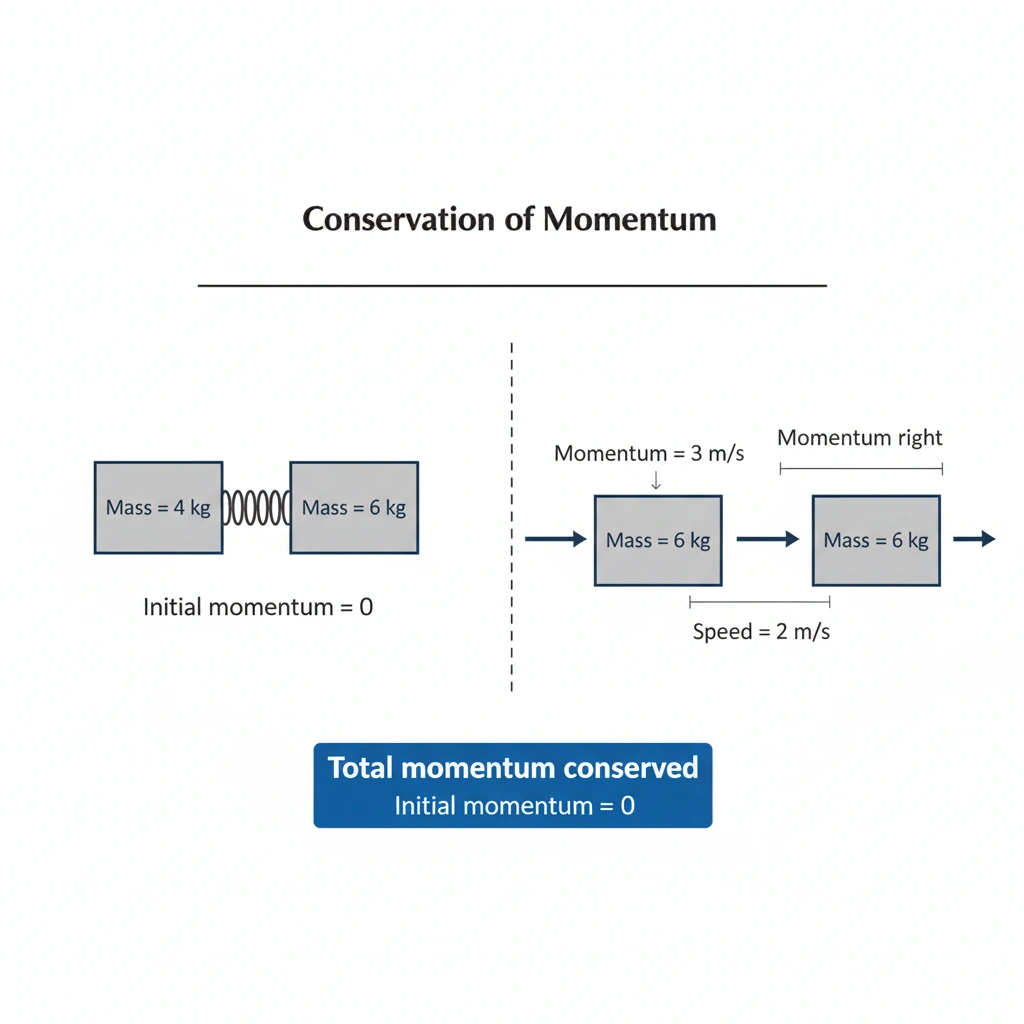
Two blocks on frictionless surface forced apart by spring. 4 kg moves left at 3 m/s; 6 kg moves right. Find 6 kg speed.

  1. A
    2 m/s
  2. B
    3 m/s
  3. C
    4 m/s
  4. D
    6 m/s

Topic Flashcards

Click to Flip
Question

What fundamental physics principle allows you to solve this problem, and what are the conditions required for it to apply?

Answer

The Law of Conservation of Momentum. It applies when the net external force on a system is zero. Here, the frictionless surface and the internal spring force mean no external horizontal forces act on the two-block system.

Question

Write the momentum conservation equation for this specific scenario, defining your sign convention.

Answer

Let right be positive. Initial momentum = 0 (both blocks at rest). Final momentum: (m₁ * v₁) + (m₂ * v₂) = 0. So, (4 kg * (-3 m/s)) + (6 kg * v₂) = 0.

Question

Solve the equation from the previous flashcard for the velocity (v₂) of the 6 kg block.

Answer

(4 * -3) + (6 * v₂) = 0 → -12 + 6v₂ = 0 → 6v₂ = 12 → v₂ = 2 m/s (positive, so moving right).

Question

In this spring-block system, is kinetic energy conserved? Why or why not?

Answer

No. The spring's stored elastic potential energy is converted into the kinetic energy of the blocks. The total energy (elastic potential + kinetic) is conserved, but kinetic energy alone is not. You can calculate the spring's initial energy from the final KE of both blocks.

Question

Calculate the total kinetic energy of the system after the blocks are pushed apart

Answer

KE_total = KE₄kg + KE₆kg = (½ * 4 kg * (3 m/s)²) + (½ * 6 kg * (2 m/s)²) = (0.5*4*9) + (0.5*6*4) = 18 J + 12 J = 30 J. This was the elastic potential energy stored in the spring.

Mini Quiz

1 / 3
If the surface had friction, could you still solve for the 6 kg block's speed using only conservation of momentum?
Available Test Sets
Available FREE Test Sets