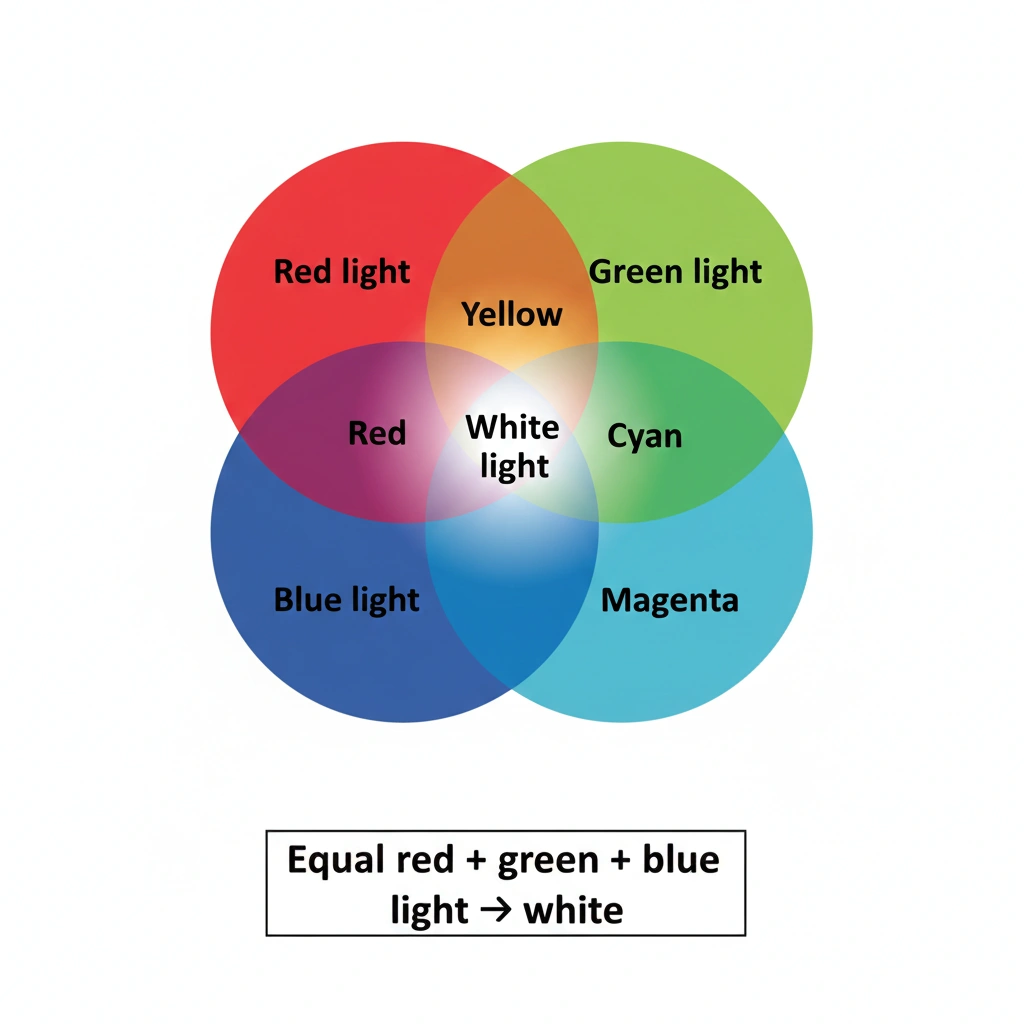
Mixing red, blue, green light equally produces _______.
-
A
Cyan
-
B
White
-
C
Magenta
-
D
Black
Mixing red, blue, and green light equally produces white light.
Light follows the rules of additive color mixing, where colors are created by combining different wavelengths of light. The three primary colors of light are red, green, and blue. When all three are mixed in equal intensities, the result is white light.
A) Cyan
Cyan is produced by mixing green and blue light only. Since red light is also present in this scenario, the result is not cyan.
B) White
When red, green, and blue light are combined equally, all wavelengths of visible light are effectively present. This balanced combination is perceived by the human eye as white light.
C) Magenta
Magenta is formed by mixing red and blue light. Adding green light changes the result to white rather than magenta.
D) Black
Black corresponds to the absence of light. Mixing lights adds brightness rather than removing it, so black cannot be produced by combining light sources.
Conclusion
In additive color mixing, equal amounts of red, green, and blue light combine to produce white light.
Topic Flashcards
Click to FlipIn the additive color model (used for light), what are the three primary colors that can be combined to create white and a broad spectrum of other colors?
Red, Green, and Blue (RGB).
What are the three secondary colors of light created by mixing two primary colors of light equally? Name the pairs.
Cyan (Green + Blue), Magenta (Red + Blue), and Yellow (Red + Green).
What is the fundamental difference between additive color mixing (for light) and subtractive color mixing (for pigments/inks)?
Additive mixing combines wavelengths of light (adding colors creates white). Subtractive mixing absorbs (subtracts) wavelengths (combining all colors theoretically creates black).
In additive color systems like TV and computer screens, how is the color white produced on the display?
By illuminating the red, green, and blue sub-pixels at their full, equal intensity simultaneously.
What color of light do you get if you mix red and green light equally? How does this relate to the concept of white light?
You get Yellow. Yellow light, when combined with the remaining primary (blue light), completes the set to produce white.