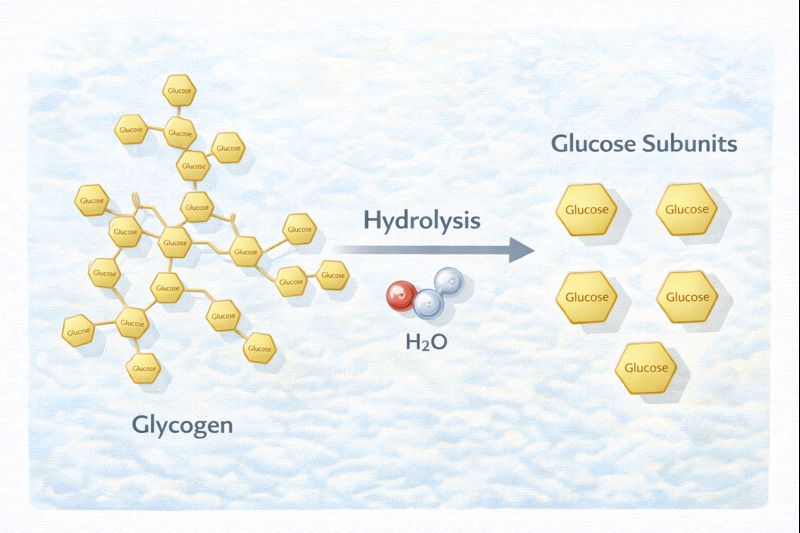
What is the term for the breakdown of glycogen into glucose subunits?
-
A
Hydrolysis
-
B
Reduction
-
C
Metabolism
-
D
Transpiration
The breakdown of glycogen into glucose subunits is accomplished through hydrolysis.
Glycogen is a large, branched polymer of glucose monomers linked by α-1,4 glycosidic bonds with α-1,6 linkages at branch points. To mobilize stored glucose, the body uses enzymes to cleave these bonds. The primary enzyme, glycogen phosphorylase, catalyzes the phosphorolytic cleavage of α-1,4 linkages, releasing glucose-1-phosphate without using a water molecule. However, the debranching enzyme system includes a transferase and α-1,6-glucosidase. The α-1,6-glucosidase enzyme does use a water molecule to hydrolyze the α-1,6 linkage at branch points, releasing free glucose. The overarching chemical concept for breaking down polymers by adding water is hydrolysis. While phosphorylysis is specific to glycogen and starch breakdown, the general term for the cleavage of glycosidic bonds by addition of water is hydrolysis.
A) Hydrolysis
Hydrolysis is a chemical reaction where a molecule is split into two parts by the addition of a water molecule. This process is fundamental to the digestion of all macromolecules: proteins are hydrolyzed by proteases, fats by lipases, and carbohydrates by glycosidases. The breakdown of glycogen, whether by phosphorylase (which uses phosphate) or debranching enzyme (which uses water), falls under the broader category of hydrolytic cleavage of glycosidic bonds.
B) Reduction
Reduction refers to a chemical reaction where a molecule gains electrons or hydrogen atoms. While the metabolism of glucose involves reduction and oxidation (redox) reactions, the initial step of breaking glycogen into glucose monomers is not a reduction. It is a cleavage reaction that breaks bonds, not one that changes the oxidation state of the carbons.
C) Metabolism
Metabolism is the entire set of life-sustaining chemical reactions in an organism, encompassing both catabolism (breakdown) and anabolism (synthesis). It is far too broad a term to describe the specific process of glycogen breakdown. Glycogenolysis is a specific metabolic pathway, but the question asks for the term for the breakdown action, not the name of the pathway.
D) Transpiration
Transpiration is the process of water movement through a plant and its evaporation from aerial parts, such as leaves, stems, and flowers. It is part of the water cycle and plant physiology, completely unrelated to carbohydrate digestion in animals.
Conclusion
The digestion of complex carbohydrates involves breaking glycosidic bonds. The general biochemical term for bond cleavage by addition of water is hydrolysis. While specific enzymes may use slightly different mechanisms (like phosphorylysis), the overarching principle for converting polymers like glycogen, starch, or disaccharides into their monomeric units is hydrolysis.
Topic Flashcards
Click to FlipWhat is the general term for a chemical reaction that splits a polymer into monomers by adding a water molecule?
Hydrolysis. This applies to breaking down proteins, fats, and carbohydrates like glycogen.
What are the two main enzymes involved in breaking down glycogen, and what specific bonds do they target?
Glycogen phosphorylase (cleaves α-1,4 linkages) and the debranching enzyme system (transfers and hydrolyzes α-1,6 linkages).
In what organ is glycogen primarily stored and then broken down to release glucose into the bloodstream?
The liver. Liver glycogen is crucial for maintaining stable blood glucose levels.
True or False: The breakdown of glycogen is primarily an anabolic (building-up) metabolic pathway.
False. Glycogen breakdown (glycogenolysis) is a catabolic pathway—it breaks down a stored polymer to release usable energy units (glucose).
What molecule, other than water, is used by the enzyme glycogen phosphorylase to cleave the bonds in glycogen?
Inorganic phosphate (Pi). This process is called phosphorolysis, not hydrolysis, but the overall breakdown is still classified under hydrolytic cleavage.