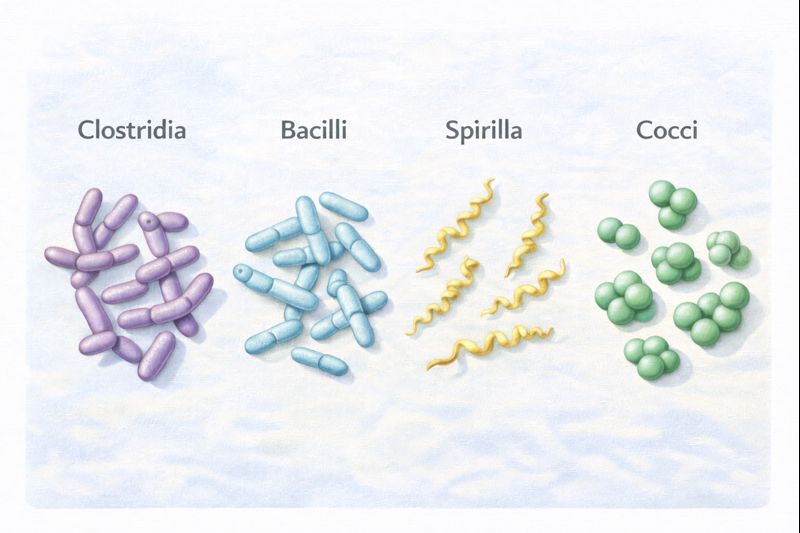
Which bacteria are spherical in shape?
-
A
Clostridia
-
B
Bacilli
-
C
Spirilla
-
D
Cocci
Bacteria that are spherical in shape are called cocci.
Bacterial morphology (shape) is a primary characteristic for classification. The three most common shapes are: spherical (cocci), rod-shaped (bacilli), and spiral (spirilla). Cocci (singular: coccus) can exist singly, in pairs (diplococci), chains (streptococci), clusters (staphylococci), or other arrangements. Their round shape is a result of their cell wall structure and the pattern of cell division.
A) Clostridia
Clostridia refer to bacteria of the genus Clostridium (e.g., C. tetani, C. botulinum). These are rod-shaped (bacillus), Gram-positive, anaerobic bacteria known for forming endospores. They are not spherical.
B) Bacilli
The term "bacilli" (singular: bacillus) specifically describes rod-shaped bacteria. They can be short, long, thin, or thick, but their defining morphology is cylindrical, not spherical.
C) Spirilla
Spirilla are spiral-shaped or helical bacteria that have a rigid cell wall and move by flagella. Examples include Spirillum and Campylobacter. Some are comma-shaped (vibrios). They are not spherical.
D) Cocci
Cocci are spherical bacteria. Examples include Staphylococcus aureus (grape-like clusters), Streptococcus pyogenes (chains), and Neisseria gonorrhoeae (pairs). Their shape is a key diagnostic feature.
Conclusion
Bacterial shape is a fundamental taxonomic trait. The names of the shapes are derived from Latin/Greek: coccus (berry), bacillus (little rod), and spirillum (little coil). Among the options, only "cocci" describes the spherical morphology.
Topic Flashcards
Click to FlipTrue or False: The name of a bacterial genus, like Streptococcus, often provides a clue about both its shape and its cellular arrangement.
True. "Strepto-" refers to chains, and "-coccus" refers to spherical shape, so Streptococcus forms chains of cocci.
What term describes rod-shaped bacteria, such as Escherichia coli?
Bacilli (singular: bacillus). This shape is cylindrical, like a rod.
Can the same bacterial species (e.g., Staphylococcus aureus) appear in different shapes under a microscope?
No. Staphylococcus aureus is a coccus and typically appears in grape-like clusters. Significant variation in shape within a species is uncommon and would be termed pleomorphism.
What is the term for spherical or round-shaped bacteria?
Cocci (singular: coccus). Examples include Staphylococcus and Streptococcus.
What are the three most common bacterial shapes used in basic classification?
Cocci (spherical), Bacilli (rod-shaped), and Spirilla (spiral-shaped).