How many neutrons are in an atom of carbon-12?
-
A
2
-
B
4
-
C
6
-
D
24
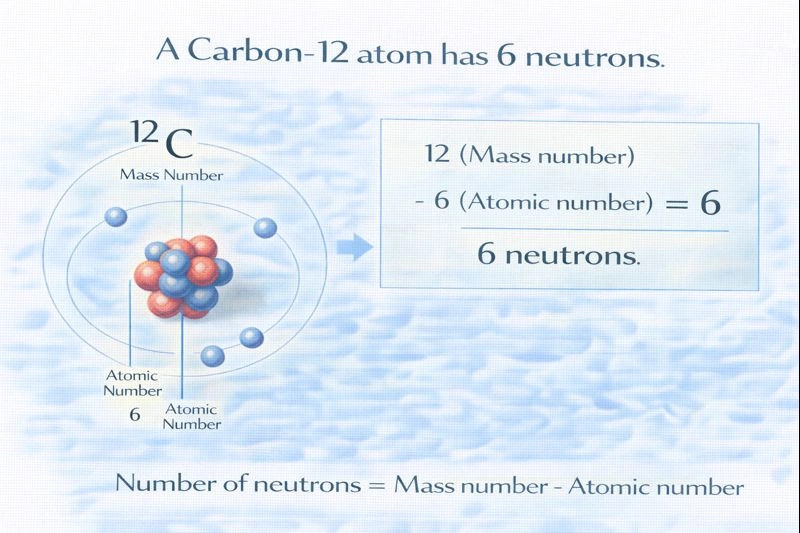
The number of neutrons in an atom of carbon-12 is 6.
Carbon-12 is the most common isotope of carbon. The number written after the element name represents the mass number, which is the total count of protons and neutrons in the nucleus. To find the number of neutrons, the atomic number (protons) is subtracted from the mass number.
Carbon has an atomic number of 6, meaning every carbon atom has 6 protons. In carbon-12, the mass number is 12, so the remaining particles in the nucleus must be neutrons.
A. 2
Two neutrons would give a mass number of 8 (6 protons + 2 neutrons), which does not correspond to carbon-12.
B. 4
Four neutrons would result in a mass number of 10, which would describe carbon-10, not carbon-12.
C. 6
Subtracting the atomic number from the mass number gives 12 − 6 = 6 neutrons.
D. 24
Twenty-four neutrons would give a mass number of 30, which is not carbon-12 and would represent an extremely unstable isotope.
Conclusion
Carbon-12 contains equal numbers of protons and neutrons. With 6 protons defining the element carbon and a total mass number of 12, the nucleus must contain 6 neutrons.

Topic Flashcards
Click to FlipThe atomic number of an element defines the number of ___ in its nucleus. To find the number of neutrons in an isotope, you subtract this number from the ___.
Protons; Mass number.
An atom of carbon-14 has a mass number of 14. Using the same atomic number for carbon (6), how many neutrons does carbon-14 have?
8 neutrons. (14 - 6 = 8)
Why is the number of protons, not neutrons, used to identify an element?
The number of protons (atomic number) defines an element's identity and its position on the periodic table. Changing the proton number changes the element itself.
If an atom has 6 protons and 7 neutrons, what is its correct isotopic symbol (like carbon-12)?
Carbon-13. (Mass number = 6 protons + 7 neutrons = 13)
What are the two primary particles that contribute significantly to the mass of an atom, found in its nucleus?
Protons and Neutrons. (Electrons have negligible mass).