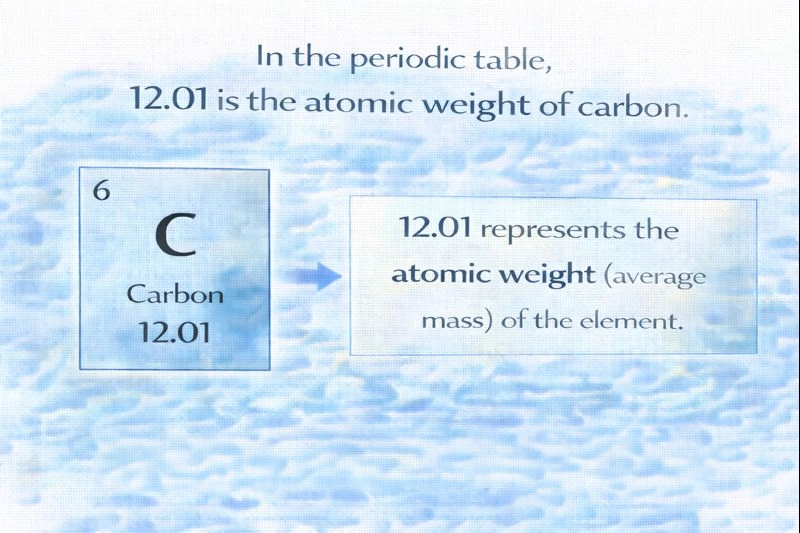
On the periodic table, what does 12.01 represent in the box for carbon?
-
A
The atomic number for carbon
-
B
The molarity of carbon
-
C
The atomic weight of carbon
-
D
The number of electrons in carbon
The value 12.01 represents the atomic weight of carbon.
On the periodic table, each element’s box contains several key pieces of information. One of these is the atomic weight (also called atomic mass), which reflects the average mass of atoms of that element as they occur naturally. This value is not a whole number because it is calculated as a weighted average of all naturally occurring isotopes of the element, based on their relative abundances.
A. The atomic number for carbon
The atomic number represents the number of protons in the nucleus of an atom. Carbon’s atomic number is 6, and it is typically shown as a whole number at the top of the element box.
B. The molarity of carbon
Molarity is a unit used to describe the concentration of a substance in a solution (moles per liter). It is not a property of an element and does not appear on the periodic table.
C. The atomic weight of carbon
The value 12.01 is the atomic weight of carbon. It represents the weighted average of the masses of carbon’s naturally occurring isotopes, primarily carbon-12 and carbon-13. Because isotopes have slightly different masses and occur in different proportions, the atomic weight is expressed as a decimal value.
D. The number of electrons in carbon
In a neutral carbon atom, the number of electrons equals the number of protons, which is 6. The value 12.01 does not represent electron count.
Conclusion
The number 12.01 shown in carbon’s box on the periodic table indicates its atomic weight, reflecting the average mass of carbon atoms found in nature.

Topic Flashcards
Click to FlipWhy is the atomic weight of carbon (12.01) not a whole number, even though carbon-12 has a mass of exactly 12 atomic mass units (amu)?
It is a weighted average of the masses of all naturally occurring isotopes (like C-12 and C-13), based on their abundance.
What two pieces of information are typically found in an element's box on the periodic table, and what does each represent?
1) The atomic number (number of protons). 2) The atomic weight (average mass of atoms of that element).
If an element has two isotopes, one with a mass of 10 amu (90% abundance) and one with a mass of 11 amu (10% abundance), what is its approximate atomic weight?
(10 amu × 0.90) + (11 amu × 0.10) = 9.0 + 1.1 = 10.1 amu.
How does the atomic weight differ from the mass number of a specific isotope?
The mass number is the total protons + neutrons for a single isotope (a whole number). The atomic weight is the average mass of all naturally occurring isotopes (often a decimal).
Looking at the periodic table, which has a larger atomic weight: Sodium (Na) or Magnesium (Mg)? What does this tell you about their average atomic masses?
Magnesium (24.31 amu) has a larger atomic weight than Sodium (22.99 amu). This means a typical magnesium atom has more mass than a typical sodium atom.