Which element has the lowest melting point and boiling point of all?
-
A
Carbon
-
B
Helium
-
C
Neon
-
D
Oxygen
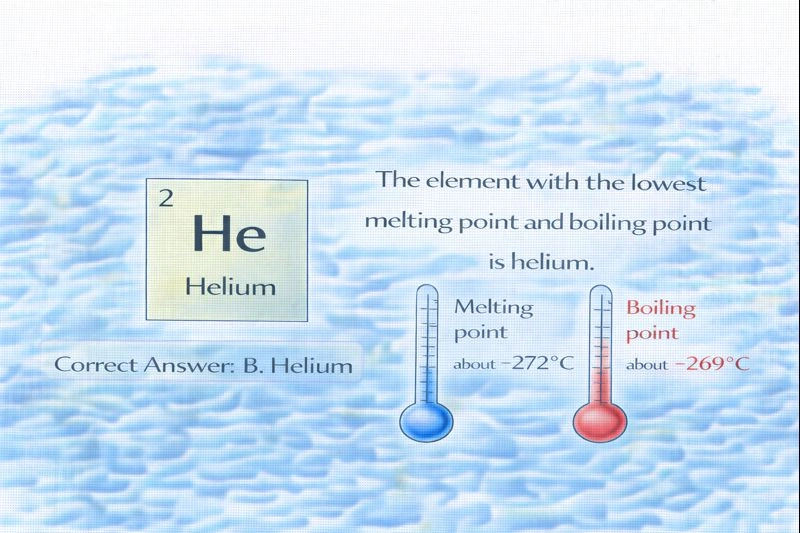
The element with the lowest melting point and boiling point is helium.
Melting point and boiling point depend on how strongly atoms or molecules attract one another. Elements with very weak intermolecular forces require extremely little energy to change from solid to liquid or from liquid to gas. Among all elements, helium has the weakest attractions between its atoms, which explains its uniquely low phase-change temperatures.
A. Carbon
Carbon has extremely strong covalent bonding. In forms such as graphite or diamond, carbon atoms are linked in extensive networks. Because of this, carbon has one of the highest melting or sublimation points of all elements, not the lowest.
B. Helium
Helium is a noble gas made of very small, monatomic particles with extremely weak London dispersion forces. As a result, helium has the lowest boiling point of any element (about 4.2 K or −268.9 °C). It also has the lowest melting point and, under normal atmospheric pressure, does not solidify at all—remaining liquid even at temperatures approaching absolute zero unless high pressure is applied.
C. Neon
Neon is also a noble gas, but its atoms are larger than helium’s and experience stronger intermolecular attractions. Consequently, neon has higher melting and boiling points than helium.
D. Oxygen
Oxygen exists as a diatomic molecule (O₂), which has stronger intermolecular forces than noble gases. Its melting and boiling points are much higher than those of helium.
Conclusion
Helium’s extremely small atomic size and exceptionally weak intermolecular forces give it the lowest melting point and boiling point of all elements.

Topic Flashcards
Click to FlipWhy does helium have the lowest boiling point of any element?
Its atoms are the smallest and have the weakest intermolecular forces (London dispersion forces), requiring very little energy to separate.
What is the general trend in boiling points among the noble gases (Group 18), and where does helium fit?
Boiling points increase down the group as atomic size and intermolecular forces increase. Helium, at the top, has the lowest boiling point.
Under standard atmospheric pressure, can helium form a solid? What special condition is required?
No, it remains liquid down to near absolute zero. To solidify helium, extreme pressure must be applied in addition to very low temperature.
Compare hydrogen (H₂) and helium (He). Why does helium have a lower boiling point even though hydrogen is lighter?
Hydrogen molecules have stronger intermolecular forces (dipole interactions and larger electron clouds) than helium’s extremely weak London forces, giving helium a lower boiling point.
What property of an element’s atoms most directly determines the strength of its London dispersion forces and, consequently, its melting/boiling point?
The size of the electron cloud (or atomic/molecular size). Larger electron clouds are more polarizable, leading to stronger temporary dipoles and higher phase-change temperatures.
Is the element with the lowest boiling point located in Group 1 of the periodic table?
No