If an electric oven has a resistance of 40 Ω when heating, what will be the current flowing through it when it’s connected to a110 V power line?
-
A
0.36 A
-
B
2.75 A
-
C
3.64 A
-
D
4.40 kA
The oven has a current of 2.75 A flowing through it.
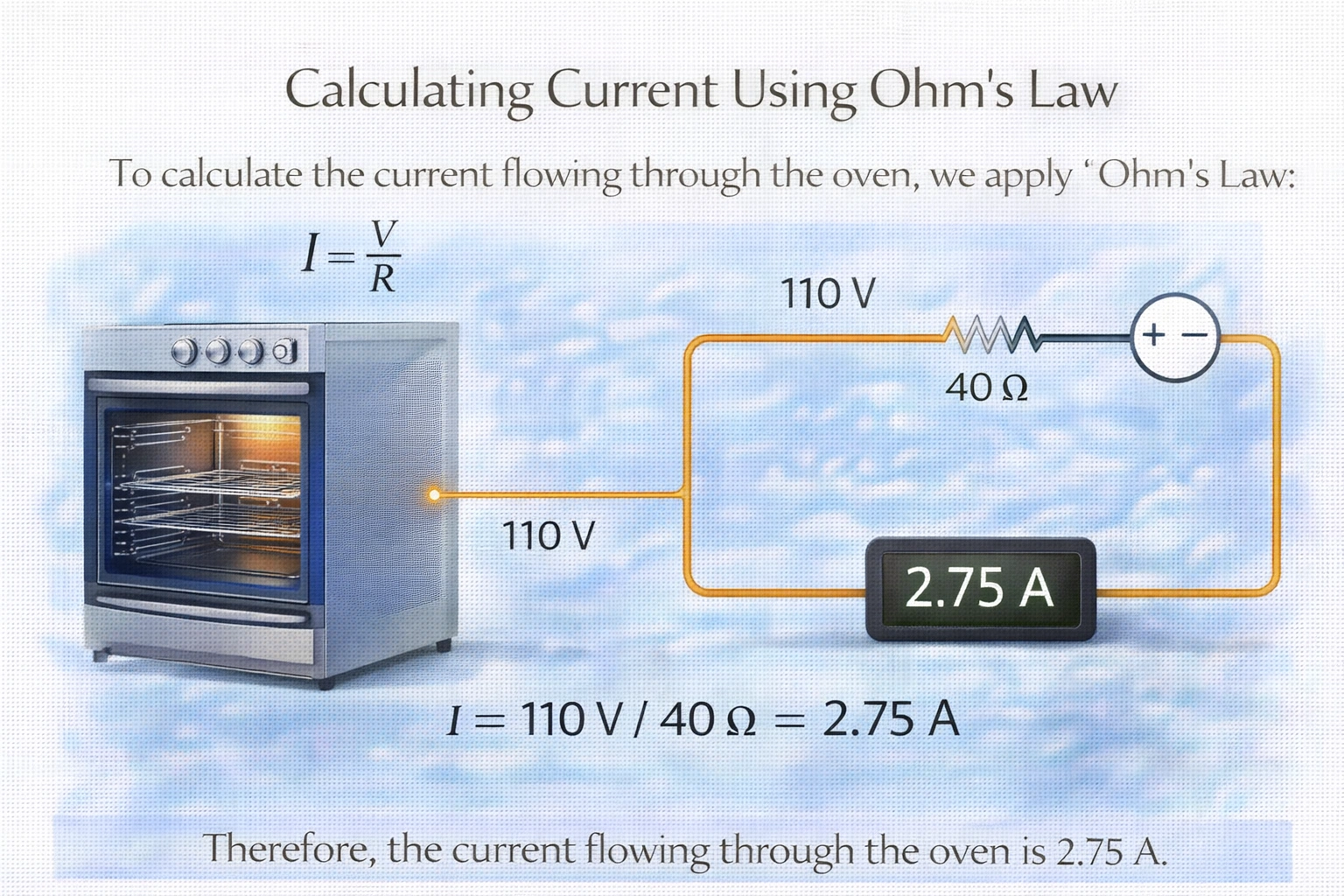
To find the current in the circuit, we apply Ohm’s Law, which states that the current is the ratio of voltage to resistance. With the voltage of 110 V and a resistance of 40 Ω, we can calculate the current.
To calculate the current flowing through the oven, we can use Ohm’s Law, which is given by:
I= V/R
where:
- I is the current,
- V is the voltage (110 V),
- R is the resistance (40 Ω).
Plugging in the values:
I= 110V/40Ω =2.75 A
Therefore, the current flowing through the oven is 2.75 A.
- A) 0.36 A:
- This value is too low and does not match the calculated current.
- B) 2.75 A:
- This is the correct value, as calculated using Ohm’s Law.
- C) 3.64 A:
- This value is too high compared to the calculated current of 2.75 A.
- D) 4.40 kA:
- This is an extremely large value for current, and is not relevant to this situation.
Conclusion: The current flowing through the oven is 2.75 A, making B) 2.75 A the correct answer.

Topic Flashcards
Click to FlipState Ohm's Law as a formula and identify the standard unit for each variable.
I = V R I= R V , where I I is current in amperes (A), V V is voltage in volts (V), and R R is resistance in ohms (Ω).
A coffee maker has a resistance of 22 Ω. What current does it draw when connected to a standard 110 V household outlet?
I=V/R=110V/22Ω=5.0A.
If a hair dryer draws 9.17 A from a 110 V circuit, what is its operating resistance?
R= I/ V = 9.17A/110V ≈12Ω.
How does the current through a fixed-resistance appliance change if the supply voltage is reduced by half?
The current is also halved, since I ∝ V I∝V when R R is constant ( I = V R I= V/R ).
An electric heater draws 2.75 A at 110 V. Calculate the power it dissipates in watts.
A: P = V × I = 110 V × 2.75 A = 302.5 W P=V×I=110V×2.75A=302.5W. (Alternatively, P = I 2 R P=I 2 R