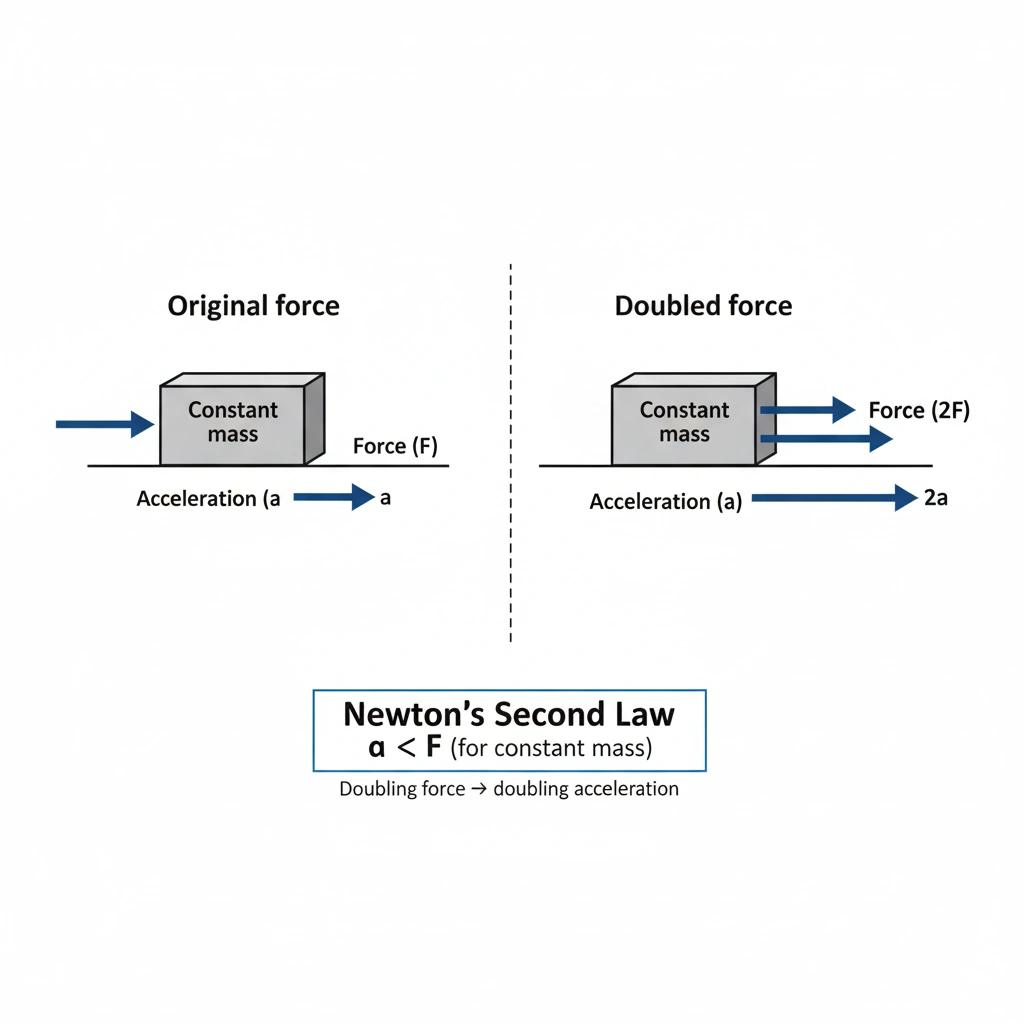
If force on object doubles, acceleration _______.
-
A
Same
-
B
Halved
-
C
Doubled
-
D
Eliminated
If the force on an object doubles, its acceleration doubles.
This relationship is described by Newton’s Second Law of Motion, which states that acceleration is directly proportional to the net force acting on an object and inversely proportional to its mass. When the mass remains constant, any change in force produces a proportional change in acceleration.
A) Same
If the force changes while mass stays constant, the acceleration cannot remain the same. This would contradict Newton’s Second Law.
B) Halved
Halving acceleration would require the force to be reduced by half or the mass to increase. Doubling the force produces the opposite effect.
C) Doubled
Using the relationship:
acceleration equals force divided by mass
doubling the force while keeping mass constant results in twice the acceleration. This directly follows from Newton’s Second Law.
D) Eliminated
Acceleration would only be zero if there were no net force acting on the object. Doubling the force does not eliminate acceleration.
Conclusion
Acceleration is directly proportional to force. Therefore, when the force on an object doubles, its acceleration also doubles.
Topic Flashcards
Click to FlipAccording to F = ma, if the mass of an object triples, what must happen to the net force to keep the acceleration unchanged?
The net force must also triple. (Since a = F/m, to keep 'a' constant, F must change in direct proportion to m).
What does the "m" in Newton's Second Law (F = ma) represent, and why is it crucial for calculating acceleration?
It represents the object's mass (specifically inertial mass). It is crucial because it is the constant of proportionality that determines how much acceleration a given net force will produce—a larger mass means less acceleration for the same force.
If a graph is plotted with Net Force on the Y-axis and Acceleration on the X-axis for an object, what does the slope of the best-fit line represent?
The slope represents the object's mass (m). (Since F = ma, the equation is in the form y = mx, where the slope 'm' is the mass).
A spaceship in the vacuum of space fires its thrusters, producing a constant force. As it burns fuel and its mass decreases, what happens to its acceleration if the thrust force remains the same?
Its acceleration increases. (From a = F/m, if F is constant and mass m decreases, the acceleration a must increase).
Newton's Second Law is often written as a = F/m. What is the key conceptual takeaway when the law is written in this form?
The acceleration of an object is directly proportional to the net force on it and inversely proportional to its mass.