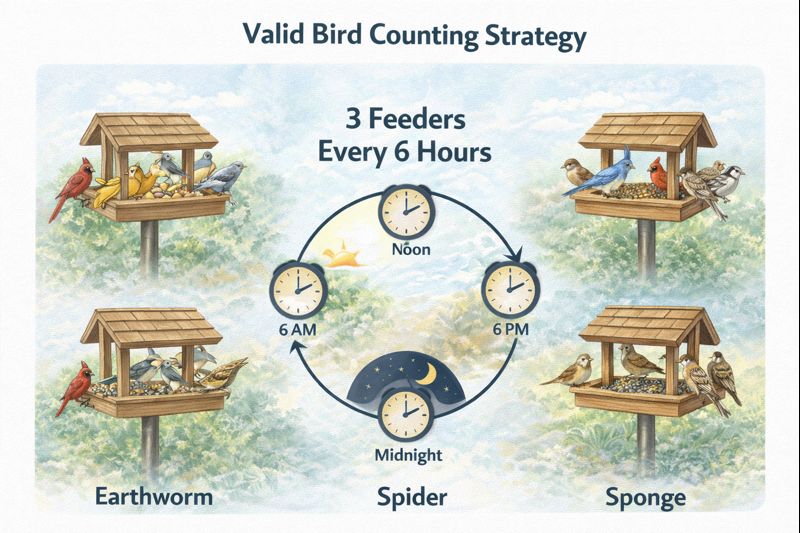
Most valid bird counting strategy?
-
A
One feeder every 6 h
-
B
Three feeders noon & 6 pm
-
C
One feeder noon & 6 pm
-
D
Three feeders every 6 h
The most valid strategy to estimate the total bird population visiting feeders is to count birds at three feeders every six hours.
Validity in ecological sampling refers to how accurately the sample represents the entire population. To achieve a valid estimate, one must minimize bias. Two major sources of bias in this context are spatial bias (only sampling one location) and temporal bias (only sampling at specific times). Using multiple feeders reduces spatial bias by sampling different areas that might attract different species or individuals. Counting at multiple times throughout the day (e.g., every 6 hours) reduces temporal bias by accounting for diurnal patterns in bird activity, some species feed at dawn, others at dusk, and others throughout the day.
A) One feeder every 6 h
This strategy has good temporal coverage but poor spatial coverage. Using only one feeder location may only attract a subset of the local bird community based on its specific placement (e.g., near cover, in sun). This spatial bias can lead to an undercount or misrepresentation of the total population.
B) Three feeders noon & 6 pm
This strategy has good spatial coverage (three feeders) but poor temporal coverage. Sampling only at noon and 6 pm misses peak feeding times at dawn and may also miss dusk activity for some species. This temporal bias results in an invalid estimate of total bird visits.
C) One feeder noon & 6 pm
This is the worst strategy, combining the spatial bias of a single feeder with the temporal bias of only two sampling times. It is highly unlikely to produce a valid estimate.
D) Three feeders every 6 h
This strategy maximizes both spatial and temporal coverage. Multiple feeders sample different microhabitats, and counts spread across the day (e.g., 6 am, noon, 6 pm, midnight) capture variation in bird activity cycles. This comprehensive approach is most likely to yield a valid, representative estimate of the bird population using the feeders.
Conclusion
A valid sampling design minimizes all identifiable biases. For a mobile population like birds, both where and when you sample are critical. The only strategy that systematically addresses both spatial and temporal variability is using multiple feeder locations and counting at regular intervals throughout the diurnal cycle.
Topic Flashcards
Click to FlipIn ecological monitoring, what are the two main types of bias that must be minimized to get a valid population estimate of mobile animals like birds?
Spatial bias (sampling only in limited areas) and Temporal bias (sampling only at specific times). A good design accounts for both.
Why is counting at only two set times (like noon and 6 pm) likely to give an invalid estimate of total bird visits?
It creates temporal bias. It misses birds active at dawn, dusk, or night, failing to account for daily activity patterns (diurnal cycles).
True or False: Using multiple feeder locations is only important if you want to know which specific feeder is most popular.
False. Multiple locations reduce spatial bias by accounting for different microhabitats and territories, giving a more complete picture of the total visiting population.
What does a "valid" estimate mean in the context of a bird counting study?
It means the data accurately represents the true number or pattern of birds in the area of interest, minimizing systematic error or bias.
How does the strategy "Three feeders every 6 h" address the limitations of a "One feeder noon & 6 pm" strategy?
It adds spatial replication (3 feeders vs. 1) to reduce location bias, and adds temporal replication (4 times a day vs. 2) to reduce time-of-day bias.