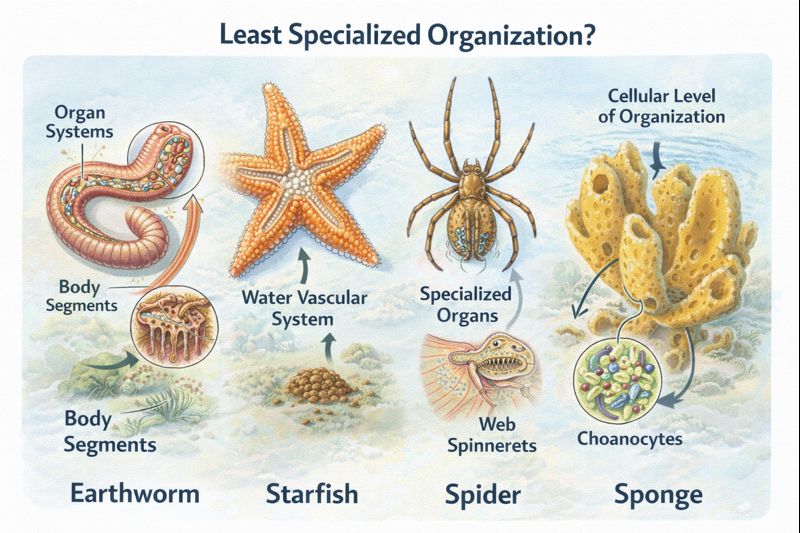
Which organism has the least specialized organization?
-
A
Earthworm
-
B
Starfish
-
C
Spider
-
D
Sponge
The sponge has the least specialized level of biological organization among the options.
Biological organization progresses from simple to complex: chemical, cellular, tissue, organ, organ system, organism. Sponges (phylum Porifera) are at the cellular level of organization. Their bodies are loose aggregates of several distinct cell types (e.g., choanocytes for feeding, amoebocytes for transport) that perform specific functions, but these cells are not organized into true tissues. There is minimal coordination between cells, no nervous system, and no organs. In contrast, the other options are all animals with true tissues and organs, representing more complex organizational levels.
A) Earthworm
Earthworms are annelids with a high degree of organization. They possess true organs arranged into complex organ systems: a closed circulatory system with hearts, a digestive system with specialized regions, a nervous system with a simple brain and ventral nerve cord, and excretory organs (nephridia). They exhibit organ-system level organization.
B) Starfish
Starfish are echinoderms with complex internal organization. They have a true coelom and well-developed organ systems, including a unique water vascular system for locomotion, a digestive system, and a nervous system. Their larval stages are bilaterally symmetric, and adults exhibit pentaradial symmetry, but they are far more complex than sponges.
C) Spider
Spiders are arthropods, among the most complex invertebrates. They have specialized organ systems: a sophisticated nervous system, respiratory structures (book lungs and/or tracheae), a digestive system, excretory Malpighian tubules, and complex reproductive organs. They represent a very high level of specialization.
D) Sponge
Sponges are the simplest multicellular animals. They lack true tissues and organs. Their body is a sac-like structure with pores. Cells work somewhat independently, and the animal's form is maintained by a simple skeleton of spicules or protein fibers. This represents the most primitive and least specialized body plan in the animal kingdom.
Conclusion
When ranking animals by organizational complexity, sponges are foundational. They represent the transition from unicellular life to multicellularity but have not evolved the tissue-level integration seen in all other animals. Earthworms, starfish, and spiders all possess true tissues and organs, placing them at more advanced organizational levels.
Topic Flashcards
Click to FlipWhat is the term for the level of biological organization where specialized cells work together but are not formed into true tissues or organs?
Cellular level of organization. This is the level exhibited by sponges (Porifera).
Which animal phylum is defined by having a body with pores and canals, and lacks true tissues and symmetry?
Porifera (the sponges). They are sessile, filter-feeding animals with the simplest body plan.
True or False: All animals except sponges have their cells organized into true tissues.
True. Sponges are the only major animal phylum that lacks true tissues, placing them at the base of animal complexity.
Name one key cellular type in a sponge and its function.
Choanocytes (collar cells). They create water currents with their flagella and trap food particles, serving in feeding and circulation.
How does the organization of an earthworm differ fundamentally from that of a sponge?
An earthworm has organ-system level organization (e.g., digestive, circulatory, nervous systems). A sponge has only independent cell types with no integrated systems.