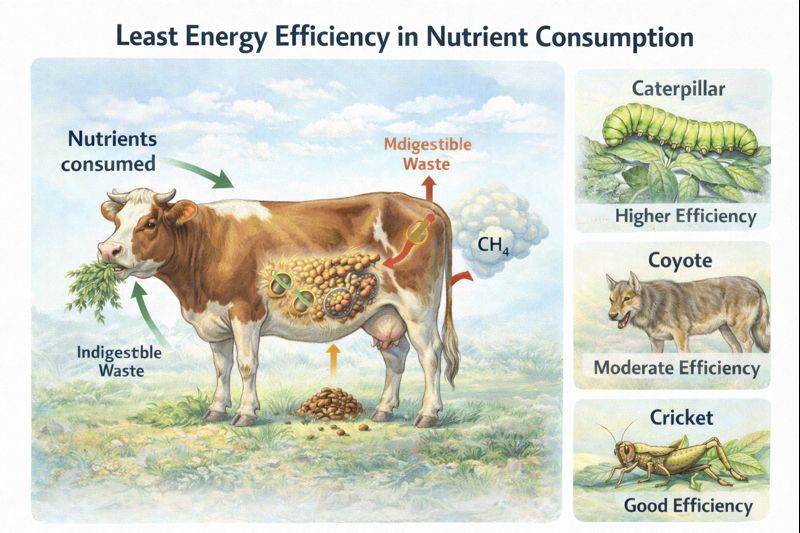
Which consumer has least energy efficiency in nutrient consumption?
-
A
Cow
-
B
Caterpillar
-
C
Coyote
-
D
Cricket
The cow has the lowest energy efficiency in converting consumed nutrients into its own biomass.
Energy conversion efficiency in consumers, often termed net production efficiency, is the percentage of assimilated energy that is incorporated into new consumer biomass (growth and reproduction), with the remainder lost as respiratory heat. This efficiency varies greatly among animal groups due to differences in physiology, metabolism, and diet. Large endothermic (warm-blooded) herbivores like cows have very low net production efficiency, typically around 3-5%. This is due to the high energy cost of maintaining a constant body temperature (homeothermy), the metabolic expense of fermenting and digesting fibrous plant material (cellulose) in a complex gut, and significant energy losses as methane gas produced by gut microbes. In contrast, insects and carnivores generally have higher efficiencies.
A) Cow
Ruminants like cows have a multi-chambered stomach hosting microbial fermentation to break down cellulose. This process is slow, generates heat, and produces methane, a significant energy loss. Furthermore, their large body size and homeothermy require substantial energy just for maintenance, leaving a very small fraction of ingested energy for producing new tissue.
B) Caterpillar
Caterpillars (insect larvae) are ectothermic (cold-blooded) and have a relatively simple digestive system. They do not expend energy on temperature regulation. Their net production efficiency can be quite high, often 15-30%, as they efficiently convert plant material into biomass for rapid growth before pupation.
C) Coyote
Coyotes, as endothermic carnivores, have high assimilation efficiency (they absorb most of the energy from their nutrient-dense meat diet). However, they still have the metabolic costs of homeothermy and activity. Their net production efficiency is moderate, typically around 10%. While higher than a cow's, it is lower than many insects due to mammalian metabolic overhead.
D) Cricket
Crickets are ectothermic insects. They have good digestive efficiency and low metabolic rates when inactive. Their net production efficiency is generally higher than that of endotherms, often in the range of 10-20%. They are more efficient at converting consumed food into biomass than large mammals.
Conclusion
Net production efficiency is constrained by thermodynamics and an organism's physiological strategy. Endothermic herbivores that digest low-quality, fibrous food through microbial fermentation represent the least efficient energy converters. The cow, with its combination of homeothermy and a fermentative digestive system, exemplifies this lowest efficiency among the given choices.
Topic Flashcards
Click to FlipWhat is the term for the percentage of assimilated energy that an organism converts into its own new biomass (growth and reproduction)?
Net Production Efficiency (NPE). The remainder of assimilated energy is lost as respiratory heat.
What two major physiological traits make a cow (a ruminant) particularly inefficient at converting food energy into its own biomass?
Endothermy (high metabolic cost to maintain body temperature) and a fermentative digestive system (which loses energy as heat and methane).
True or False: An ectothermic insect like a caterpillar typically has a higher net production efficiency than an endothermic mammal like a coyote.
True. Ectotherms don't spend energy on thermoregulation, allowing a greater portion of assimilated energy to go toward growth.
Why is assimilation efficiency—the percentage of ingested energy absorbed into the body—generally higher for a coyote than for a cow?
Meat (coyote's diet) is more easily and completely digested than fibrous plant material (cow's diet).
What specific energy-rich gas, produced by microbes in a cow's rumen, represents a significant pathway of energy loss not found in carnivores?
Methane (CH₄). This is a byproduct of fermentation that the cow cannot use, so the energy in methane is lost.