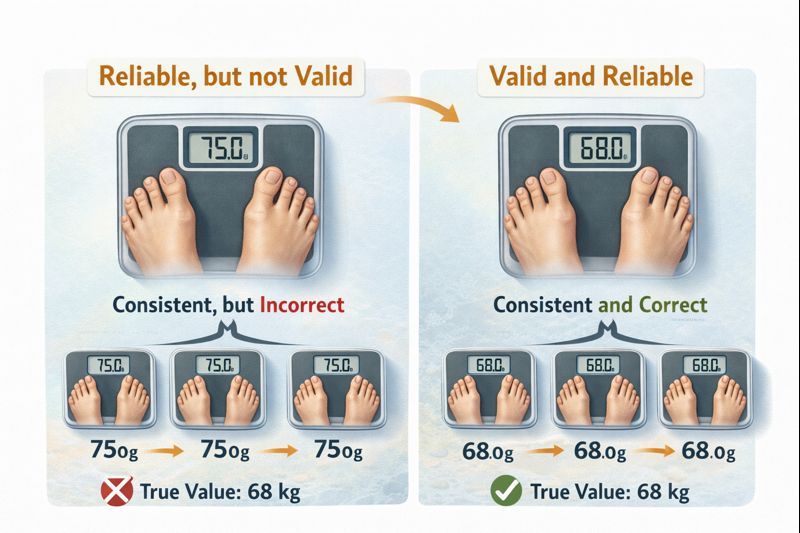
Scale reads 75 kg (true = 68 kg) 20 times. Description?
-
A
Valid, not reliable
-
B
Reliable, not valid
-
C
Both
-
D
Neither
The scale's measurements are reliable but not valid.
In measurement theory, reliability refers to the consistency or repeatability of a measurement tool. A reliable instrument yields very similar results when the same quantity is measured repeatedly under unchanged conditions. Validity refers to the accuracy of the measurement, how closely the measured value aligns with the true or accepted value. A valid instrument measures what it is intended to measure without systematic bias. In this scenario, the scale reads 75 kg every single time out of 20 trials. This demonstrates exceptional consistency and a complete absence of random error, which defines high reliability. However, the true mass is 68 kg. The scale's consistent reading is 7 kg higher than the true value, indicating a persistent, systematic error (bias). This means the scale is not accurate; it does not provide a valid measurement of the actual mass.
A) Valid, not reliable
This describes an instrument that is accurate on average but gives inconsistent readings. For example, if readings were 68, 72, 65, and 69 kg (averaging close to 68), it would be somewhat valid but not reliable. The scale in question shows the opposite pattern: perfect consistency but gross inaccuracy.
B) Reliable, not valid
This accurately describes the situation. The scale's output is perfectly consistent (reliable), as it gives the same result repeatedly. However, its consistent result is far from the true value (invalid). This indicates a calibration error or a systematic bias in the measuring mechanism.
C) Both
For an instrument to be both valid and reliable, it must be both accurate and consistent. It would need to read very close to 68 kg every time. Since the scale consistently reads 75 kg, it lacks validity and therefore cannot be both.
D) Neither
An instrument that is neither valid nor reliable would produce inconsistent readings that also do not center around the true value. For example, readings of 60, 80, 55, and 85 kg would be neither reliable (high variability) nor valid (not near 68 kg). The given scale is highly reliable, so this option is incorrect.
Conclusion
The concepts of reliability and validity are distinct. Reliability is about precision and repeatability, while validity is about accuracy and truthfulness. A measuring device can be reliable without being valid if it has a consistent bias. The scale's perfect consistency across 20 trials confirms high reliability, but its significant and constant deviation from the known true value confirms a lack of validity.
Topic Flashcards
Click to FlipWhat is the term for the consistency or repeatability of a measurement when the same quantity is measured multiple times?
Reliability (or Precision). A reliable measurement yields very similar results each time.
If a scale consistently reads 10 pounds over your true weight every time you step on it, is it providing a valid measurement?
No. It is reliable (consistent) but not valid (accurate), due to a systematic error (bias).
True or False: A measurement can be valid (accurate) even if it is unreliable (inconsistent).
True. On average, the measurements might center on the true value, but if they are scattered, the tool is unreliable. This is possible but uncommon.
What type of error (random or systematic) causes a measurement to be unreliable?
Random error. This causes unpredictable variation between measurements, reducing consistency.
In the scenario, what single action would most likely fix the scale's problem and make it valid?
Recalibration. Adjusting the scale to read "0" when empty and align with known weights would correct the systematic bias.