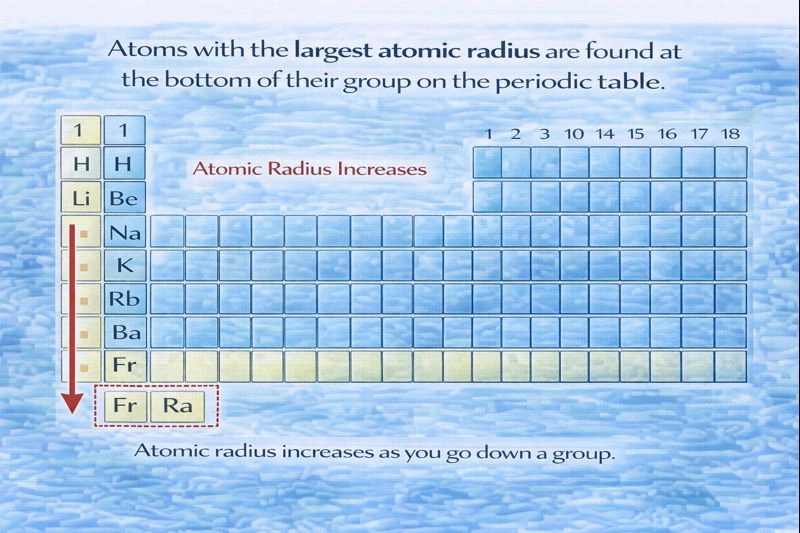
On the periodic table, where are atoms with the largest atomic radius located?
-
A
At the top of their group
-
B
In the middle of their group
-
C
At the bottom of their group
-
D
Along the right hand side
Atoms with the largest atomic radius are located at the bottom of their group on the periodic table.
Atomic radius refers to the size of an atom, typically measured as the distance from the nucleus to the outermost electron shell. As you move down a group on the periodic table, each successive element has an additional energy level (electron shell). These extra shells place the outermost electrons farther from the nucleus, increasing the overall size of the atom. The effect of increased distance and electron shielding outweighs the increased nuclear charge, resulting in a larger atomic radius.
A. At the top of their group
Elements at the top of a group have fewer electron shells, meaning their outer electrons are closer to the nucleus. With fewer shells and less shielding, the nucleus pulls the electrons in more tightly, producing a smaller atomic radius. These atoms are among the smallest within their groups.
B. In the middle of their group
Elements located in the middle of a group have more electron shells than those at the top but fewer than those at the bottom. As a result, their atomic radius is intermediate in size and not the largest within the group.
C. At the bottom of their group
Elements at the bottom of a group have the greatest number of electron shells. Each additional shell increases electron shielding and places the valence electrons farther from the nucleus. This leads to a weaker effective nuclear attraction on the outer electrons and a larger atomic radius. For example, cesium has a much larger atomic radius than lithium, even though both are in the same group.
D. Along the right-hand side
As you move from left to right across a period, atomic radius generally decreases. The number of protons increases, strengthening the nuclear attraction without adding new electron shells. This pulls electrons closer to the nucleus, making atoms on the right-hand side of the periodic table relatively small.
Conclusion
Atomic radius increases down a group because additional electron shells are added, increasing shielding and distance from the nucleus. As a result, atoms with the largest atomic radius are found at the bottom of their group on the periodic table.

Topic Flashcards
Click to FlipWhat are the two major periodic trends for atomic radius as you move a) down a group and b) across a period (left to right)?
a) Atomic radius increases down a group (due to adding electron shells). b) Atomic radius decreases across a period (due to increasing nuclear charge pulling electrons closer).
Why does atomic radius decrease across a period even though more electrons are being added?
Electrons are added to the same principal energy level (same shell), but protons are also added to the nucleus. The increasing nuclear charge pulls the electron cloud inward more strongly, shrinking the atom.
Which group on the periodic table typically contains the element with the largest atomic radius in a given period, and why?
Group 1 (Alkali Metals). They have the fewest protons for that energy level and their single outer electron is shielded effectively by inner electrons, resulting in a larger radius compared to other elements in the same period.
When comparing two ions, such as Na⁺ and Mg²⁺, which has the smaller ionic radius? Explain using the concepts of nuclear charge and electron configuration.
Mg²⁺ is smaller. Both ions have the same electron configuration (1s²2s²2p⁶, like neon), but Mg²⁺ has 12 protons (a +12 nuclear charge) versus Na⁺'s 11 protons. The greater nuclear charge in Mg²⁺ pulls the same number of electrons closer.
Place the following atoms in order of increasing atomic radius: Potassium (K), Sodium (Na), Lithium (Li).
Li < Na < K. (All are in Group 1; radius increases down the group as electron shells are added).