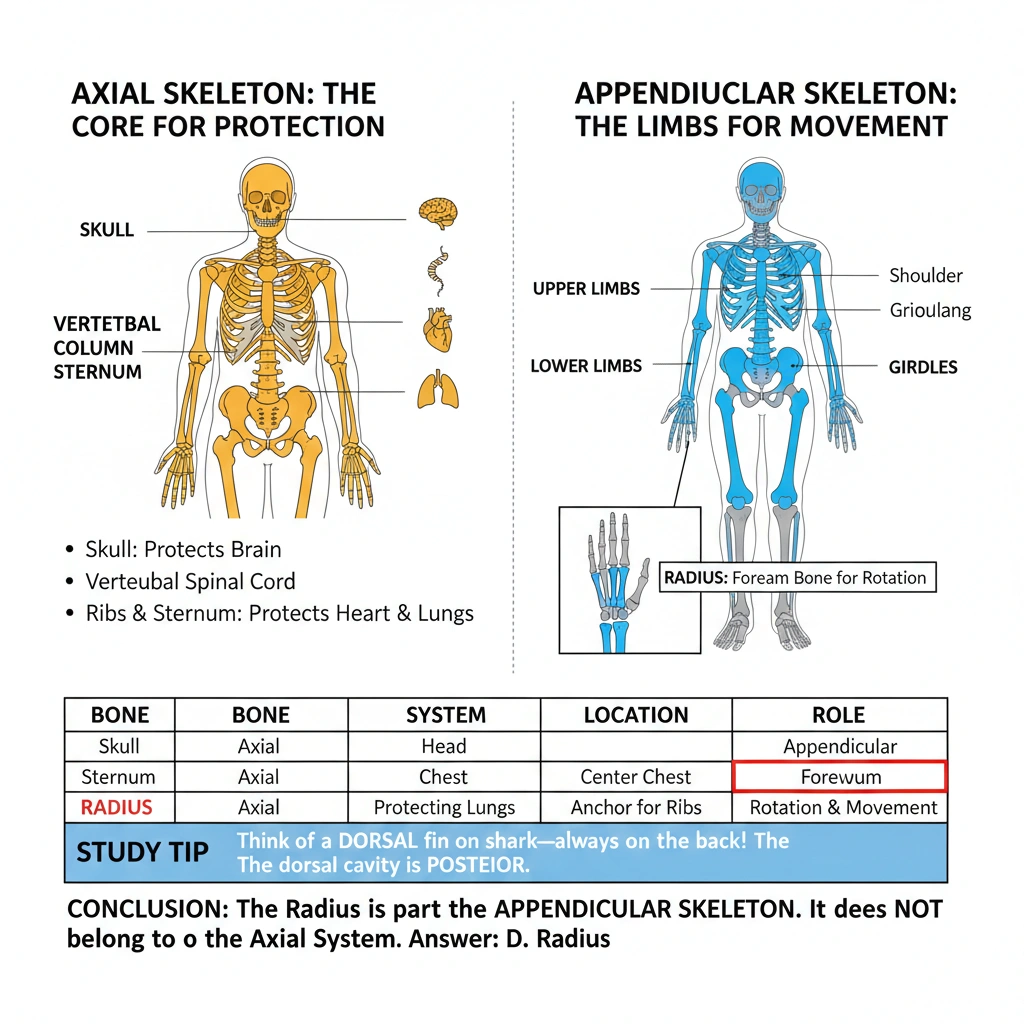
The axial skeletal system contains all of these except the __________ .
-
A
skull
-
B
ribs
-
C
breastbone
-
D
radius
The axial skeletal system contains all of these bones except the radius, which is part of the appendicular skeleton.
The axial skeleton serves as the central support structure for the body, consisting of bones that form the axis or core of the body. It includes the bones of the head, neck, and trunk, and its primary function is to protect vital organs such as the brain, spinal cord, and heart. The axial skeleton is composed of the skull, vertebral column (spine), ribs, and sternum, and it is critical for structural support and the movement of the body in a controlled manner.
- A. Skull: The skull is a fundamental component of the axial skeleton. It is responsible for protecting the brain and providing the structure for the face. It consists of 22 bones, which can be further divided into the cranium (which protects the brain) and the facial bones. The skull is integral to the axial skeleton as it forms the uppermost part of the body’s central axis.
- B. Ribs: The ribs are another essential part of the axial skeleton. They are a series of curved bones that form the rib cage, which encases and protects the thoracic organs, including the heart and lungs. The ribs also assist in respiration, expanding and contracting with the movement of the diaphragm. The rib cage is one of the most recognizable features of the axial skeleton, providing both structural integrity and protection.
- C. Breastbone (Sternum): The sternum, or breastbone, is a flat bone located in the center of the chest. It is a key component of the axial skeleton and serves as the attachment site for the ribs and the clavicles (collarbones). The sternum helps protect the heart and lungs and is an essential element of the thoracic cage, contributing to both respiratory mechanics and structural stability.
- D. Radius: The radius is a long bone in the forearm, located on the lateral side (thumb side) when the arm is in an anatomical position. It is part of the appendicular skeleton, not the axial skeleton. The appendicular skeleton includes the limbs (arms and legs) and the girdles (shoulder and pelvic girdles), which facilitate movement and interaction with the environment. The radius works in conjunction with the ulna, the other long bone in the forearm, to allow movement of the hand and wrist. Because the radius is a limb bone, it belongs to the appendicular skeleton, which is distinct from the axial skeleton.
Conclusion: The radius is part of the appendicular skeleton, not the axial skeleton. The axial skeleton is primarily responsible for providing structural support and protecting critical organs, while the appendicular skeleton facilitates movement and interaction with the environment. Therefore, the correct answer is D. Radius, as it does not belong to the axial skeletal system.

Topic Flashcards
Click to FlipWhat is the primary function of the axial skeleton?
To provide central support and protect vital organs (brain, spinal cord, heart, lungs).
Which two bony girdles connect the appendicular skeleton to the axial skeleton?
The pectoral (shoulder) girdle and the pelvic (hip) girdle.
List the three major bone groups that make up the axial skeleton.
The skull, vertebral column (spine), and thoracic cage (ribs & sternum).
To which part of the skeleton (axial or appendicular) do the bones of the arms and legs belong?
The appendicular skeleton.
The radius is a bone in the forearm. With which other bone does it articulate to allow rotation of the hand?
The ulna.