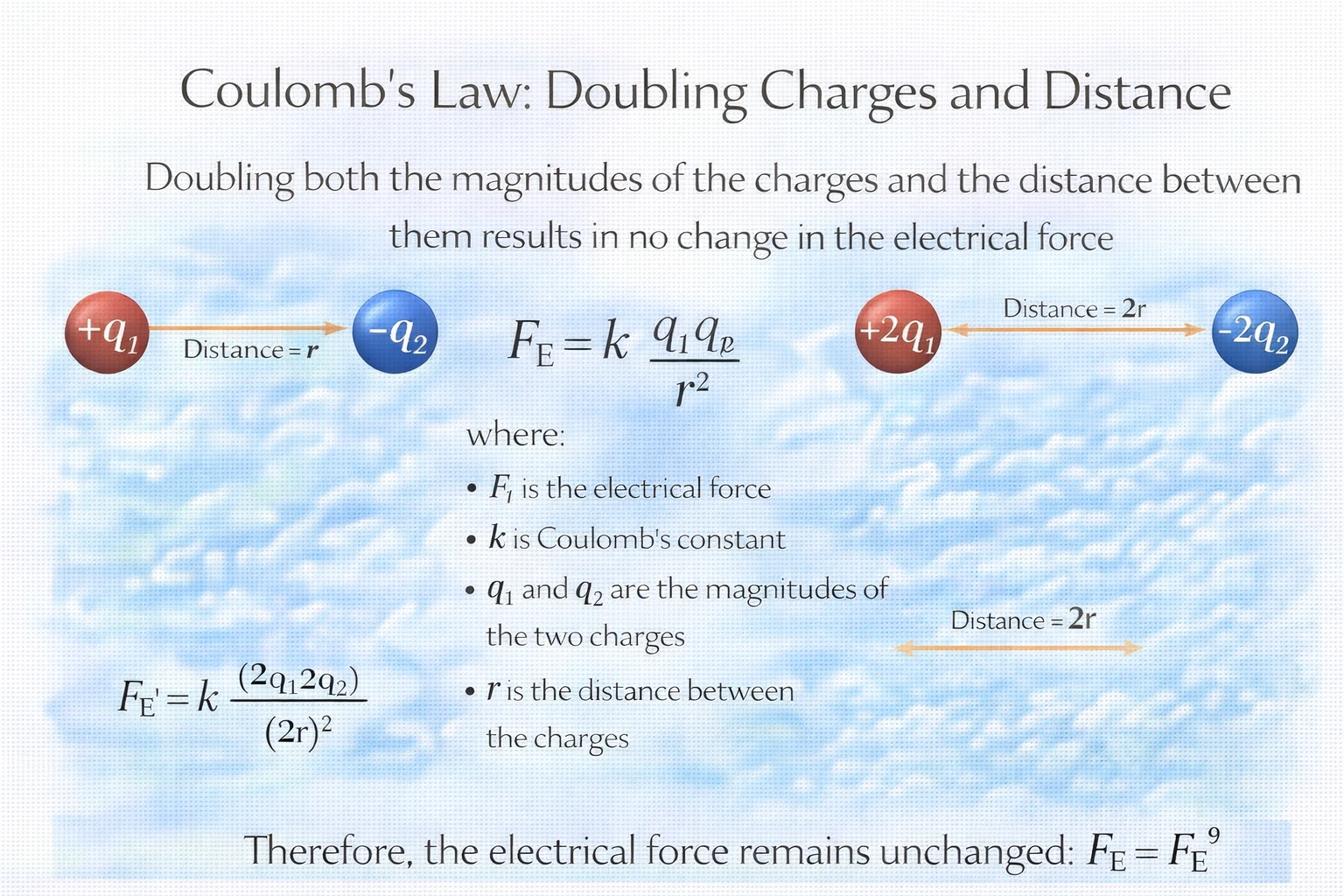
The electrical force between two point charges is FEº. If the magnitude of both charges is doubled and the distance between them is doubled, what would be the new electrical force between the charges, FE ք ?
-
A
FE ք= FEº
-
B
FE ք = 2FEº
-
C
FE ք = 4FEº
-
D
FEº =FE ք
The electrical force between two point charges is governed by Coulomb’s Law
Which depends on both the magnitudes of the charges and the distance between them. If both the charge magnitudes and the distance are doubled, the force remains unchanged because the increase in the numerator (charge magnitudes) is exactly canceled out by the increase in the denominator (distance squared)
The electrical force between two point charges is described by Coulomb's Law, which is given by the equation:
where:
- F_E is the electrical force,
- k is Coulomb’s constant,
- q₁ and q₂ are the magnitudes of the two charges,
- r is the distance between the charges.
According to the question, both the charge magnitudes and the distance between the charges are doubled:
- When the charges are doubled, the numerator of the equation becomes 4 times greater (since both charges are multiplied by 2).
- When the distance is doubled, the denominator of the equation becomes 4 times greater (since r² becomes (2r)² = 4r²).
Since both the numerator and denominator increase by the same factor of 4, the overall force remains the same:
Therefore, the electrical force remains unchanged.
- A) FEₖ = FEº:
- This is correct. The force does not change, as both the charges and the distance affect the force equally in a way that cancels out.
- B) FEₖ = 2FEº:
- This is incorrect because the force does not double; it remains unchanged due to the relationship between the charges and the distance.
- C) FEₖ = 4FEº:
- This is incorrect. While the charges are doubled, the distance is also doubled, which results in no net change in force.
- D) FEº = FEₖ:
- This option is not correctly worded. The correct expression is FEₖ = FEº, which indicates that the force remains the same.
Conclusion: The new electrical force is the same as the original force, so A) FEₖ = FEº is the correct answer.

Topic Flashcards
Click to FlipAccording to Coulomb's Law, if the distance between two point charges is halved while the charges remain the same, how does the electrical force change?
The force increases by a factor of four. (Since F ∝ 1/r², halving *r* multiplies F by (1/(1/2)² = 4).
If the magnitude of one charge is tripled and the other is halved, with the distance unchanged, what is the multiplicative factor for the new electrical force?
The new force is 1.5 times (or 3/2 of) the original force. (Since F ∝ q₁*q₂, the factor is 3 * (1/2) = 1.5).
In the formula for Coulomb's Law (F = kq₁q₂ / r²), what does the constant *k* represent, and what are its typical units?
*k* is Coulomb's constant (≈ 8.99 x 10⁹ N·m²/C²). It relates the units of force, charge, and distance in the electrostatic system.
Two charges exert a force F on each other. If the distance is tripled and both charges are also tripled, what is the new force in terms of F?
The new force is equal to F. (Factor from charges: 3 * 3 = 9. Factor from distance: 1/(3²) = 1/9. Combined: 9 * (1/9) = 1).
State Coulomb's Law in words, describing the relationship between electrical force, the magnitudes of the charges, and the distance separating them
The electrical force between two point charges is directly proportional to the product of their charges and inversely proportional to the square of the distance between them.