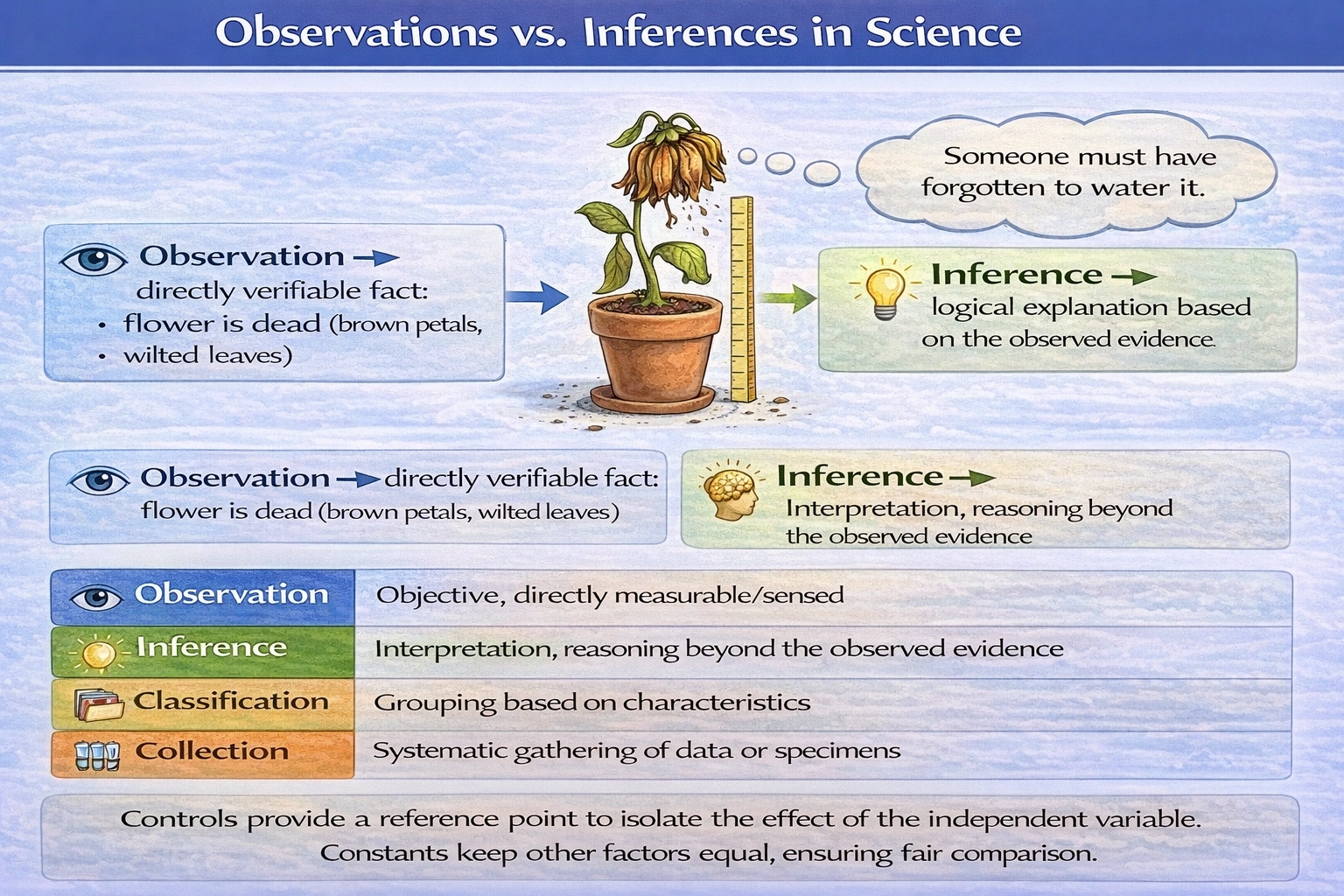
"This flower is dead; someone must have forgotten to water it." This statement is an example of which of the following?
-
A
A classification
-
B
An observation
-
C
An inference
-
D
A collection
The statement combines a direct observation ("this flower is dead") with an inference ("someone must have forgotten to water it")—a conclusion drawn from evidence that extends beyond directly observable facts.
Inferences represent logical interpretations or explanations derived from observations, incorporating prior knowledge and reasoning to propose causes, intentions, or unobserved events that cannot be directly verified through sensory data alone.
A) A classification
Classification involves grouping objects based on shared characteristics according to established criteria (e.g., categorizing the flower as "angiosperm" or "rose family"). The statement makes no taxonomic assignment or systematic grouping—it proposes a causal explanation for the flower's condition rather than categorizing it within a classification system.
B) An observation
The first clause ("this flower is dead") constitutes an observation—directly verifiable through sensory evidence (wilted petals, brown leaves, lack of turgor pressure). However, the complete statement extends beyond observation to propose an unobserved cause ("forgotten to water"), making the entire utterance more than pure observation. Scientific observations must remain objective and verifiable; the watering hypothesis introduces unverified assumptions beyond sensory data.
C) An inference
The conclusion about forgotten watering represents an inference—reasoning from observed evidence (dead flower) to an unobserved cause using prior knowledge (plants require water to survive). Multiple alternative explanations exist (pest infestation, disease, excessive fertilizer, root damage) that the observer hasn't verified. Inferences bridge observations with explanatory hypotheses but remain provisional until tested—distinguishing them from direct observations. Scientific reasoning requires distinguishing between what is observed versus what is inferred to avoid conflating evidence with interpretation.
D) A collection
Collection refers to the systematic gathering of specimens, data points, or samples for analysis—not a type of statement or reasoning process. The utterance makes no reference to gathering physical items or data; it presents an explanatory claim about a single observed phenomenon.
Conclusion:
Scientific literacy requires distinguishing between direct observations (verifiable sensory data) and inferences (interpretations extending beyond observation). While the dead flower's condition is observable, the cause attribution represents inference—plausible but unverified reasoning that could be tested through investigation (checking soil moisture, examining roots, interviewing caretakers). Option C correctly identifies the explanatory component as inference, highlighting a fundamental scientific skill: recognizing when conclusions extend beyond direct evidence. This distinction prevents confirmation bias and encourages hypothesis testing rather than accepting initial interpretations as factual.